Translation Westward: How Recipes Crossed a Language
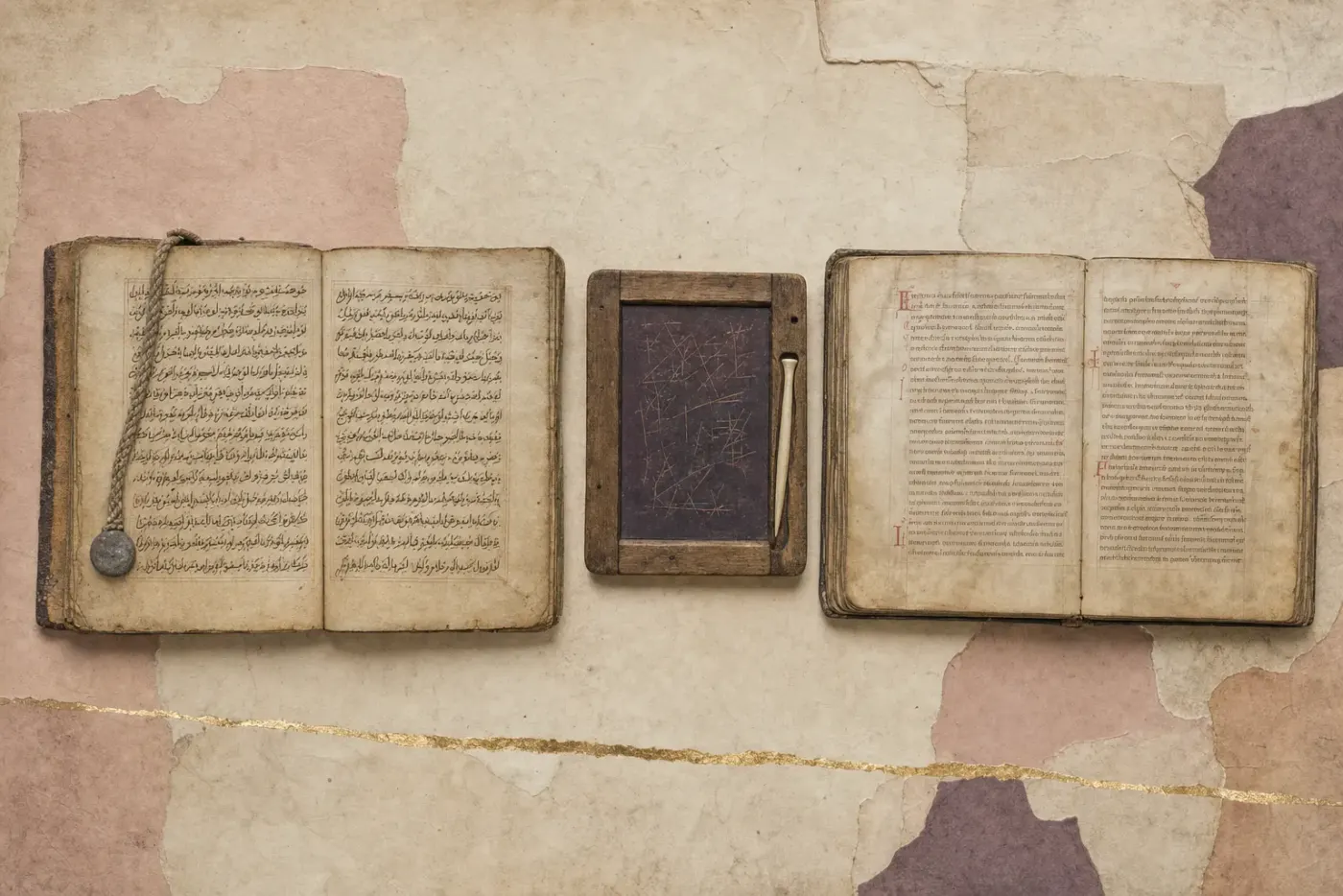
Cosmetic knowledge entered Latin Europe as freight, inside medical books that were being acquired for other reasons.
In short
Arabic medical encyclopaedias translated into Latin from the twelfth century carried their cosmetic chapters with them, which is the principal route by which formulations developed in the Islamic world entered European practice.
- 11min read
- 6chapters
- 4sources
Vivien
Your guide through time
Listen to this essay
5 min listenVivien reads our essays aloud, word for word — every date and every name in its place — so you can listen the way you would be walked through a gallery.
An AI voice, designed for History of Makeup
Knowledge rarely moves because someone wants that particular knowledge. It moves attached to something else — and the cosmetic material that reached Latin Europe in these centuries travelled as a passenger inside medical books acquired for their surgery and their pharmacology.[1]
Al-Zahrawi’s compendium is the clearest case. It was translated because the surgical volume was wanted; Book 19, on the medicines of adornment, came with it.[1]
This is worth stating at the outset because it shapes what arrived. Europe did not select this material; it received whatever happened to be bound in with the books it was selecting for other reasons, which makes the inheritance considerably more arbitrary than a tidy account of influence would suggest.[1]
What Survives a Translation
A recipe is unusually portable. It is a list of materials and a sequence of operations, and both survive translation better than argument or description do — which is why formularies cross linguistic boundaries more readily than the theory that justified them.[2]
What does not survive as well is the name of a substance. Materials are identified by local names, and a translator working without the material in front of him has to guess — producing a class of error that is invisible in the manuscript and consequential in the still-room.[3]
Quantities fare no better. Weights and measures were local, and a translator converting a figure he cannot verify is making a judgement that looks like a transcription. For a cosmetic preparation this is mostly harmless; for anything containing an active mineral it is not, and the same manuscript tradition carried both kinds of recipe without distinguishing between them.[2]
The Route Ran Through Contact Zones
Transmission happened where languages and libraries overlapped — Iberia above all, and southern Italy — rather than at any single centre or through any single scholar.[4]
Salerno is the relevant node for this timeline: a place with medical standing, with access to the Arabic material, and with a compilation habit. What came out the other side is the Trotula ensemble.[5]
Knowledge rarely moves because someone wants that particular knowledge. It moves attached to something else.
What Europe Received
The inheritance was a way of organising the subject as much as a set of formulations: cosmetics as a division of medicine, treated head to foot, written for a practitioner.[6]
That organisation persisted in European cosmetic writing long after the texts themselves were superseded, which is the usual fate of an inherited structure — it outlives its contents.[7]
It also inherited a standard of evidence, and a low one. The authority of a recipe in this literature rests on the reputation of the compiler and on the chain of compilers behind him, not on anything having been tested. That is an entirely reasonable arrangement for a period without a mechanism for testing, and it is the reason a formulation could travel for four hundred years without anyone establishing whether it worked.[6]
The Credit Problem
Latinised names obscure the origin. Al-Zahrawi becomes Albucasis; Ibn Sina becomes Avicenna; and a European reader encountering these authorities in Latin had no particular reason to register where the work came from.[8]
The consequence is a historiography in which a period of substantial transmission reads as a period of European invention. Correcting that is not a courtesy — it is the difference between an accurate account of where this knowledge originated and a false one.[9]
Trade Moved With Text
A recipe is useless without its materials, and the same routes that carried the manuscripts carried the substances — which means the practical availability of a formulation depended on commerce as much as on translation.[10]
Where a material did not travel, the recipe was adapted, substituted or quietly dropped, and a compendium copied in one region can differ from the same compendium copied in another for reasons that are entirely about supply.[11]
What Is Not Known
The chronology of translation is approximate and the attribution of particular versions to particular translators is contested in many cases. Dates given for this transmission are scholarly reconstructions rather than records.[12]
Nor is it possible to say how much practical cosmetic knowledge moved outside the manuscript record entirely, by demonstration and by trade. Almost certainly a great deal, and by definition it left nothing to read.[13]
What survives is therefore biased twice over: toward what was written rather than shown, and toward what institutions chose to keep. Neither filter has anything to do with what was most used, and both run in the same direction.[13]
Sources
- [1, 4, 8, 12]Kitab al-Tasrif, Book 19: on adwiyat al-zinah (the medicines of adornment) 1000.
- [2, 7, 10, 13]Fashions in Makeup: From Ancient to Modern Times Peter Owen, 1972.
- [3, 5, 6, 11]The Trotula: A Medieval Compendium of Women’s Medicine University of Pennsylvania Press, 2001.
- [9]For Appearance’ Sake: The Historical Encyclopedia of Good Looks, Beauty, and Grooming Oryx Press, 2001.
Filed under