The Tebako: A Cosmetic Box as a Masterpiece
The Heian aristocracy kept its cosmetics in lacquered boxes of such quality that the boxes, and not what was in them, are what survived.
In short
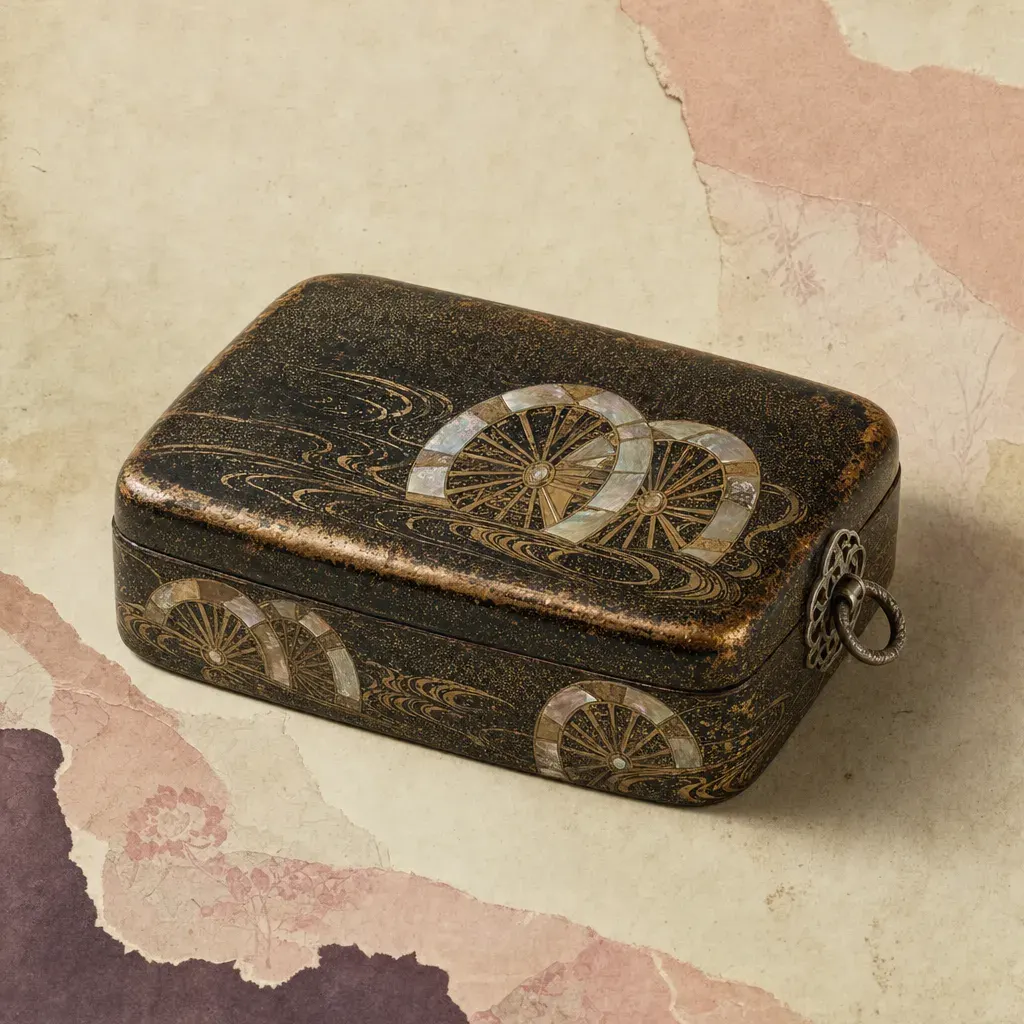
The Tokyo National Museum holds a twelfth-century lacquered cosmetic box, or tebako, decorated with ox-cart wheels half-sunk in a stream in gold and mother-of-pearl, and a thirteenth-century box on the same theme designated a National Treasure.
- 3min read
- 4chapters
- 5sources
Vivien
Your guide through time
Listen to this essay
4 min listenVivien reads our essays aloud, word for word — every date and every name in its place — so you can listen the way you would be walked through a gallery.
An AI voice, designed for History of Makeup
A tebako is a lidded box in which a Japanese aristocrat kept cosmetics and toilet articles. The Tokyo National Museum calls its twelfth-century example a representative masterpiece of Heian lacquer, and describes it as a toiletry case: a relatively small one, about thirty centimetres wide, with a lid that fits down over the body.[1]
What survives of Heian cosmetics is, for the most part, this: the containers, and the words of the people who used them. The white powder, the red and the black are gone. The boxes, made to last, remain.
Wheels in a Stream
The decoration shows ox-cart wheels half submerged in flowing water. The museum explains the image as a detail of Heian life: cart wheels were soaked so that they would not dry out and crack, and the motif was a favoured theme on mirrors and on the decorated paper of sutra scrolls as well.[2]
The techniques are those of the most expensive lacquer of the period. On a ground of gold particles sprinkled densely over black lacquer, the water and wheels are worked in togidashi maki-e, in which gold or silver powder is sprinkled onto a design laid in lacquer, sealed under further coats and polished back to reveal it; in aogin, a blue-tinted mixture of gold and silver whose hue shifts with the light; and in raden, cut mother-of-pearl set into the lacquer. Openwork silver fittings on the sides repeat the wheels, and inside, box and lid are covered with flying birds and flowers.[2]
The white powder, the red and the black are gone. The boxes, made to last, remain.
Three Centuries of One Form
The theme outlived its century. The same museum holds a second cosmetic box with cart wheels in a stream, of the Kamakura period in the thirteenth century and worked in mother-of-pearl, and it is designated a National Treasure.[3] A cosmetic box in the Metropolitan Museum from the first half of the fifteenth century carries chrysanthemums instead, in raised and flat gold and silver maki-e with applied gold and silver foil on a speckled nashiji ground, and gilt bronze fittings.[4]
Three boxes across three centuries share a form and a purpose. The decoration changes; the idea that the case for an aristocrat's cosmetics should be among the most finished objects in a house does not.
What the Boxes Kept
The court these boxes served is best seen in its own fiction. Murasaki Shikibu's novel notices faces precisely: a princess's complexion of a whiteness that would have put snow to shame, and a young girl whose teeth were not yet blackened, because her grandmother was old-fashioned, and whose eyebrows were delicately touched with stain.[5]
White, red and black remained the working palette of Japanese cosmetics for centuries afterwards; Japan's national library, tracing it into the Edo period, sets out the same three colours and the meanings attached to blackened teeth and shaved brows.[6] A tebako is where the materials and implements of such a palette were kept. Which of them any surviving box held, and in what arrangement, the boxes themselves no longer say.
What Is Not Known
Who owned these particular boxes, how they were used day to day, and whether the finest of them were ever used at all or were kept as treasures from the start. The museum records describe the objects with great precision and their owners not at all.[7]
Sources
- [1, 2, 7]Tebako (cosmetic box), design of wheels half submerged in stream in maki-e lacquer and mother-of-pearl inlay Google Arts & Culture.View source (opens in a new tab) Accessed 2026-09-25.
- [3]Tebako (cosmetic box), cart wheels in stream design in mother-of-pearl inlay, H-4445View source (opens in a new tab) Accessed 2026-09-25.
- [4]Cosmetic Box (Tebako) with Chrysanthemum Flowers, accession number 2019.421a-d Department of Asian Art, The Metropolitan Museum of Art.View source (opens in a new tab) Accessed 2026-09-25.
- [5]The Tale of Genji Houghton Mifflin, Boston and New York; Project Gutenberg eBook #66057, 1925.View source (opens in a new tab) Accessed 2026-09-25.
- [6]Kaleidoscope of Books No. 29: Make-up Then and Now — Cosmetic Culture from Edo to Showa National Diet Library, Tokyo, 2021.View source (opens in a new tab) Accessed 2026-09-22.
Filed under