The Medicines of Adornment: Cosmetics Inside the Medical Book
The most influential surgical encyclopaedia of the Middle Ages gives a whole book to cosmetics — and does not think it is changing the subject.
In short
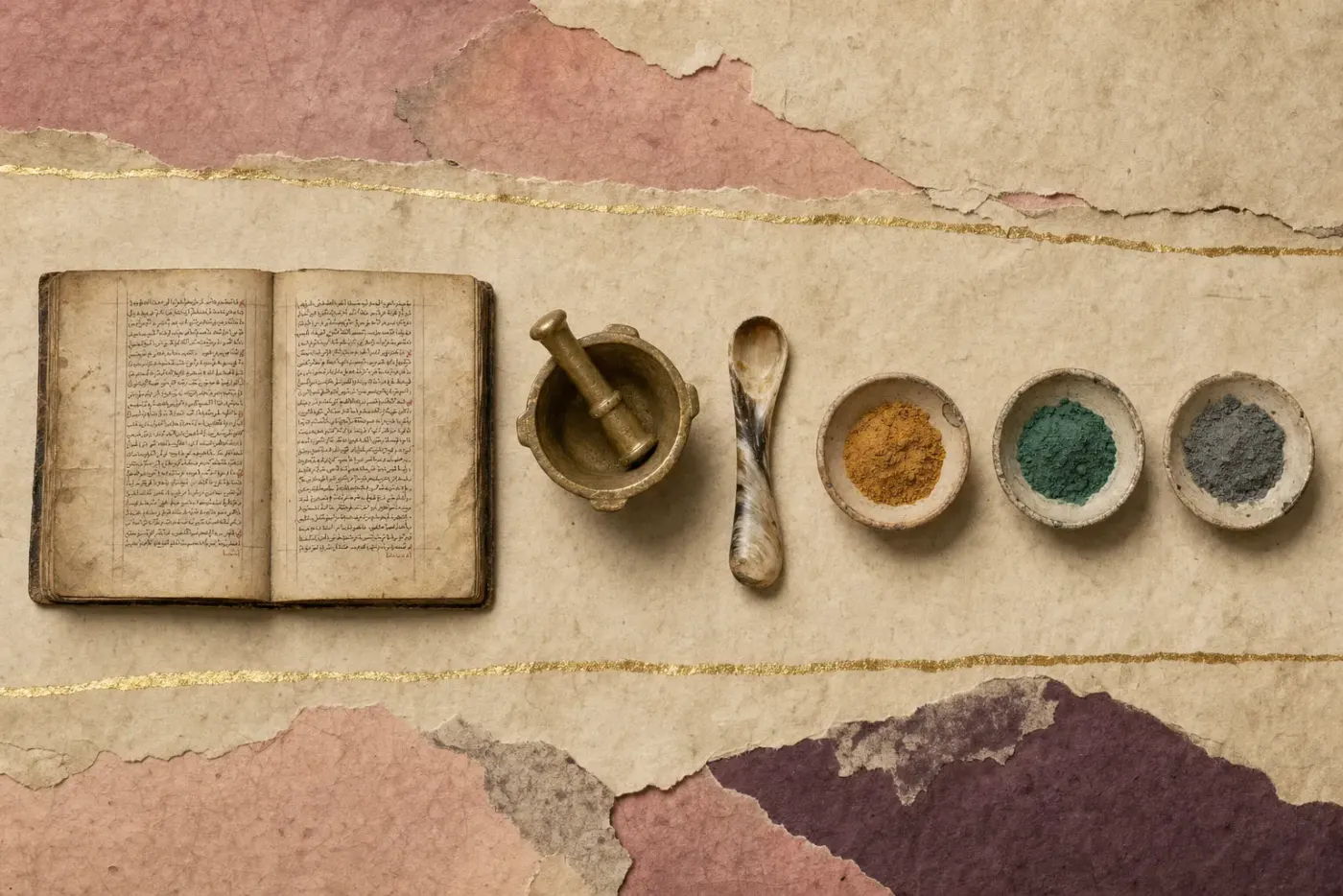
Book 19 of al-Zahrawi’s Kitab al-Tasrif, written around the year 1000, treats adwiyat al-zinah — the medicines of adornment — as a branch of medicine rather than as a separate craft, and the work was transmitted into Latin Europe from the twelfth century.
- 12min read
- 6chapters
- 4sources
Vivien
Your guide through time
Listen to this essay
6 min listenVivien reads our essays aloud, word for word — every date and every name in its place — so you can listen the way you would be walked through a gallery.
An AI voice, designed for History of Makeup
Around the year 1000, a physician working outside Córdoba completed a medical encyclopaedia in thirty books. Abu al-Qasim al-Zahrawi — Albucasis to Latin readers — is remembered chiefly for the surgical volume, which circulated in Europe for centuries. Book 19 is about cosmetics.[1]
Its title is the part worth stopping on. Adwiyat al-zinah means the medicines of adornment, and the phrase is not a euphemism. In the scheme al-Zahrawi is working in, a preparation that improves the hair, the skin, the breath or the nails belongs in a medical compendium because the body it acts on is the physician’s business.[1]
What a Classification Does
Where a subject is filed determines who is allowed to write about it, what counts as an argument, and whether it survives. Filed under medicine, cosmetic knowledge inherits an apparatus: a tradition of compilation, a habit of citing authorities, a reason for copyists to reproduce it, and institutional libraries to keep it in.[2]
Filed under vanity, it inherits none of those. The reason so much medieval cosmetic knowledge survives in legible form is that somebody decided it was a medical topic — and the reason so much later cosmetic knowledge does not survive is that later periods decided otherwise.[3]
The Contents Are Practical
The cosmetic material in this tradition is recognisably technical. It covers preparation as well as application — how a substance is ground, dissolved, boiled, strained or perfumed — and it addresses hair colouring, depilation, skin preparations, dental care and the treatment of odour.[4]
This is a formulary rather than an aesthetic. There is very little in it about what is beautiful and a great deal about what is done, which is the signature of writing intended for a practitioner instead of for a reader.[4]
The range is also wider than the modern category. Breath, teeth, nails, odour and the condition of the scalp sit alongside the skin, because the organising idea is the presentable body rather than the painted face. A modern reader looking for cosmetics in this literature will find them, and will find them filed beside a great deal that a modern shelf would separate out into dentistry, dermatology and hygiene.[4]
Where a subject is filed determines who is allowed to write about it, and whether it survives.
Why This Reached Europe
The transmission is the consequential part. Al-Zahrawi’s compendium was translated into Latin from the twelfth century onward and became one of the routes by which cosmetic knowledge reached the West.[5]
It travelled because the surgical book was wanted. A work valued for one of its volumes is copied whole, and the cosmetic material came along inside a text nobody was acquiring for that purpose — which is how a great deal of knowledge actually moves.[6]
The Justification Built In
The medical framing also supplied an answer to an objection that was always available. A preparation that treats a condition of the skin is a remedy; the same preparation described as an improvement to the appearance is a vanity. Writing the first sentence rather than the second placed the whole subject beyond easy attack.[7]
That manoeuvre recurs constantly in this history. The Victorian complexion trade would reach for the identical framing eight hundred years later, for the identical reason, and the modern regulatory line between a cosmetic and a drug exists to police what is essentially the same ambiguity.[8]
Not a European Story
It is worth naming the direction of travel plainly, because most popular accounts reverse it. The sophisticated written cosmetic tradition of these centuries is Arabic, and Latin Europe is the recipient rather than the author.[9]
The Salernitan compendium covered next on this timeline sits downstream of that transmission, not upstream of it. Salerno was a receiving point as much as a producing one, and its compilers were working with material that had already crossed a language.[10]
What Is Not Known
How widely any of these preparations were actually made and used cannot be recovered. A recipe in a compendium is evidence that somebody thought it worth writing down, which is a weaker claim than it appears — compilers copy from compilers, and a formulation can survive for centuries without anyone having mixed it.[11]
The dating is also approximate. Around the year 1000 is the conventional placement for the completion of the work, and precise dates in this period generally rest on inference rather than on a colophon.[11]
Sources
- [1, 2, 4, 5, 7, 9, 11]Kitab al-Tasrif, Book 19: on adwiyat al-zinah (the medicines of adornment) 1000.
- [3, 6]Fashions in Makeup: From Ancient to Modern Times Peter Owen, 1972.
- [8]For Appearance’ Sake: The Historical Encyclopedia of Good Looks, Beauty, and Grooming Oryx Press, 2001.
- [10]The Trotula: A Medieval Compendium of Women’s Medicine University of Pennsylvania Press, 2001.
Filed under