Three Colours and No More: A Palette Defined by Refusal
Most traditions accumulate colours. This one worked for centuries with three and got more out of them than the accumulators did.
In short
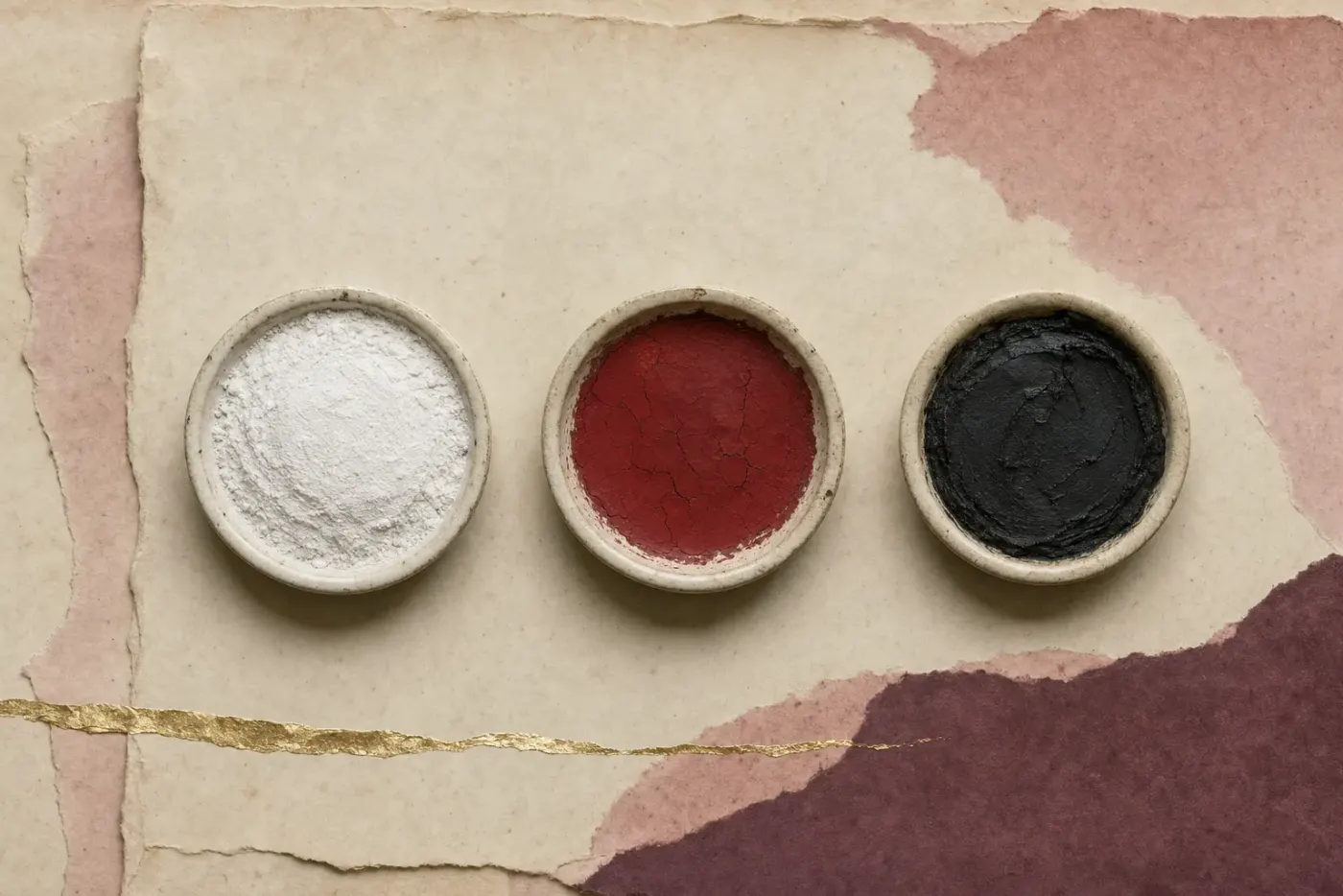
Japanese cosmetic practice worked with an unusually small palette: white for the face, red for lips and eye corners, and black for teeth and brows.
- 12min read
- 6chapters
- 3sources
Vivien
Your guide through time
Listen to this essay
5 min listenVivien reads our essays aloud, word for word — every date and every name in its place — so you can listen the way you would be walked through a gallery.
An AI voice, designed for History of Makeup
Three colours: white for the face, red for the lips and the corners of the eyes, black for the teeth and the brows.[1]
That is a smaller palette than almost any other tradition in this history worked with, and the restriction is not a sign of limited means. It is a system, and a system with three terms can be read at a glance in a way one with thirty cannot.
What a Small Palette Buys
Legibility. If there are only three colours and each has a settled place, then a departure from the arrangement is information rather than noise, and everybody can read it without being told.
It also means each colour has to carry more. White is not merely a complexion but a ground; red is not merely a lip but the one warm point on a face; black is not merely a brow but a marker of life stage.[2]
The economy compounds. Three colours in settled places can be combined, omitted or exaggerated, and each variation is legible precisely because the baseline is fixed — whereas a large palette makes any single choice unremarkable.[2]
The White Was a Surface Preparation
Laid over an oil base, mixed with water, applied by finger or brush to the face, the neck, the back of the neck and the chest, and not to the ears or the collarbones.[3]
The excluded areas are the informative part. A convention that specifies where the white stops is a convention about a designed edge, which means the white was understood as a surface with boundaries rather than as a correction of the skin.[3]
That is a genuinely different idea from the European one. A foundation that aims at a natural complexion has to hide its own edge; a white understood as a surface can have a visible edge, because the edge is part of what is being made.[3]
Three colours, each with a settled place. Anything out of place is therefore a sentence.
Why White Carried So Much
A proverb records it directly: a white skin hides seven flaws.[4]
That is a claim about coverage rather than about colour, and it explains the persistence better than fashion does. A material that conceals is wanted regardless of taste, which is why lead white survived everything said against it for as long as it did.[4]
Variation Inside the Rule
The system was not frozen. The Bunka-Bunsei years produced the sasa-iro lower lip, a green iridescence achieved by laying beni on thickly, which is a fashion operating inside the three-colour scheme rather than adding a fourth colour to it.[5]
That is how a restricted system evolves: by technique rather than by addition. A tradition that cannot introduce a new colour discovers instead what its existing ones will do when pushed, which tends to produce more skill and less product.[5]
Which is also why the practice transmits through manuals and apprenticeship rather than through purchase. When the difference between an ordinary face and an admired one is technique, the knowledge is the expensive part.[5]
The Palette Outlives Its Society
The scheme survives in one profession as a documented living practice — the standard ethnographic account is based on fieldwork in a Kyoto geisha community in the mid-1970s.[6]
Two cautions travel with that. It is a source for the conventions of one occupation rather than for makeup across Japanese society, and it is not a source for the kabuki stage — two things the surviving imagery constantly invites a reader to conflate.[6]
The conflation is easy to make because the imagery is the most reproduced part of the tradition, and a striking photograph carries no label saying which profession, which city and which decade it belongs to.[6]
What Is Not Known
Why the palette settled on three rather than expanding is not explained by anything cited here. Availability, cost, sumptuary constraint and aesthetic preference are all candidates and none is demonstrated.[7]
How far the scheme reached down the social scale is also unresolved. The evidence is weighted towards people whose appearance was recorded, which is not the same population as the one that wore it.[8]
When the scheme became settled is equally open: a palette described as characteristic across many centuries was arrived at somehow, and the sources here record the convention rather than its formation. Nor can the modern ethnographic account be read backwards, since fieldwork in the 1970s documents one profession in one city at one moment.[8]
Sources
- [1, 2, 5, 7]Kaleidoscope of Books No. 29: Make-up Then and Now — Cosmetic Culture from Edo to Showa National Diet Library, Tokyo, 2021.View source (opens in a new tab) Accessed 2026-09-22.
- [3, 4]Beauty Secrets in Japanese Prints Asian Art Newspaper, 27 October 2020, 2020.View source (opens in a new tab) Accessed 2026-09-22.
- [6, 8]Geisha University of California Press, 1983.
Filed under