Pigment
Every ingredient in the dictionary that works as a pigment — what it is, where it came from, and how long it has been doing the job.
40 ingredients in the dictionary
Browse by what it does
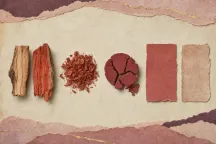
Brazilwood
CAESALPINIA SAPPAN BARK EXTRACT
A cheap, fugitive red drawn from several tropical heartwoods, traded in such quantity that Brazil is named after the tree rather than the tree after the country.
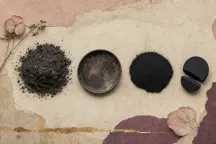
Carbon Black
CI 77266
Near-pure elemental carbon made by burning hydrocarbons under controlled conditions: the densest black available to a formulator, certified batch by batch in the United States and carrying a separate European authorisation for its nano form.
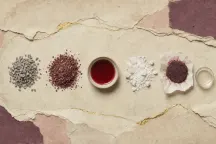
Carmine (Cochineal)
CARMINE
A deep crimson lake pigment made from the dried bodies of the female cochineal insect, and the only red of animal origin still in routine industrial use in cosmetics.
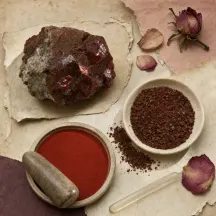
Cinnabar
Cinnabar is the natural ore of mercury sulphide and the source of the pigment vermilion: a dense scarlet mineral spread on Copper Age bodies, Roman statues and, on contested evidence, Roman faces.
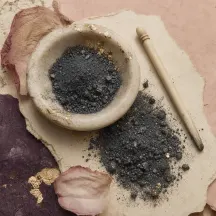
Galena (Kohl)
Galena is the natural ore of lead sulphide, ground on a stone palette and bound with fat to make the black eye paint of dynastic Egypt. It is the material behind the oldest sense of the word kohl.
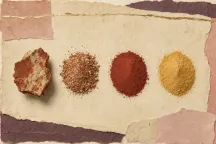
Iron Oxides
IRON OXIDES
Three iron compounds, a red, a yellow and a black, which between them mix almost every shade of human skin and carry most of the colour in foundation, concealer and pressed powder.
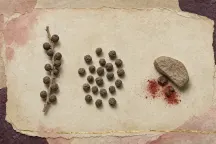
Kermes
The scarlet of the Mediterranean world before American cochineal: a red dye taken from the dried females of a scale insect that lives on the kermes oak.
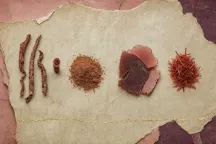
Madder
RUBIA TINCTORUM ROOT EXTRACT
A red from the root of Rubia tinctorum whose principal colourant, alizarin, became the first natural dye to be manufactured synthetically, and so ended its own cultivation.
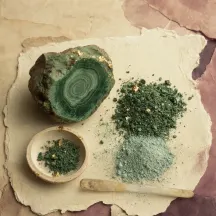
Malachite
MALACHITE
Malachite is a green copper carbonate mineral, ground on stone palettes into the green eye paint of Predynastic and Old Kingdom Egypt, and one of the earliest cosmetic colours that can be named as a specific substance.
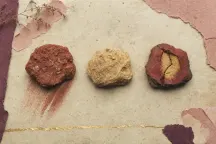
Red Ochre
Red ochre is iron-oxide-rich earth, haematite mixed with clay and quartz: the oldest colouring material in the human record, and, purified and synthesised, still the red in most foundations.
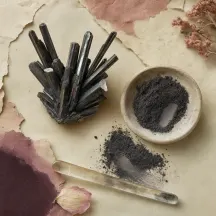
Stibnite (Antimony Kohl)
Stibnite is antimony trisulphide, the grey ore that gave the element its symbol, Sb, and the mineral that later tradition credits, mostly wrongly, as the basis of ancient Egyptian kohl.
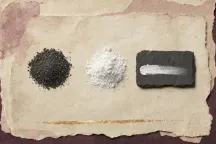
Titanium Dioxide
TITANIUM DIOXIDE
The manufactured white that replaced lead: a titanium oxide with a refractive index high enough to make it the most opaque white a cosmetic chemist can use, and a permitted mineral ultraviolet filter.
Ultramarine
ULTRAMARINES
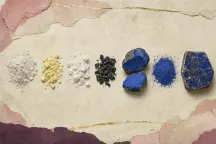
The blue of lapis lazuli, reproduced industrially from china clay, soda, sulphur and charcoal since 1828, and permitted in the United States only in externally applied cosmetics: nothing for the lips or any mucous membrane.
White Lead (Ceruse)
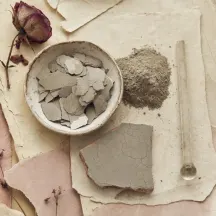
A synthetic basic lead carbonate, made since antiquity by corroding metallic lead over vinegar, which gave the face a dense opaque white and is the most consequential poisonous cosmetic in the European record.
Zinc Oxide
ZINC OXIDE
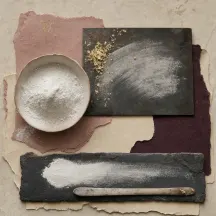
The white that came between lead and titanium: a manufactured zinc oxide, mildly astringent and mildly soothing, now met as often in a mineral sunscreen as in a face powder.