The Daily Routine: How Recently the Sequence Was Assembled
Prime, base, conceal, set, colour. Only one of those steps is old, and the one that now comes first arrived last.
In short
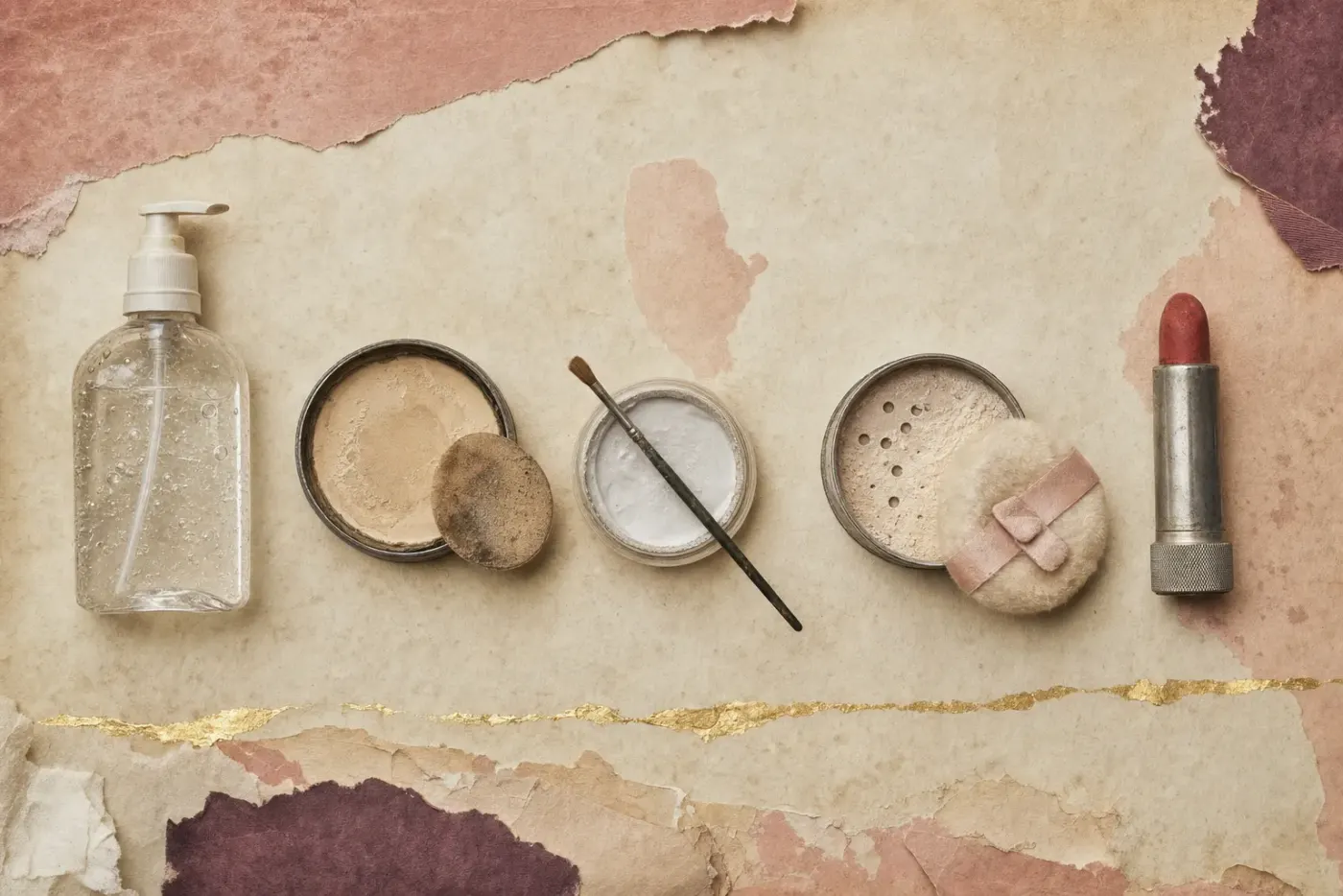
The order most people apply makeup in — prime, base, conceal, set, colour — is barely a century old at its oldest point, and primer, the step that now comes first, was the last of the five to arrive.
- 9min read
- 6chapters
- 14sources
Vivien
Your guide through time
Listen to this essay
8 min listenVivien reads our essays aloud, word for word — every date and every name in its place — so you can listen the way you would be walked through a gallery.
An AI voice, designed for History of Makeup
Ask how a face is done and the answer comes back as a sequence. Primer, then foundation, then concealer, then powder, then colour on eyes, cheeks and mouth. It has the settled feel of something handed down.
It is not. The sequence is an assembly of separately invented products, arranged into an order that could only become standard once all of them existed. Taken apart, each step has a history, and the parts of it that can be dated are surprisingly close together.[1]
Powder Is the Oldest Step
Setting powder is the only part of the modern sequence with a long history behind it. Face powders of starch, chalk, talc and kaolin long predate everything else in the order, and the function has barely changed: absorb oil, reduce shine, fix what is underneath so it stays where it was put.[2]
What has changed is the material. Powders moved from lead carbonate to zinc oxide, and then to titanium dioxide blended with talc and kaolin. Talc remains in wide use, and it was evaluated in 2024: an International Agency for Research on Cancer working group meeting from 11 to 18 June 2024 classified it as probably carcinogenic to humans, Group 2A, a conclusion announced in IARC Press Release No. 352 and prepared for Monographs Volume 136.[3]
Base, with a Patent Number
Modern foundation has a document behind it. On 27 November 1936, Frank Factor and Paul E. Fisher filed for a dry make-up cosmetic in solid cake form, assigned to Max Factor and Co. of Los Angeles. US Patent 2,101,843 was granted on 14 December 1937. The specification describes water-repellent pigments dispersed by water-soluble agents, applied with a damp sponge to leave a water-repellent film on the skin.[4]
It was developed for Technicolor, which greasepaint could not survive, and reached the public as Pan-Cake in 1938.[5] The significance is not that nobody had covered their face before. It is that a film-industry problem produced a cake-and-sponge base which ordinary buyers then adopted, and the base step of the sequence has been recognisably that ever since.
Conceal, and the Myth of the First
Concealer has two dates and one correction. Lydia O’Leary filed on 31 December 1930 for a dermal cover preparation: zinc powder, glycerine and water in stated proportions, mixed to a thin paste and brushed on. The patent states its object plainly — to cover and conceal birthmarks and other skin blemishes, while simulating normal skin in texture, flexibility and colour. US Patent 1,877,952 was granted on 20 September 1932.[6]
Max Factor’s Erace, launched in 1954 in five shades — Fair, Medium, Deep Natural, Tan and Deep Tan — is frequently called the first stick concealer. It was not: Covermark’s Spot-Stik, introduced in 1936, preceded it by eighteen years.[7]
A sequence that feels inherited is in fact an assembly, and the piece that now comes first was the last to arrive.
Primer Came Last
The step that now opens the routine is the newest one in it, and the chemistry it uses was worked out before the category existed. Through the 1990s, formulators combined volatile silicones and volatile hydrocarbons such as isododecane with film-forming resins to make colour cosmetics that did not transfer. Revlon’s patent, granted in 1996, claims a volatile solvent at one to seventy per cent, preferring a blend of a cyclic silicone and an isoparaffin.[8] The Procter and Gamble patent granted in 2000 names isododecane as the volatile hydrocarbon carrier and MQ resins as the film former.[9] The carrier evaporates and leaves the pigment held in a flexible film.
The same family of volatile carrier and film former later appears in primers — a film applied to the skin to smooth it and to change what the next layer sits on. That is a resemblance of formulation chemistry, not a documented line of descent: neither patent is about a primer, and neither claims one. The siloxysilicate resins used as film formers have been assessed as cosmetic ingredients by the Cosmetic Ingredient Review panel, whose conclusion on trimethylsiloxysilicate is qualified by respiratory-tract irritation in aerosolised products.[10] The retail category itself has no clean founding date, and the confident brand-first claims made for it do not survive checking.
Colour Is Oldest and Goes On Last
Colour is the step the sequence ends with and the one with the longest run behind it. Reddened lips and cheeks are attested across the whole span this site covers; what is recent is not the colour but the container, and the container is what turned colour into a step rather than an occasion.[11]
Maurice Levy’s sliding metal container of 1915, made by the Scovill Manufacturing Company, took lipstick out of the pot.[12] James Bruce Mason Jr’s swivel-up tube, patented in 1923, made it one-handed and portable.[13] A cosmetic that can be applied without a table, a mirror or a maid is one that can be applied last, quickly, and reapplied during the day.
That is why it sits at the end. The four steps before it are corrective and are meant to be invisible; colour is the only one intended to be seen, and the only one that is touched up after the face has left the house.
The Sequence Is Taught
An order has to be learned from somebody. For the first half of the twentieth century that somebody stood behind a counter. Elizabeth Arden built her business on a prescribed regimen — cleansing, nourishing and toning, with tightening by the patting technique of muscle-strapping — demonstrated in person and sold as a matched set.[14] The counter, and the woman standing at it, are where Kathy Peiss’s history locates the transmission of American beauty routines.[15] The Ardena Skin Tonic and Venetian Orange Skin Food that anchored the Arden regimen had been available before the First World War.[14]
The teaching later moved to the screen. Michelle Phan began posting makeup tutorials to YouTube in 2007, and the form she worked in — one face, one camera, the whole sequence performed in order — became the standard way the order is now transmitted.[16] Claims that any particular video was the first of its kind are not verifiable, and the defensible statement is the duller one: the genre had no single author, and the sequence it teaches was assembled within living memory.
Sources
- [1, 2, 11]Fashions in Makeup: From Ancient to Modern Times Peter Owen, 1972.
- [3]IARC Monographs evaluate the carcinogenicity of talc and acrylonitrile (Press Release No. 352) International Agency for Research on Cancer, Volume 136, 2024.View source (opens in a new tab) Accessed 2026-09-22.
- [4]US Patent 2,101,843 — Dry Make-Up Cosmetic in Solid Cake Form (assigned to Max Factor and Co.) United States Patent Office, 1937.View source (opens in a new tab) Accessed 2026-09-22.
- [5]Pan-Cake Make-up Cosmetics and Skin, 2026.View source (opens in a new tab) Accessed 2026-09-22.
- [6]US Patent 1,877,952 — Dermal Cover Preparation United States Patent Office, 1932.View source (opens in a new tab) Accessed 2026-09-22.
- [7]Max Factor (1945–1960) Cosmetics and Skin, 2026.View source (opens in a new tab) Accessed 2026-09-22.
- [8]Cosmetic compositions with improved transfer resistance. United States Patent 5,505,937, assigned to Revlon, priority 15 December 1992, granted 9 April 1996 United States Patent Office, 1996.View source (opens in a new tab)
- [9]Transfer resistant cosmetic compositions. United States Patent 6,071,503, assigned to The Procter and Gamble Company, priority 7 November 1995, granted 6 June 2000 United States Patent Office, 2000.View source (opens in a new tab)
- [10]Safety Assessment of Silylates and Surface-Modified Siloxysilicates International Journal of Toxicology, 2013.View source (opens in a new tab)
- [12]Metal lipstick container, Scovill Manufacturing Company 1915.
- [13]US Patent 1,470,994 — Toilet article (swivel-up lipstick holder) United States Patent and Trademark Office, 1923.View source (opens in a new tab) Accessed 2026-09-22.
- [14]Elizabeth Arden (1920–1930) Cosmetics and Skin, 2026.View source (opens in a new tab) Accessed 2026-09-22.
- [15]Hope in a Jar: The Making of America’s Beauty Culture Metropolitan Books, 1998.
- [16]Michelle Phan, Em Cosmetics: Influencer Brand to Know Glossy (Digiday Media), 2022.View source (opens in a new tab) Accessed 2026-09-22.
Filed under