Kevyn Aucoin and the Face as Construction
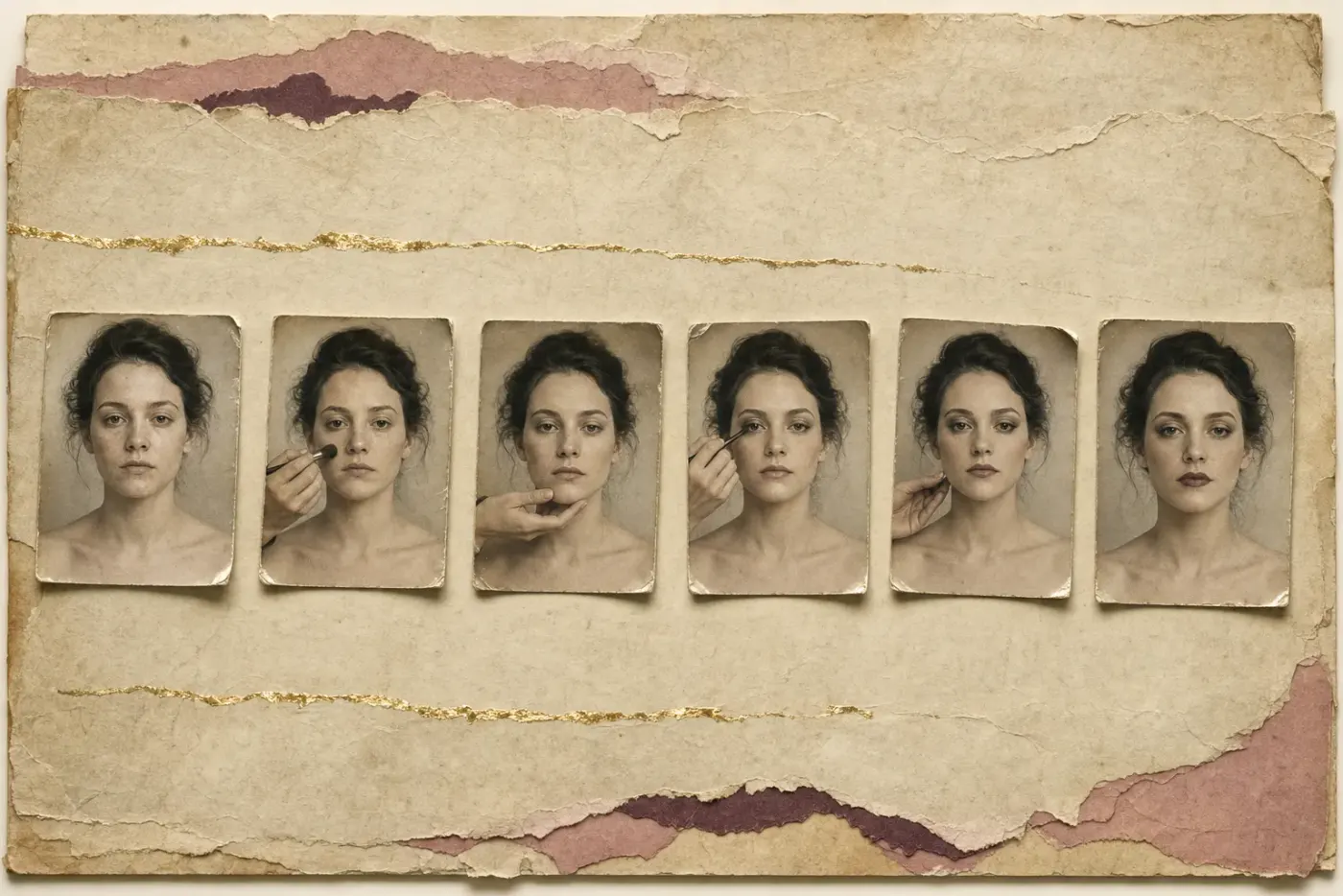
He photographed the middle of the process, and turned a trade skill into something a reader could follow.
HOM · Person1962 – 2002Make-up artist and author
In short
Kevyn Aucoin did not invent contouring, which film make-up departments had used since the silent era, but by publishing it step by step with the shades named he moved it out of the studio and into general use.
- 3min read
- 5chapters
- 6sources

Vivien
Your guide through time
Listen to this essay
4 min listenVivien reads our essays aloud, word for word — every date and every name in its place — so you can listen the way you would be walked through a gallery.
An AI voice, designed for History of Makeup
Kevyn Aucoin changed how make-up is taught by photographing the middle of the process. Published instruction before him mostly showed a finished face and described it in prose. He showed the same face at six stages, with the hand still in shot and the product named.[1]
He also argued, in print and at length, that make-up was construction rather than correction. A face was a surface on which something could be built, not a list of deficiencies to be reduced. That position was unusual in a trade whose selling language had run on flaws for a century.
Lafayette
He was born in Shreveport, Louisiana, on 14 February 1962 and adopted as an infant. He grew up in Lafayette, taught himself to work on faces using his sisters and their friends as subjects, and left for New York in the early 1980s.[2]
He worked with the Vogue photographer Steven Meisel — as the make-up artist on the shoots, not as an assistant to him — for a stretch of about eighteen months, and a Vogue cover with Cindy Crawford made his name. A long run of magazine covers and campaign work followed through the late 1980s and the 1990s, with the sculpted, high-contrast face that became the decade's signature.
The Books
The Art of Makeup appeared in 1994 from HarperCollins.[3] Making Faces followed from Little, Brown in 1997,[4] and Face Forward, from the same publisher, in 2000.[5]
The format was the argument. Each book set out technique as a numbered sequence of photographs with the products identified, so that a reader could follow it at home without a studio, a lighting rig or an assistant. Nothing was withheld as trade knowledge, and nothing was described that had not been photographed.
A face was a surface on which something could be built, not a list of deficiencies to be reduced.
Construction, Not Correction
The technique most associated with him is sculpting: using lighter and darker shades to alter the apparent structure of a face. It was not his invention. Shading and highlighting belong to film make-up from the silent era onward,[6] and were ordinary studio practice through the decades of black-and-white and early colour work that preceded his birth, with the make-up houses supplying and instructing the studios directly.[7]
What Aucoin did was publish it for people who were not being paid to do it, with the shades named and the placement photographed rather than described. The knowledge left the studio because somebody printed it in a form a reader could follow without permission from anyone.
The Transformations
Making Faces included sequences in which one subject was made to resemble someone else entirely. They were read at the time as a party trick, and they are the most serious pages in the book: a demonstration that much of what a viewer treats as a person's identity is a matter of shadow and placement.[8]
Working in a trade that sold correction, he took the opposite position throughout. The interesting question was not what a face lacked. It was what a face could be made into, and how plainly the method could be written down.
After
Aucoin died on 7 May 2002, aged forty.[9] The cosmetics line carrying his name, launched shortly before, has continued since.
His lasting effect is structural rather than stylistic. The make-up artist as a named author, with a byline, a readership and an argument, is a position he did more than anyone to establish, and every artist who now publishes technique under their own name is working inside it.
Sources
- [1, 4, 8]Making Faces Little, Brown and Company, 1997.
- [2, 9]Kevyn Aucoin, 40, an Artist Whose Best Work Was Unseen The New York Times, 8 May 2002, 2002.View source (opens in a new tab) Accessed 2026-09-22.
- [3]The Art of Makeup HarperCollins, 1994.
- [5]Face Forward Little, Brown and Company, 2000.
- [6]Hollywood Before Glamour: Fashion in American Silent Film Palgrave Macmillan, 2013.
- [7]Max Factor (1930-1945)View source (opens in a new tab) Accessed 2026-09-22.
Filed under