Stockings Out of a Bottle: Leg Makeup and the Missing Nylons
When the war took silk and nylon, the cosmetics industry sold women a stocking they could paint on — and learned, in the process, how to make a better foundation.
In short
When silk and nylon went to war, leg makeup — sold as cosmetic stockings, liquid stockings and bottled stockings — was offered by a long list of houses as a stand-in for hosiery; it was hard to make and slow to apply, and its lasting benefit was to the face foundations developed after it.
- 6min read
- 6chapters
- 6sources
Until the end of the 1930s the best stockings were silk. DuPont began making nylon in 1939, and nylon stockings were launched nationally in the United States in 1940, priced the same as silk and bought up faster than DuPont could make them.[1] When the country entered the war they were gone again, and the cosmetics industry offered women something to put in their place: a stocking that came out of a bottle.
Leg makeup never quite convinced. It was hard to make, slow to put on and easy to streak. But the work that went into it outlasted the war, on the face rather than the leg.[1]
Where the Stockings Went
Most of DuPont’s nylon had gone into stockings, though the military had bought some to replace the silk in parachutes. When the United States entered the war, nylon production went to parachutes and bomber tyres. Silk was no alternative: trade with Japan had ceased, and the army had requisitioned the silk in store for parachutes, munitions and other military uses — silk made a favoured casing for the powder bags of naval guns, because it burned away completely.[2]
Women were asked to hand in their old silk and nylon hose, and a government bulletin of 1943 set out which mixtures were wanted.[2] American women still had rayon and cotton stockings. In Britain, where clothes were rationed from 1 June 1941, a pair of stockings cost two coupons, out of an annual allowance that began at sixty-six points and shrank as the war went on.[3]
All stockings should first be washed and then taken to any hosiery collection depot.
A Long List of Bottles
Leg makeup was not invented for the war. Lotions to give the legs a tan were sold well before it — Dorothy Gray’s Finishing Lotion in 1929, Elizabeth Arden’s Velva Beauty Film in 1933 — and a few products had been made as stocking substitutes, Doraldina’s Leg Make-up of 1927 among them.[5] Cyclax introduced its Stockingless Cream in 1940, and Arden’s film became Velva Leg Film in 1941.[5][6]
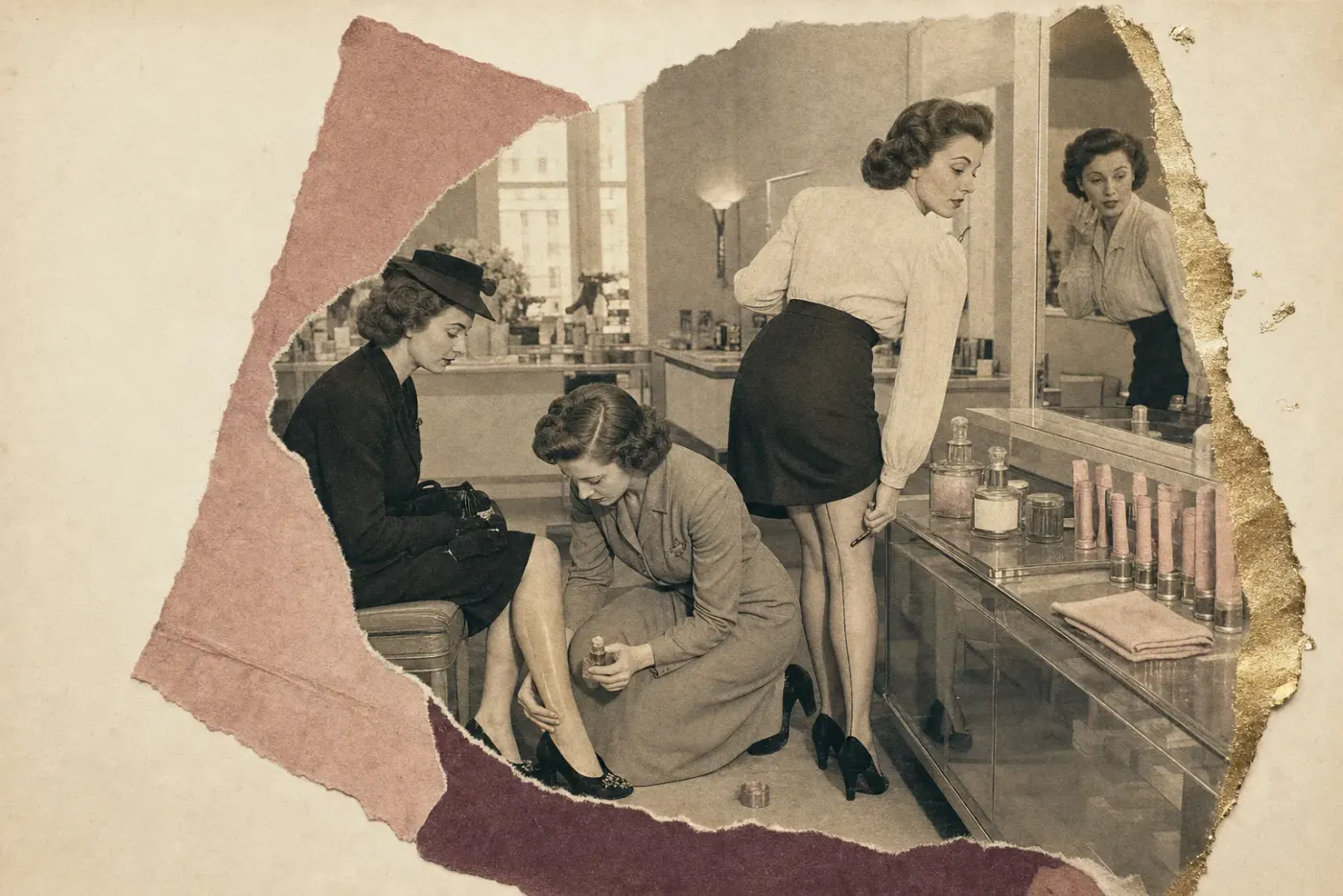
During the war a long list of houses added one: Charles of the Ritz, Harriet Hubbard Ayer, Dorothy Gray with Leg Show, Revlon with Leg Silk, Helena Rubinstein with Leg Stick, and a liquid that simply called itself Liquid Stockings. The United States had the widest range.[5] In 1942 Rubinstein opened a Bare-Leg Bar in her Fifth Avenue salon, where on the first day cosmetic stockings were demonstrated in three forms: as a stick, out of a bottle, and sprayed on.[5][7]
Hard to Make
A good cosmetic stocking had to look like hosiery, go on without streaks, dry fast, stay on when wet or rubbed by a skirt, and still wash off with soap and water. The ingredients show the problem being worked: zinc oxide and titanium dioxide for cover, iron oxides, lakes and dyes for colour, talc to imitate the sheen of a stocking, glycerine or sorbitol against flaking, methyl cellulose, casein or latex to make it stick, and alcohol to hurry the drying.[8]
Many brands failed at least one of those tests. Pigments separated in the bottle, only a few products were waterproof, and the whole business took a long time to put on and take off. Sales were low in the early part of the war, picked up as manufacturers improved their products and their selling, and never met early expectations.[8]
Putting It On
The illusion began before the bottle was opened. Legs had to be shaved or rubbed smooth, and loose skin scrubbed away, or it flaked off and left pale patches. Then came practice. A London newspaper column of September 1942 told its readers to find their most flattering shade and then “practice putting it on until you can do it easily”, and described three kinds: dark tinted liquids put on with cotton, lotions and creams spread by hand, and sticks stroked straight on.[9]
Real stockings had a sheen and a seam. Arden sold a Velva Leg Film Buffer to polish up the first; the second was drawn down the back of the leg with an eyebrow pencil, which took a steady hand, and many women did not bother.[9] Not everyone had the choice. The Marine Corps Women’s Reserve required seamed stockings with its uniforms, and while some women in other services were allowed leg makeup, women Marines were not.[10]
What It Left Behind
The end of the war brought nylon back. DuPont was making it for stockings again within two weeks of the Japanese surrender, and American reporters wrote of “nylon riots” in 1945 and 1946 as women scrambled to buy.[11] Where clothes stayed rationed, cosmetic stockings lingered, and were still on sale in the 1950s.[11]
Their lasting effect was elsewhere. A good leg makeup posed the same problems as a good liquid face powder, with the added demand that it look like silk; by the end of the war trial and error had produced serviceable products, and companies turned what they had learned to new makeup bases and foundations. One of the first of the new emulsion bases, Liquid Beauty, went on sale in 1946.[12] The historian of these products calls those foundations, not leg makeup, the true beneficiary of all the research.[11]
What Is Not Known
How many women painted their legs is not known. The sources used here record what was sold and what was advised, and that sales never met early expectations, but they give no figures.[13]
Home-made versions are a favourite part of the story, and some did exist: wartime austerity led some women in England to make their own from published recipes, such as a 1947 manual’s mixture of talc, kaolin and pigment.[13] Which kitchen-cupboard substitutes were really used, and how widely, is harder to establish, and those not found in the sources cited here are not repeated. Even the ration is given differently: an allowance of sixty-six coupons a year at first in the Imperial War Museum’s account, sixty in the cosmetics history used here.[14][13]
Sources
- [1, 2, 4, 5, 8, 9, 11, 13]Cosmetic Stockings (Leg Make-up) Cosmetics and Skin, 2012.View source (opens in a new tab) Accessed 2026-09-25.
- [3, 14]Clothes Rationing in Britain During the Second World War Imperial War Museums.View source (opens in a new tab) Accessed 2026-10-03.
- [6]Elizabeth Arden (1930-1945) Cosmetics and Skin.View source (opens in a new tab) Accessed 2026-09-22.
- [7]Helena Rubinstein (1930-1945) Cosmetics and Skin, 2009.View source (opens in a new tab) Accessed 2026-09-22.
- [10]Free a Marine to Fight: Women Marines in World War II — Uniforms Marine Corps History and Museums Division (Marines in World War II Commemorative Series); npshistory.com mirror.View source (opens in a new tab) Accessed 2026-10-03.
- [12]Liquid Face Powders Cosmetics and Skin, 2014.View source (opens in a new tab) Accessed 2026-09-25.
Filed under