The Television Counter: Mineral Makeup Sold on Air
A loose powder that had to be shown to be sold found its counter on home-shopping television and in half-hour infomercials. When its maker went public in 2006, more than half of its sales came through a television set.
In short
Bare Escentuals sold its loose mineral foundation on QVC from 1997 and through a long-form infomercial from 2002; when it went public in 2006, infomercials made up 37.4 per cent of its net sales and home-shopping television 14.7, and by 2007 mass-market mineral makeup sales had reached $149 million.
- 6min read
- 6chapters
- 4sources
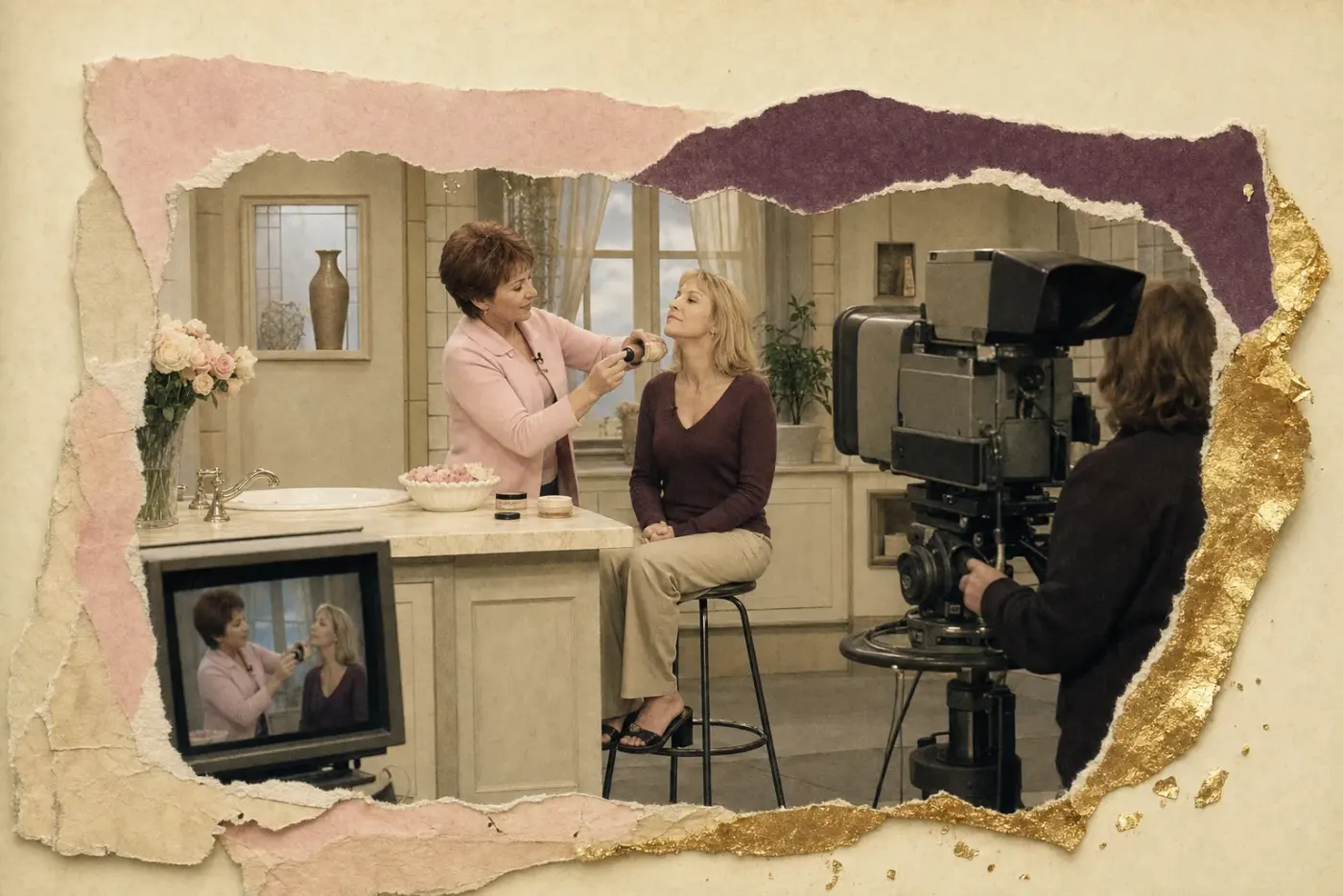
Some makeup can be sold from a shelf. A loose powder, put on with a brush in a sequence its maker had to teach, has to be shown. In the 2000s the place it was shown was a television set: a home-shopping channel, or a half-hour infomercial on cable.[1]
When Bare Escentuals went public in the autumn of 2006, its prospectus set out how far that had gone. More than half of what the company sold, it sold through a screen.[1]
A Powder and a Brush
Bare Escentuals, based in San Francisco, had opened its first boutique in 1976. Leslie Blodgett, who had worked for Neutrogena, Procter & Gamble and Max Factor, had been its chief executive since 1995.[2] By the 2000s its business rested on one line, i.d. bareMinerals: products made, the company said, “primarily from finely milled minerals” and without “preservatives, oil, fragrances, talc, waxes, binders and other potential skin irritants.” Foundation alone accounted for about half of its net sales.[2]
The product came with its own instructions. The company registered two phrases as trademarks: “Makeup so pure you can sleep in it,” and “Swirl, Tap, Buff,” which it described as the signature technique of applying the powder with a makeup brush.[2] A foundation sold as a method needed somewhere to demonstrate the method.
On Air
It found two places. Bare Escentuals had sold on QVC since 1997, and in December 1998 it gave the shopping channel the exclusive right to sell its products in the United States through every channel except the company’s own boutiques and the prestige trade of department stores, specialty stores, boutiques and salons.[3] In 2002 it launched a long-form infomercial, broadcast as 28-minute programmes and as spots of 60 to 120 seconds on cable networks such as Lifetime, Oxygen and Bravo. Their purpose, the company said, was to create awareness and to educate the consumer “regarding proper application techniques.”[3]
In the year that ended on 1 January 2006, infomercials accounted for 37.4 per cent of the company’s net sales and home-shopping television for 14.7 per cent.[3] A little over half of everything it sold, in other words, was sold through a television. Its products had also gone into Ulta in 1997 and into Sephora in 2004, and it described itself as the top-selling cosmetics brand at both in 2005 — the company’s own claim.[3]
It is mainly marketing hype. The minerals in it have never been shown to be beneficial for your skin.
Everyone Follows
The mass market followed. By one tracker’s count, American mass-market stores, Wal-Mart among them, sold $4.5 million of mineral-based cosmetics in 2005, $69 million in 2006 and $149 million in 2007, a total that left out department stores, infomercials and the internet. By another’s, the industry answered with 451 mineral-based products in 2007, against 132 two years before.[5]
Maybelline promoted its Mineral Power line as “more natural” and “healthier”; Revlon had a ColorStay Mineral Collection, L’Oréal a line called Bare Naturale, Neutrogena its Mineral Sheers, and Laura Mercier extended its mineral collection into eye shadows and blush.[5] The company an industry analyst called the trailblazer of the trend kept growing: Bare Escentuals reported sales of $511 million in 2007, up 30 per cent, and that year its infomercials were broadcast an average of 500 times a week, bringing in $128 million in direct sales.[5]
What Is a Mineral?
The word did a great deal of work. The new lines were promoted, as the newspaper put it, with “natural-sounding ‘mineral’ formulations” and ingredients such as titanium dioxide and mica, and the industry’s own trade association conceded that the word had no fixed meaning. Its chief scientist, John Bailey, said: “There’s not really a rigid definition of what it is or what it’s supposed to accomplish. It really comes down to each company’s individual representation of it.”[6]
The selling worked through reassurance as much as chemistry. One customer, a woman with rosacea who had paid $75 for a starter kit of powders and brushes, told the paper she would “never go back to the other (brands).”[6] What the powders promised was the absence of things, and a brush to put them on with.
An Old Lesson
Selling makeup on television was not new. Hazel Bishop had become the largest television cosmetics advertiser in the United States by 1953, and in 1955 Revlon became the sole sponsor of a quiz show.[7][8] What was new was the shop inside the set. The 1950s sponsor bought an audience and sent it to a store; the home-shopping channel and the infomercial took the order themselves, by telephone or website, in answer to the programme.[9]
It asked of the customer what a counter had always asked: watch someone apply the product, then do it yourself. The infomercial was the counter demonstration at the scale of cable television, and within a few years the same lesson would be filmed by customers themselves.
What Is Not Known
The figures here are the company’s own, given to investors in a prospectus, or market researchers’, given to a newspaper. None of the sources used measures what the products did for anyone’s skin. “Makeup so pure you can sleep in it” was a registered trademark, not a finding.[10]
Popular accounts of Leslie Blodgett’s first appearance on QVC give dramatic figures for how fast the powder sold; none of the sources used here records them, and they are not repeated. Nor do these sources settle whether mineral makeup suited sensitive skin better than other foundations. The company said its formula left out “potential skin irritants”; a dermatologist called the health claims “mainly marketing hype.”[10][11]
Sources
- [1, 2, 3, 9, 10]Prospectus (Form 424(b)(4)), dated 28 September 2006 U.S. Securities and Exchange Commission, EDGAR, 2006.View source (opens in a new tab) Accessed 2026-10-03.
- [4, 5, 6, 11]Mineral-based makeup hits mother lode USA Today, reprinted in The Honolulu Advertiser, 25 March 2008, 2008.View source (opens in a new tab) Accessed 2026-10-03.
- [7]Hazel Bishop Cosmetics and Skin.View source (opens in a new tab) Accessed 2026-09-22.
- [8]The $64,000 Question PBS (WGBH).View source (opens in a new tab) Accessed 2026-10-03.
Filed under