Kohl, Henna and the Medicine of Adornment
Not a country and not a century: a sphere in which cosmetics were filed as medicine and worked out as chemistry.
HOM · Culture9th – 12th centuriesMedicine & Adornment
All of The Islamic World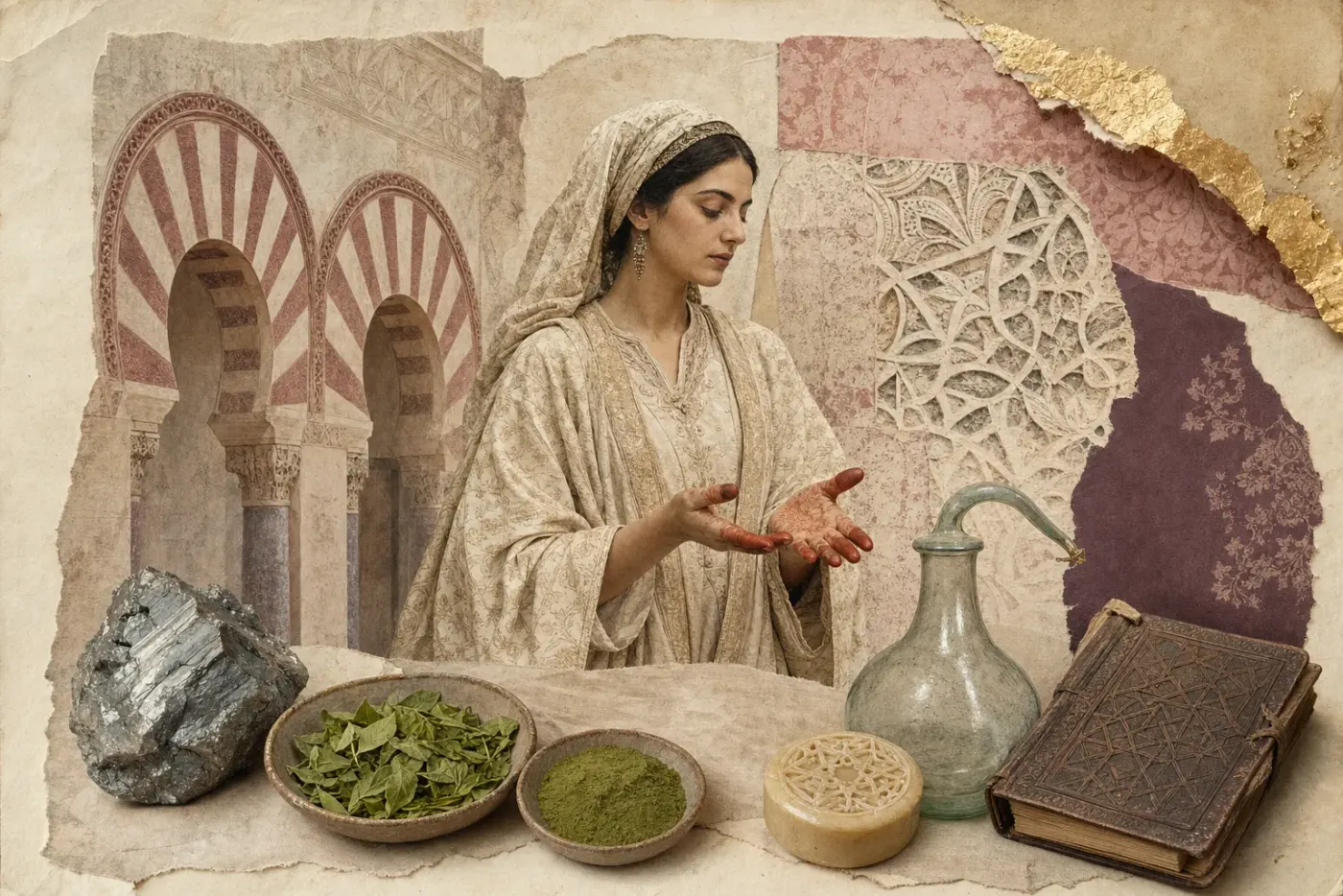
In short
Around the year 1000 the Andalusian physician al-Zahrawi gave one of the thirty books of his medical encyclopaedia to adwiyat al-zinah, the medicines of adornment — which placed cosmetics inside medicine rather than beside it, and is a large part of why the recipes survive at all.
- 12min read
- 6chapters
- 16sources
Vivien
Your guide through time
Listen to this essay
12 min listenVivien reads our essays aloud, word for word — every date and every name in its place — so you can listen the way you would be walked through a gallery.
An AI voice, designed for History of Makeup
Islamic here names a civilisational sphere rather than a country or a period, and this entry covers a part of it rather than the whole. Its evidence runs between two cities — Baghdad, where al-Kindi wrote on perfume, and Córdoba, where al-Zahrawi wrote on adornment — and forward from them into Latin Europe. Persia, Egypt, the Maghreb, India, Central Asia and the Ottoman centuries had cosmetic traditions of their own, and they are not covered here.
Two things distinguish what is. The first is that cosmetics were filed with medicine, which is why so much of the record survives: recipes kept inside pharmacopoeias get copied, and recipes kept in households do not. The second is that the field is unusually well supplied with fiction, most of it manufactured much later and much further west.
Kohl Names a Colour, Not a Recipe
In the Arabic and Unani pharmacological traditions the best kohl is ithmid, understood as antimony sulphide, and its use is recommended in a hadith transmitted from Ibn Abbas.[1] The preference is genuine and it is old. What it does not establish is what was in any particular pot.
The best empirical check on that is modern, and has to be read as modern. A survey published in 1998 took forty-seven kohl samples off the market in Oman and put them through X-ray powder diffraction. Of the eighteen made in Oman, five were principally galena, twelve amorphous carbon and one haematite. The remaining twenty-nine had been made in other countries and sold there, and their principal components were galena, minium, amorphous carbon, magnetite, zincite, calcite or sassolite. Antimony sulphide was the principal component of none of them.[2] Eight centuries separate those jars from al-Zahrawi's, and the survey is evidence about a twentieth-century market rather than a medieval pot. What it corrects is a modern assumption: that the word names a composition. Kohl is a name for a black powder applied to the eye margin. It is not a formula, and treating it as one has produced error in both directions — Egyptian galena described as antimony, antimony assumed for samples that turn out to be lead.
The regulatory position now differs by jurisdiction. Antimony and its compounds are prohibited in cosmetic products in the European Union under Annex II of Regulation (EC) No 1223/2009, adopted on 30 November 2009 and applied in full from 11 July 2013.[3] In the United States the Food and Drug Administration holds kohl, kajal and surma to be unapproved colour additives within the meaning of section 201(t) of the Federal Food, Drug, and Cosmetic Act.[4] Eye-area cosmetics whose labels declare them fall under Import Alert 53-06, which provides for detention without physical examination at the port of entry; the alert was last revised on 17 November 2023 and was consulted here on 22 September 2026.[5]
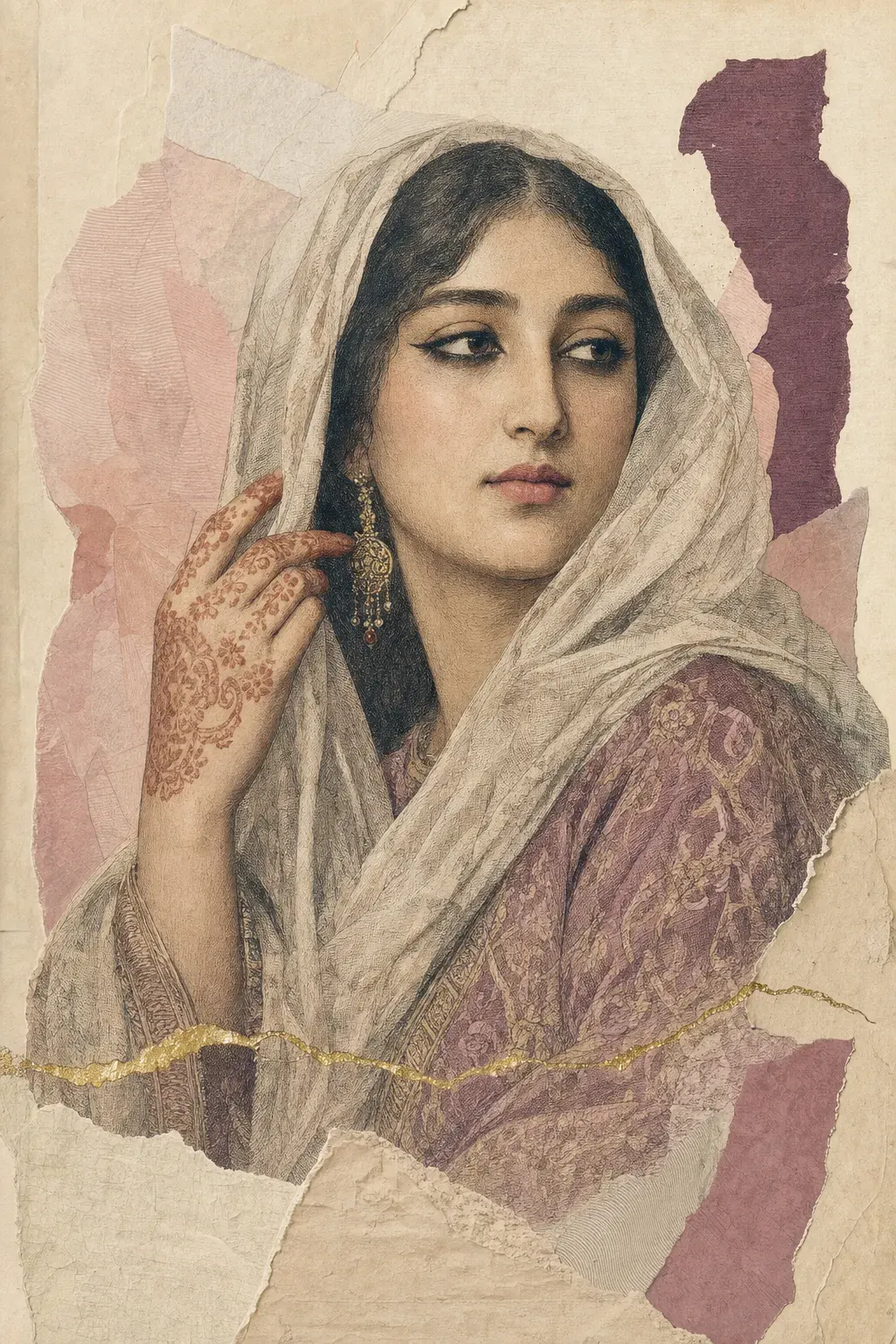
It also removes the marks from the face caused by superfluities of the body, freckles, relaxes facial spasm, and if applied to the tired sight [eyes] relieves perturbation.
Al-Zahrawi and the Medicines of Adornment
Around the year 1000 the physician Abu al-Qasim al-Zahrawi, who worked outside Córdoba and was known to Latin readers as Albucasis, completed Kitab al-Tasrif, a medical encyclopaedia in thirty books. The nineteenth is given to adwiyat al-zinah, the medicines of adornment.[7]
Its contents are recognisably a cosmetics manual: preparations for the skin and hands, hair dyes and hair treatments, depilatories, dentifrices, underarm preparations, and scented compounds including solid perfumes rolled and pressed in moulds.[8] That last item is routinely described in modern writing as the first lipstick. The description is a gloss rather than a translation — the text has a solid perfume in a mould, and the step from there to a coloured stick for the mouth is taken by the person retelling it.
The more consequential point is where the book sits. Adornment is a volume of a medical encyclopaedia, shelved beside surgery and pharmacy, by the author of the most influential surgical text of the medieval centuries. The standard pharmaceutical study of al-Tasrif reads it that way: cosmetics are not an indulgence attached to medicine here, but a branch of it.[8]
Henna
Henna is older than Islam and was absorbed by it. The leaf of Lawsonia inermis contains lawsone, which binds to keratin and stains hair, nails and the outer skin orange-red. Egyptian mummified remains have been recovered with hair dyed red with henna — among them a woman of about 1000 BCE from Deir el-Bahri at Thebes — and the Natural History Museum's account puts the dyeing probably at the time of embalmment rather than in life.[9]
Across the Islamic world it carried meanings a pigment does not ordinarily carry: applied to a bride's hands and feet before a wedding, used by men on hair and beards, and given religious warrant by association with the Prophet.[9] It is among the very few practices described in this archive that are still performed at scale, for substantially the same reasons.
Regulators treat it narrowly. The European Union's Scientific Committee on Consumer Safety adopted an opinion on Lawsonia inermis on 19 September 2013 addressing its use as a hair dye, and set out the limits of what it had assessed.[10] In the United States, 21 CFR 73.2190 lists henna as a colour additive exempt from certification for colouring hair only, and not for the eyelashes, the eyebrows or the area of the eye.[11]
What Was Written Down, and What Was Not
The ninth-century philosopher al-Kindi compiled Kitab Kimiya' al-'Itr wa-l-Tas'idat, the book of the chemistry of perfume and distillations: a working treatise of procedures and apparatus rather than a theoretical one. Its distillations are distinct in method and in purpose from those of the alchemical tradition al-Kindi himself attacked, being aimed at a product rather than at a transmutation.[12] Perfumery was being handled as craft chemistry — a named practitioner, written procedures, a repeatable result — by an author whose other work was taken seriously.[12]
Al-Zahrawi's book of adornment is the same phenomenon in a different container: cosmetic procedure written into a medical encyclopaedia, and preserved because the encyclopaedia was.[13] That is most of the reason the record looks the way it does. Work written down that way ends up in libraries. Knowledge passed between households does not — which is why we know a great deal about what an Andalusian physician recommended and very little about what an Andalusian woman actually did.
Ziryab, and the Distance Between a Man and His Legend
Almost every popular account of beauty in al-Andalus turns on one man: Ziryab, the Baghdadi musician who reached the Umayyad court at Córdoba in the ninth century and is credited with introducing toothpaste, deodorant, seasonal dress and a fashion in hair.
The source chain is worth stating before the list is repeated. No contemporary account of Ziryab survives. The fullest early treatment is in the Muqtabis of Ibn Hayyan, who died in 1076, some two centuries after the events, and who assembled it from seven earlier sources whose versions sometimes contradict one another. The version usually quoted today is later still: al-Maqqari's, written in the seventeenth century, which melds Ibn Hayyan's competing voices into a single narrator and removes the passages showing Ziryab in an unflattering light.[14]
None of that makes the innovations false. It does mean a claim about what one man introduced in the 820s rests on the authority of a compiler working eight centuries later, from a compiler working two centuries after the fact. That is some distance from evidence, and the distance is worth naming.
What Travelled West
Transmission into Europe ran through translation and through trade, and the two are hard to separate. The Salernitan compendium known as the Trotula, assembled in southern Italy in the twelfth century, carries a full treatise on women's cosmetics, De ornatu mulierum, and sits at the point where the two traditions meet.[15]
Al-Zahrawi's encyclopaedia travelled too, though later and less tidily than the usual telling allows. A complete Latin al-Tasrif was printed at Augsburg in 1519 as Liber theoricae necnon practicae Alsaharavii, five centuries after it was written.[16] The claim usually made — that the book of adornment entered the European medical curriculum in the twelfth century alongside the surgery — is more than this archive can presently show, and it is the part of the story that would matter most if it could be shown.
Materials moved along the same routes: pigments, gums, resins, aromatics and dyestuffs that did not grow in northern Europe and had to be bought at distance.[17]
One trace of the transmission survives in the vocabulary, and it runs the opposite way to the way it is usually told. Arabic al-kuhl became Medieval Latin alcohol, meaning at first the powdered ore of antimony specifically; the sense widened through Paracelsus to any fine powder or sublimate, reached the pure spirit of anything by the 1670s, and only in the eighteenth century settled on the distilled liquor that has since displaced the rest.[18] The word for the oldest cosmetic in this archive started narrow, widened, and ended somewhere else entirely — which is also a fair description of what happened to the assumption about what kohl was made of.
Sources
- [1]Kohl (surma): retrospect and prospect Pakistan Journal of Pharmaceutical Sciences 22(1), 107-122, 2009.View source (opens in a new tab) Accessed 2026-09-22.
- [2]Composition of eye cosmetics (kohls) used in Oman Journal of Ethnopharmacology 60(3), 223-234, 1998.View source (opens in a new tab)
- [3]Regulation (EC) No 1223/2009 on cosmetic products 2009.View source (opens in a new tab) Accessed 2026-09-22.
- [4]Kohl, Kajal, Al-Kahal, Surma, Tiro, Tozali, or Kwalli: By Any Name, Beware of Lead PoisoningView source (opens in a new tab) Accessed 2026-09-22.
- [5]Import Alert 53-06: Detention Without Physical Examination of Cosmetics That Are Adulterated and/or Misbranded Due to Color Additive Violations U.S. Food and Drug Administration, Office of Regulatory Affairs, 2023.View source (opens in a new tab) Accessed 2026-09-22.
- [6, 8]A Pharmaceutical View of Abulcasis al-Zahrawi in Moorish Spain, with Special Reference to the Adhan E. J. Brill, Leiden, 1963.
- [7, 13]Kitab al-Tasrif, Book 19: on adwiyat al-zinah (the medicines of adornment) 1000.
- [9]The henna plant: transcending time, religion and culture Natural History Museum, London, 2026.View source (opens in a new tab) Accessed 2026-09-22.
- [10]Opinion on Lawsonia inermis (Henna), COLIPA no. C169, SCCS/1511/13 European Commission, Directorate-General for Health and Food Safety, 2013.View source (opens in a new tab) Accessed 2026-09-22.
- [11]21 CFR 73.2190: Henna Electronic Code of Federal Regulations, Title 21, Part 73, Subpart C, 2026.View source (opens in a new tab) Accessed 2026-09-22.
- [12]Al-Kindi's Attack on Alchemy and His Perfume Making Orient 52, 72-92, 2017.View source (opens in a new tab) Accessed 2026-09-22.
- [14]Al-Maqqari's Ziryab: The Making of a Myth Middle Eastern Literatures 11(2), 155-168, 2008.View source (opens in a new tab) Accessed 2026-09-22.
- [15]The Trotula: A Medieval Compendium of Women’s Medicine University of Pennsylvania Press, 2001.
- [16]Liber theoricae necnon practicae Alsaharavii qui vulgo Acararius dicitur Augsburg: Siegmund Grimm and Marcus Wirsung; copies in the Wellcome Collection, London, 1519.View source (opens in a new tab) Accessed 2026-09-22.
- [17]Fashions in Makeup: From Ancient to Modern Times Peter Owen, 1972.
- [18]kohl (n.) Online Etymology Dictionary, 2026.View source (opens in a new tab) Accessed 2026-09-22.
Filed under