White Powder, Safflower Red and Blackened Teeth
Three colours, held to for a thousand years, and a white face that was ordinary long before it belonged to the geisha.
HOM · Culture4th century CE – presentWhite, Red, Black
All of The Japanese Tradition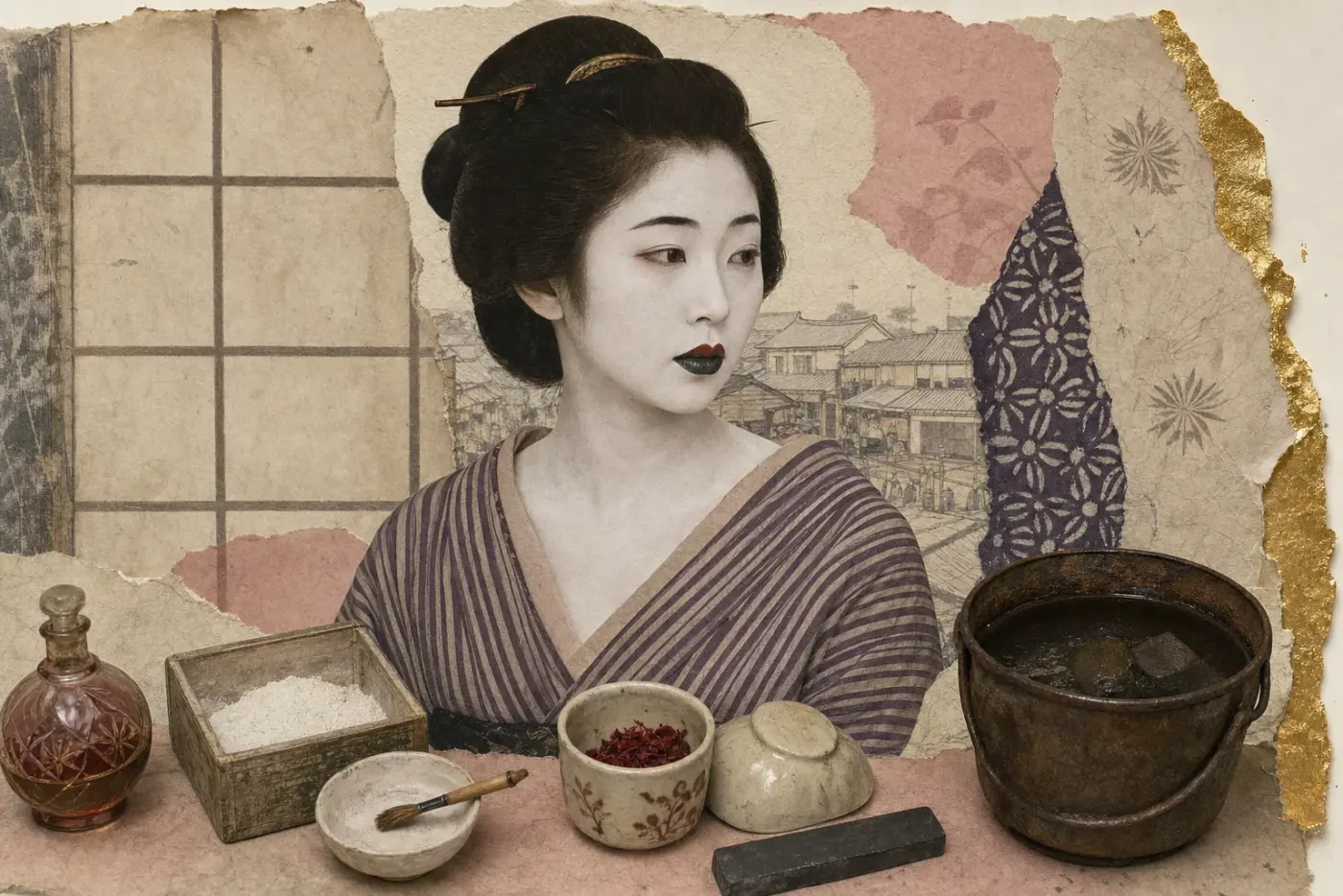
In short
Japanese makeup worked in three colours — the white of oshiroi powder, the red of safflower beni, and the black of blackened teeth and painted brows — and the heavy white face now read as a geisha's was, for most of its history, ordinary makeup worn by ordinary women.
- 15min read
- 6chapters
- 11sources
Vivien
Your guide through time
Listen to this essay
14 min listenVivien reads our essays aloud, word for word — every date and every name in its place — so you can listen the way you would be walked through a gallery.
An AI voice, designed for History of Makeup
Japanese cosmetic practice worked with an unusually small palette: white for the face, red for the lips and the corners of the eyes, black for the teeth and the brows. Three colours, placed according to age, rank and marital status, and kept to with remarkable consistency for something over a thousand years.
Most of that system has gone. The blackened teeth and the shaved, redrawn brow disappeared within two generations. The white face survives, but chiefly on a stage — which is why it now reads as a geisha's face rather than as what it was for most of its history, which was unremarkable.
A Palette of Three Colours
The National Diet Library's survey of Japanese cosmetic culture states the constraint plainly: Edo women worked in three colours and no more — the white of oshiroi, the red of beni, the black of stained teeth and drawn brows.[1] Everything else was placement and proportion.
The arrangement was legible at a glance. Blackened teeth indicated a married woman; eyebrows removed and not redrawn indicated one who had borne a child.[1] Makeup here was less enhancement than notation — a way of writing status on the face where anyone could read it.
It was also written down. In 1813 a beautician, Sayama Hanshichimaru, published Miyako fūzoku kewaiden, illustrated by the painter Hayami Shungyōsai: a beauty handbook in three volumes and seven chapters, covering makeup, skincare, hairstyles and dress.[2] Cosmetic books for upper-class women already existed; this was the first written for commoners, and it went past the face to deportment — how to stand, how to correct a turned-out walk, how to make a short back look taller. It stayed in print for more than a century, until the woodblocks burned in the Great Kantō earthquake of 1923.[1]
Oshiroi, and What It Was Made Of
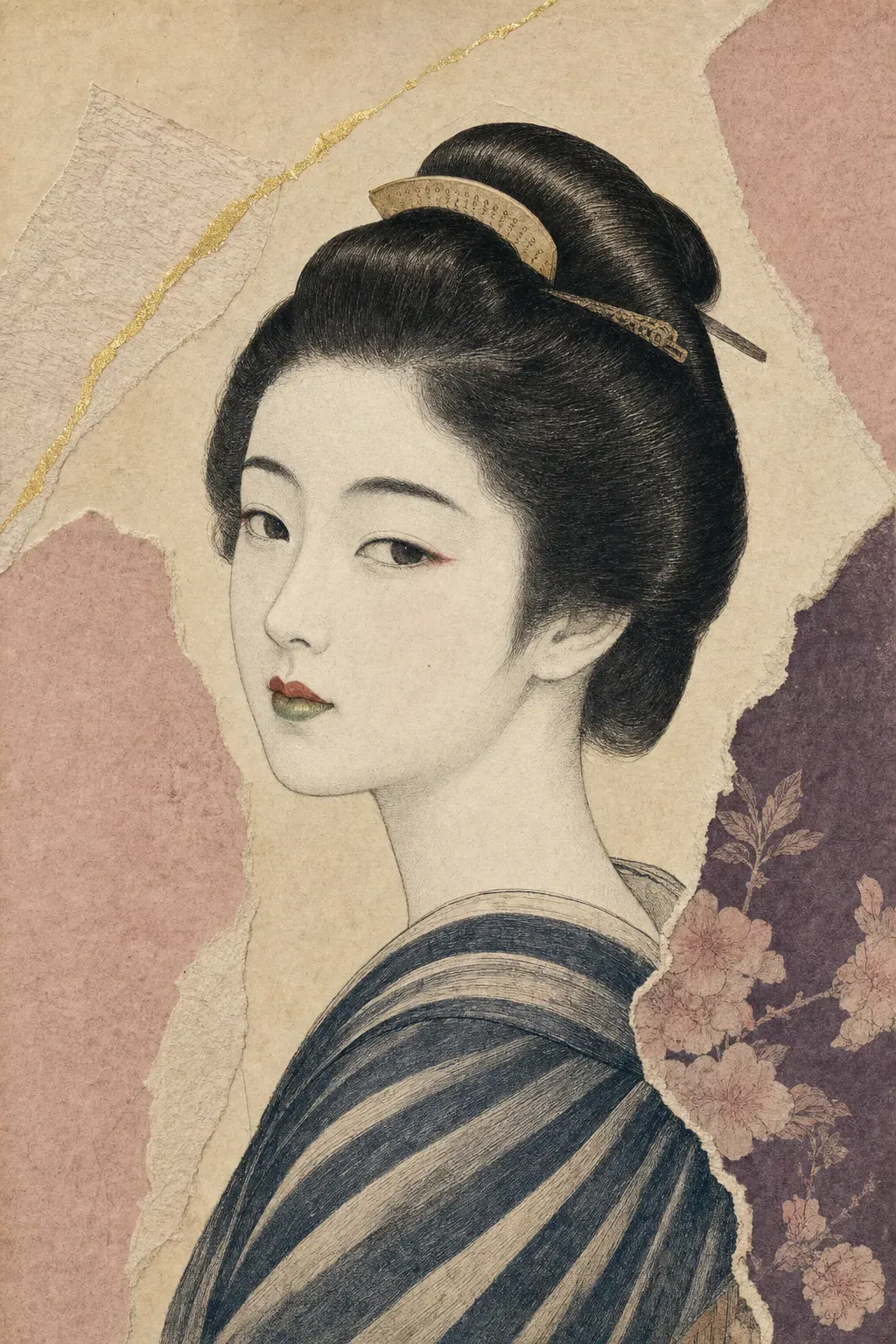
A history of Japanese pharmacy dates the arrival of lead from China to about the middle of the fifth century, and says that from then on it was the material of white powder.[3] That is one account resting on one line of one abstract, and it is given here as such rather than as a settled date. Better attested is what the powder had become by the Edo period, when two grades were in circulation: lead white, and keifun or light powder, based on mercury. Lead white was cheaper and took to the skin more readily, and it was the more widely used of the two.[4]
Oshiroi was not dusted on. A scented oil base, bintsuke-abura, went on bare skin first; the powder was then worked up with water and laid on with a finger or a brush to the face, the neck, the back of the neck and the upper chest — the areas a kimono leaves visible.[4] The Kewaiden sets out the sequence in detail: the forehead first, then both cheeks, the nose, around the mouth, the ears and the nape; a sheet of paper pressed over the face and swept with a wetted brush to settle the powder into the skin; dry powder brushed out level; a damp cloth to lift the excess from above the eyes and the outer corners so the finish would not read as heavy; and a little extra on the nose, to make the bridge look straight.[5]
Plant and mineral materials of many kinds had been used for white powder, but from the Edo period onward the lead white was the one in general use.[5] Rice starch and other plant powders stayed within reach of households that could not afford the mineral whites, and they did not perform as well: thinner, patchier, quicker to wear off. Whiteness was the first term of the period's account of beauty — iro no shiroki wa shichinan kakusu, a white skin hides seven flaws, was proverbial — and the powder that delivered it best was the one with lead in it.[4]
Beni: A Fraction of a Per Cent
Red came from safflower, Carthamus tinctorius, and the arithmetic of the plant explains why beni was expensive. The patent that describes an industrial route to the red gives the water-soluble yellows as about 60 per cent by weight of the dyestuff the petals contain, and carthamin, the red, as 0.4 to 0.6 per cent by weight — a figure it states without naming its denominator, which is why the two numbers are given here separately rather than as one ratio.[6] Either way the red is the remainder: it is recovered from what is left behind once the yellow has been washed out with water.[6]
Applied thinly, beni is a clear pink. Applied thickly and allowed to dry, it turns iridescent: a metallic green-black sheen sitting over the red. In the Bunka and Bunsei years (1804–1830) it became fashionable to build that sheen on the lower lip alone, leaving the upper lip red — sasa-iro, bamboo-leaf colour.[7] The pigment was bought in small cups, benizara or benichoko, glazed inside with the dried colour; it was lifted with a wet fingertip or brush and laid on in successive thin coats, and the cup was turned face down on the dressing table afterwards to keep the colour from oxidising.[8]
A momme of beni for a momme of gold, the saying went.[7] This is worth pausing on, because it inverts the usual account of cosmetics as a pursuit of the natural. A green-black lower lip is not a naturalistic effect. It is a demonstration of how much safflower a household could spend, made visible in the only way a pigment that scarce can be shown off. The Kewaiden gives the economy version for those who could not: lay down a ground of ink or lamp soot, and put the little beni you have over the top.[7]
Ohaguro and Hikimayu
Ohaguro, tooth blackening, appears to have been practised in Japan from the fourth century onward: blackened teeth have been found on buried remains and on haniwa figures of the Kofun period, and a Chinese chronicle of the Wei calls Japan the land of black teeth.[9] The dye was made at home. Rice-rinsing water, vinegar, tea, sake and scrap iron were left to ferment into an iron acetate solution — it stank, by every account — and the teeth were painted with it and set with the tannin in powdered gallnut.[10] The black is an iron-tannin complex formed on the tooth rather than a pigment laid over it, which is why it had to be renewed each morning. It is now generally held to have given the enamel some protection against decay and gum disease, while the acid preparation laid down beneath it is reported to have damaged the surface it sat on.[10]
Hikimayu was its companion. Women of the court and the warrior class shaved the eyebrows off at a set age and redrew them in prescribed shapes, high on the forehead, in soot-based ink; the rules were codified in etiquette manuals, one of which is given over to eyebrows alone. Commoners removed them at pregnancy or at the birth of a first child, and for the most part did not redraw them.[10]
The Meiji state moved against both, twice and in different registers. In 1870 the Dajōkan issued Proclamation No. 88, ending tooth-blackening and eyebrow-shaving among the nobility who had undergone genpuku.[11] In 1873 it announced that the Empress and the Empress Dowager had given up ohaguro and eyebrow ink — the court withdrawing its own example rather than legislating anyone else's.[10] Neither ended the practice. A woodblock print of about 1877, four years after the announcement, shows a woman's teeth painted solidly black, and by the middle of the Meiji years an instant powdered ohaguro that needed only water was on sale.[10]
Then the lady herself took a box of white powder, and laid it on her face, ears, and neck … the teeth were blackened, or rather reblackened … and then a patch of red was placed upon the lower lip.
The Lead, and the Long Argument About It
The cost is measurable. Bone from an Edo-period samurai cemetery gave a median lead concentration of 1,241 micrograms per gram of dry bone in children of three and under, and 462.5 in those aged four to six, against 14.3 in adult men and 23.6 in adult women. The authors attribute the exposure to lead-based white powder reaching infants through nursing and close contact.[13] The National Diet Library's account of the same route is more specific: the wet nurses who served upper-class households wore the powder from the face down over the neck and chest, and the infants who fed from them suffered anaemia and digestive failure, some of them dying with the signs of meningitis.[14]
It became a public matter in 1887. Months after a command performance at the Foreign Minister's residence, the leading onnagata of the day, Nakamura Fukusuke, collapsed on stage, and the director of the Japanese Red Cross Hospital diagnosed chronic lead poisoning from white powder.[14] In 1900 the Home Ministry issued Ordinance No. 17, the Regulations for the Control of Harmful Colouring Materials, whose Article 4 barred lead and other harmful colourants from cosmetics.[16] White powder was then held back from it, under a supplementary article and expressly for the time being, because no lead-free powder yet existed to replace it.[14] The rule that answered the problem carved out the product that caused it.
The replacement arrived four years later. Misono oshiroi, the first lead-free white powder made in Japan, went on sale in 1904 and took the market so completely that it was known as the Misono of the powder trade.[14] Its harmlessness had been certified by three pharmacologists, two of whom — Jun'ichirō Shimoyama and Yoshizumi Tahara — are named on the surviving leaflet: the first case of a pharmacist involved in certifying the quality of a cosmetic in Japan before the Pharmaceutical Affairs Law was enacted.[15]
The shelves took another three decades to clear. In 1901 Shiseido advertised its Euthérmine lotion on the claim that white powder laid over it would not cause poisoning even if it was the conventional domestic lead kind — a rival product selling around the law rather than the law ending the product.[14] Misono was still marking itself out as purely lead-free in 1916.[14] The end came by ordinance: in October 1930 the Home Ministry issued Ordinance No. 30, which allowed the manufacture of lead white powder until the end of 1933 and its sale until the end of 1934.[17] Almost fifty years after Fukusuke fell, the three colours had outlasted the argument about what one of them was made of — and then lost it.
The Geisha Face Is a Late and Narrow Case
The image that now stands for Japanese makeup — dense white, a small red mouth, a drawn line at the eye, the nape left unpainted in points — belongs to a profession rather than to a country. It is the working face of geisha and their apprentices, and it survives because performance preserves conventions that ordinary life discards.[18] The kabuki stage kept the white too, and kept it long enough to be where the lead problem surfaced: it was an onnagata's collapse, not a customer's, that put white powder in the newspapers.[19]
Everywhere else it went. Through the Meiji, Taishō and early Shōwa decades the everyday face changed by stages: Western-style soaps, lotions and creams arrived and were taken up; the modern girls of the 1920s drew the mouth wide and thin instead of small and full, and added rouge to it; advertising through the 1930s shifted its pitch from pallor to health and offered darker shades to go with it; and after the war lipstick displaced the powder-centred routine altogether.[19]
So what is preserved on stage is not the tradition. It is one late, specialised branch of it, kept by an institution with a reason to keep it, long after the thing it branched from had quietly stopped.
Sources
- [1, 5, 7, 10, 14, 19]Kaleidoscope of Books No. 29: Make-up Then and Now — Cosmetic Culture from Edo to Showa National Diet Library, Tokyo, 2021.View source (opens in a new tab) Accessed 2026-09-22.
- [2]Descriptions of a common belief in an 1813 Japanese beauty handbook regarding the influence of striped clothing on perceived body shape i-Perception 13(5), 2022.View source (opens in a new tab) Accessed 2026-09-22.
- [3, 15]Background of the Fabrication of Japan's First Lead-free White Powder and the Pharmacologists Who Certified Its Harmlessness The Japanese Journal for the History of Pharmacy 57(2), 93-100, 2022.View source (opens in a new tab) Accessed 2026-09-22.
- [4, 8, 9]Beauty Secrets in Japanese Prints Asian Art Newspaper, 27 October 2020, 2020.View source (opens in a new tab) Accessed 2026-09-22.
- [6]US Patent 5,750,379 — Process for the production of carthamin United States Patent and Trademark Office; assigned to Toyo Ink Manufacturing, 1998.View source (opens in a new tab) Accessed 2026-09-22.
- [11]Dajōkan Proclamation No. 88 of Meiji 3 (1870): Kazoku genpuku no tomogara, senshi sōbi wo teishi su — tooth-blackening and eyebrow-shaving discontinued among nobles who have undergone genpuku Dajōkan, Empire of Japan; printed in Hōrei Zensho, Meiji 3 (Naikaku Kanpōkyoku), 1870.
- [12]Unbeaten Tracks in Japan John Murray, London (text of the 1911 edition); Project Gutenberg eBook #2184, 1880.View source (opens in a new tab) Accessed 2026-09-25.
- [13]Severe lead contamination among children of samurai families in Edo period Japan Journal of Archaeological Science 38(1), 23-28, 2011.View source (opens in a new tab) Accessed 2026-09-22.
- [16]Home Ministry Ordinance No. 17 of Meiji 33 (1900): Yugaisei chakushokuryō torishimari kisoku — Regulations for the Control of Harmful Colouring Materials Home Ministry, Empire of Japan; promulgated in Kanpō no. 5034, 17 April 1900, 1900.
- [17]Home Ministry Ordinance No. 30 of Shōwa 5 (1930): ending the manufacture and sale of lead white face powder Home Ministry, Empire of Japan; promulgated in Kanpō no. 1145, 22 October 1930, 1930.
- [18]Geisha University of California Press, 1983.
Filed under