Arinobu Fukuhara and the Pharmacy That Became Shiseido
A pharmacist opened a Western-style dispensary in Ginza in 1872. Its cosmetics outgrew its medicine.
In short
Shiseido began in 1872 as Arinobu Fukuhara's Western-style pharmacy in Ginza, was advertising its red skin lotion Eudermine by 1901, and spun its cosmetics off as a separate business in 1916.
- 3min read
- 5chapters
- 6sources
Vivien
Your guide through time
Listen to this essay
4 min listenVivien reads our essays aloud, word for word — every date and every name in its place — so you can listen the way you would be walked through a gallery.
An AI voice, designed for History of Makeup
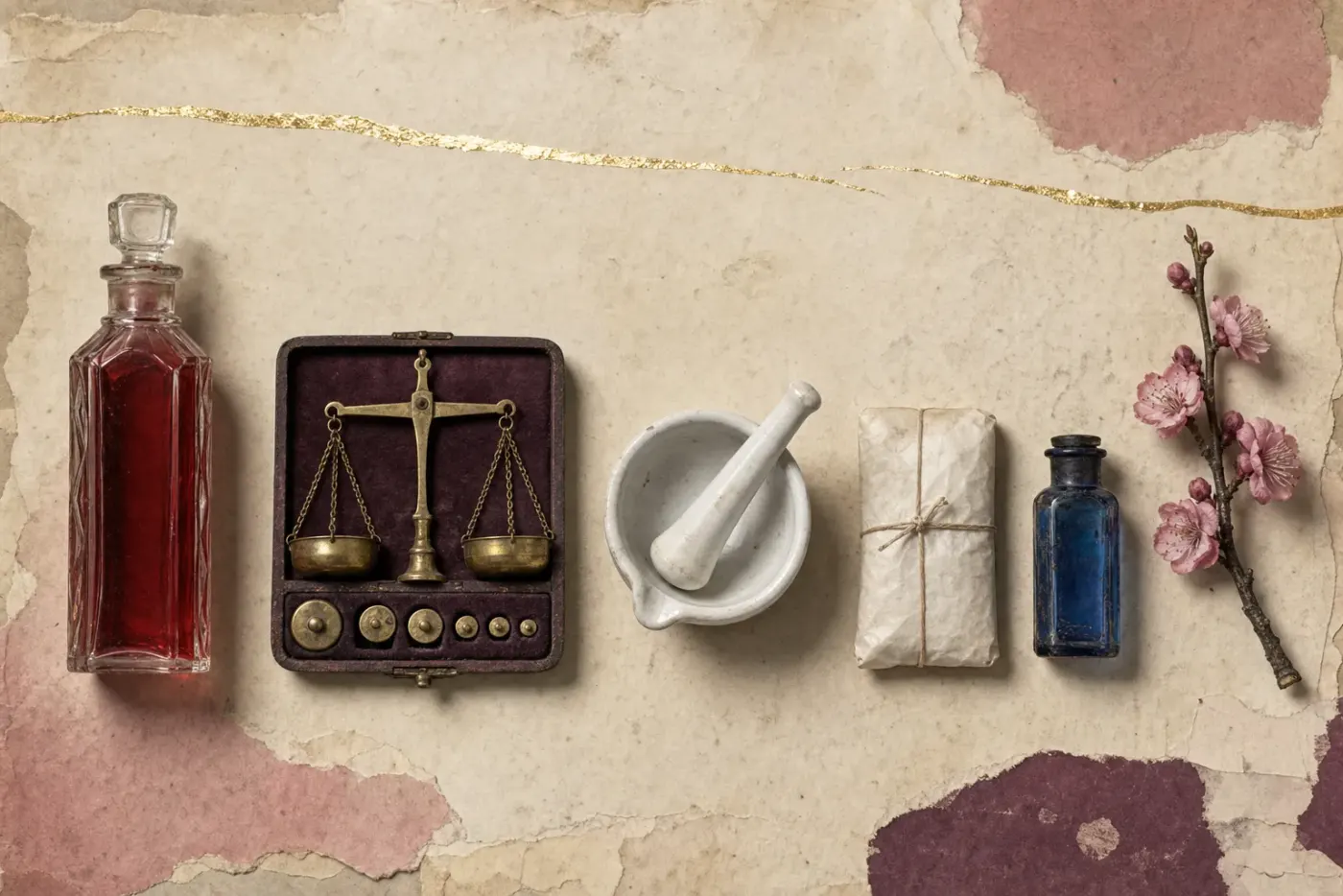
In 1872 Arinobu Fukuhara opened a pharmacy in the Ginza district of Tokyo, which the company that grew out of it describes as Japan's first private Western-style pharmacy. He had studied Western pharmacology, and he named the shop Shiseido, after a passage in the Book of Changes praising the virtue of the earth from which all things are born.[1]
Shiseido became one of the great global beauty companies.[2] It began as a dispensary, and the order matters.
The Old Face Retired
The pharmacy opened into a country whose court was giving up its own cosmetic order. In 1870 the government had told members of the new peerage who had come of age to stop blackening their teeth and shaving their eyebrows,[3] and in 1873 the imperial household announced that the Empress and the Empress Dowager had given them up as well.[4]
The face that had marked status for centuries was being retired by decree and by example in the same years that a new kind of cosmetic, sold on the authority of Western science, arrived to take its place. A pharmacist in Ginza was well placed for that change.
The Lead Problem
In 1900 the Home Ministry prohibited lead and other harmful colouring materials in cosmetics, and then held white powder back from the prohibition, expressly for the time being, because no lead-free substitute yet existed.[7] The substitute, when it came, was not Shiseido's. It was Misono oshiroi, launched in 1904,[8] and certified harmless by three pharmacologists.[9]
That is the market a pharmacist's cosmetics entered. Safety had become something a manufacturer could claim and a scientist could vouch for, and a company that had begun as a dispensary was well placed to trade on it.
A cosmetic sold from a pharmacy came with a claim about science that one sold from a stall did not.
Red Water
Shiseido's red skin lotion, Eudermine, was being advertised by 1901; Japan's national library reproduces the copy in its history of Japanese make-up.[10] In 1916 the company spun its cosmetics department off as a separate business and opened a shop devoted to cosmetics alone.[11]
The sequence, a pharmacy first, a lotion sold on the pharmacy's authority, then a cosmetics business standing on its own, explains why the company's early products were sold as much on science as on beauty. The medicine was the credential.
What Is Not Known
Much of the founder's own career. The most accessible account of the early company is the company's own, which is a primary source about what Shiseido wants remembered rather than an independent history, and should be read with that in mind.[12]
Sources
- [1, 5, 11, 12]The History of Shiseido in Five MinutesView source (opens in a new tab) Accessed 2026-09-25.
- [2]Beauty Imagined: A History of the Global Beauty Industry Oxford University Press, 2010.
- [3]Dajōkan Proclamation No. 88 of Meiji 3 (1870): Kazoku genpuku no tomogara, senshi sōbi wo teishi su — tooth-blackening and eyebrow-shaving discontinued among nobles who have undergone genpuku Dajōkan, Empire of Japan; printed in Hōrei Zensho, Meiji 3 (Naikaku Kanpōkyoku), 1870.
- [4, 8, 10]Kaleidoscope of Books No. 29: Make-up Then and Now — Cosmetic Culture from Edo to Showa National Diet Library, Tokyo, 2021.View source (opens in a new tab) Accessed 2026-09-22.
- [6, 9]Background of the Fabrication of Japan's First Lead-free White Powder and the Pharmacologists Who Certified Its Harmlessness The Japanese Journal for the History of Pharmacy 57(2), 93-100, 2022.View source (opens in a new tab) Accessed 2026-09-22.
- [7]Home Ministry Ordinance No. 17 of Meiji 33 (1900): Yugaisei chakushokuryō torishimari kisoku — Regulations for the Control of Harmful Colouring Materials Home Ministry, Empire of Japan; promulgated in Kanpō no. 5034, 17 April 1900, 1900.
Filed under