Liquid foundation
The most adjustable form of base: sheer or full, matte or dewy, and applied with a sponge, a brush or the fingers. What it is, how to choose one, how to wear it — and where it came from.
Liquid foundation is pigment suspended in a fluid, usually an emulsion, spread over the skin to even its tone — the most adjustable form of base, from sheer to full coverage and matte to dewy.
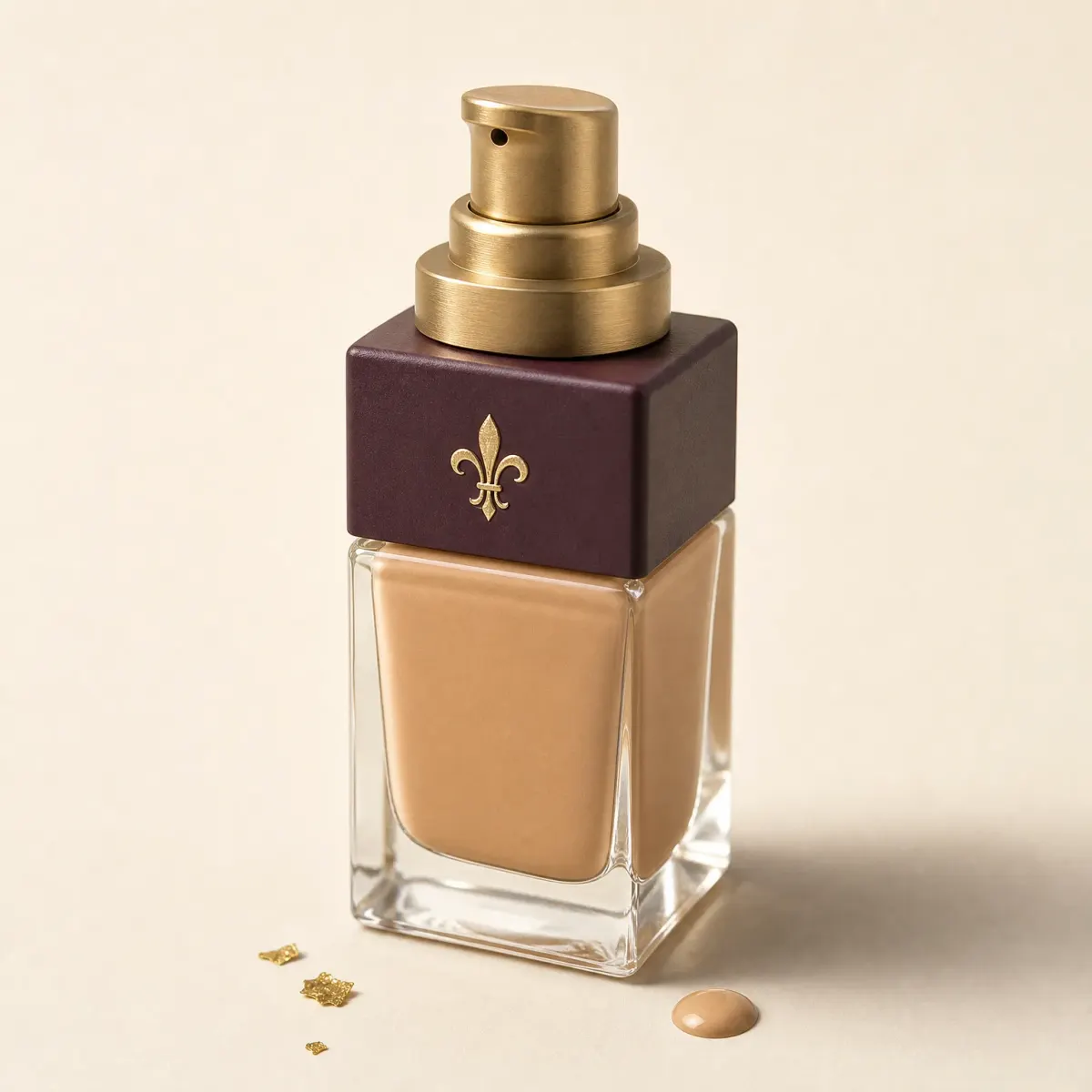
Our picks
Chosen to cover the range of finishes, coverage and budgets, from drugstore to prestige. Each opens where its maker sells it — on Amazon, or at the house’s own shop for those that do not sell there — and you choose your shade on that page.
As an Amazon Associate I earn from qualifying purchases. Affiliate links — we may earn a commission at no extra cost to you. How this works
GlowPrestige Dior
Dior Forever Skin Glow
Dior’s radiant foundation: hydrating, with a glow finish that reads as healthy skin rather than shine.
- Glow
- Hydrating
Long wearPrestige Estée Lauder
Double Wear Stay-in-Place Foundation
The long-wear reference point: a matte, oil-free formula built to stay put from morning to night.
- Matte
- Buildable
- Oil-free
Oily skinDrugstore Maybelline New York
Fit Me Matte + Poreless Foundation
An inexpensive matte, oil-free formula for normal to oily skin.
- Matte
- Medium
- Oil-free
Oil controlPrestige Bobbi Brown
Weightless Skin Foundation SPF 15
From the makeup artist who argued foundation should match skin, not mask it: oil control with a natural-matte finish that stops short of flat.
- Natural matte
- Medium
- SPF 15
Healthy glowPrestige Chanel
Les Beiges Healthy Glow Foundation Hydration and Longwear
Light, luminous coverage for skin that should look rested rather than made up.
- Luminous
- Light to medium
- Hydrating
Shade matchingDrugstore L'Oréal Paris
True Match Super-Blendable Foundation
Shades coded warm, neutral and cool, which makes matching easier than guessing from a name.
- Natural
- Medium
- Undertone-coded shades
Pore blurringPrestige Charlotte Tilbury
Airbrush Flawless Foundation
Full coverage that blurs pores and resists transfer — the prestige choice for long nights and photographs.
- Natural matte
- Full
- Transfer-resistant
RadiantPrestige Laura Mercier
Flawless Lumière Radiance-Perfecting Foundation
The one to choose when matte formulas look dull on drier skin: luminous, hydrating, buildable.
- Radiant
- Medium, buildable
- Normal to dry skin
Combination skinDrugstore Revlon
ColorStay Longwear Makeup for Combination/Oily Skin
A long-wear matte formula made specifically for combination and oily skin.
- Matte
- Medium to full
- SPF 15
Natural glowPrestige Armani Beauty
Luminous Silk Natural Glow Blurring Foundation
The newest Luminous Silk: a natural glow with a soft-focus blur, for skin that should look like skin.
- Natural glow
- Medium, buildable
- Blurring
With SPFPrestige Clinique
Even Better Clinical Serum Foundation SPF 25
A serum-textured foundation with broad-spectrum SPF 25 — full coverage that still reads as skin.
- Full, buildable
- SPF 25
EverydayDrugstore Neutrogena
Healthy Skin Liquid Makeup SPF 20
An everyday medium-coverage foundation with broad-spectrum SPF 20, for normal to dry skin.
- Natural
- Medium
- SPF 20
Full-coverage mattePrestige YSL Beauty
All Hours Foundation
Full coverage with a natural-matte finish, made to last through long days.
- Natural matte
- Full
- 40 shades
Soft glowPrestige Hourglass
Ambient Soft Glow Foundation
A diffused glow rather than shine — radiance for skin that does not want to look wet.
- Soft glow
- Medium, buildable
Full coverageDrugstore NYX Professional Makeup
Can't Stop Won't Stop Full Coverage Foundation
Full coverage and a waterproof matte finish — for evenings, photographs and heat.
- Matte
- Full
- Waterproof
Natural mattePrestige Lancôme
Teint Idole Ultra Wear Foundation
A long-wearing natural-matte finish for long days, at medium to full coverage.
- Natural matte
- Medium to full
Skincare hybridPrestige NARS
Light Reflecting Advanced Skincare Foundation
Foundation made as skincare as much as colour, with a natural, radiant finish at buildable medium coverage.
- Natural, radiant
- Medium, buildable
LightweightDrugstore L'Oréal Paris
Infallible Fresh Wear Lightweight Foundation
Lighter than most long-wear formulas: buildable coverage with a fresh rather than flat finish.
- Natural
- Buildable
- Waterproof
Heat and humidityPrestige Shiseido
Synchro Skin Self-Refreshing Foundation SPF 30
Made for long, warm days: waterproof and transfer-resistant, with SPF 30.
- Medium, buildable
- SPF 30
- Waterproof
Soft mattePrestige Tom Ford Beauty
Architecture Soft Matte Blurring Foundation
Matte without the flatness: a lightweight formula that blurs rather than masks.
- Soft matte
- Lightweight
- Blurring
Budget matteDrugstore COVERGIRL
TruBlend Matte Made Liquid Foundation
A straightforward matte formula for shine control on a small budget.
- Matte
- Medium
Liquid foundation is pigment carried in a fluid — most often an emulsion of water and oils — spread over the skin to even its tone. The colour comes from a small palette: iron oxides in a run of yellows, reds, browns and black, and titanium dioxide as the white that lightens them and governs how much light the film returns.[1] Everything else in the bottle decides how that colour behaves: how thinly it spreads, how long it stays, and whether it dries flat or with a sheen.
Of all the forms a base is sold in — powder, stick, cushion, cream — liquid is the most adjustable. It can be sheered out with a damp sponge or built up in layers, loosened with a drop of moisturiser or lifted with a drop of illuminator, and it moves with the face rather than sitting on top of it. That flexibility is the whole case for it.
Finish and coverage
Two choices decide most of what a liquid foundation will do. Finish is how the surface reads: a matte formula absorbs light and holds down shine; satin, or natural, sits between; a dewy or radiant one reflects light and reads as fresh skin — and, on skin that makes its own oil, as shine. Coverage is how much of the skin shows through: sheer and light let freckles and texture stay visible, medium evens tone, and full covers discolouration outright.
They are separate decisions. A full-coverage formula can be dewy and a sheer one matte, and coverage is built in the application as much as in the bottle: one thin layer, with a second only where it is needed, usually looks more like skin than a single heavy one. As a starting point, oilier skin tends to suit matte, long-wear formulas and drier skin satin or dewy ones — but it is a place to start testing, not a rule.
How to apply it
Start on moisturised skin, with primer only where it earns its place — a mattifying one on the T-zone, a smoothing one over large pores. Dot a little foundation on the centre of the face, where most people need the most coverage, and work outward, so the edges of the face get the least product and the hairline and jaw blend without a line.
The tool changes the finish. A damp blending sponge, bounced rather than dragged, presses the formula into the skin and gives the most skin-like result. A dense flat-top brush, buffed in small circles, gives more coverage and a smoother surface. A duo-fibre stippling brush dots it on for an airbrushed finish, and fingers warm the formula and suit sheer coverage. Set only what creases or shines — under the eyes, the sides of the nose — with a light layer of powder, pressed on rather than swept.
Finding your shade
Match foundation on the jaw, not the wrist or the back of the hand, and look at it in daylight: the right shade disappears into the neck. Undertone matters as much as depth. Two shades of the same lightness can lean warm (golden, yellow), cool (pink, red) or neutral, and the wrong lean shows as a grey or orange cast rather than as a shade that is simply too light or too dark.
Many formulas deepen slightly as they dry, so judge a swatch after a few minutes rather than at once. And if no single shade is right, two can be: a lighter and a deeper shade from the same range, mixed on the back of the hand, is how makeup artists have always filled the gaps between the bottles.
Where it came from
The base as a single product is younger than it looks. Faces were long evened with powders and, on the stage, with greasepaint; one of the best-documented steps from stage to street came from the film studios. Max Factor's Pan-Cake, a cake applied with a damp sponge, was developed for Technicolor, first used on a feature released in 1937, and sold to the public from 1938.[2][3]
Liquid arrived by a less obvious route. When stockings grew scarce in the Second World War, women painted their legs instead, and cosmetic stockings were worn from roughly 1940 to 1946.[4] When real stockings returned the research outlived the product: many companies used what they had learned to develop new liquid and cream face powders, and the true beneficiary was the new make-up bases and foundations of the 1940s and 1950s.[4][5] Most of those post-war liquids were emulsions — surfactants, suspending and spreading agents, pigments and fillers — sold under names like Liquid Beauty (1946), Revlon's Touch and Glow (1950), Richard Hudnut's Flatter-Glo (1953) and Max Factor's Hi-Fi (1955).[5]
The largest change since has not been in the formula but in who it is made for. Eunice W. Johnson launched Fashion Fair Cosmetics in 1973 for women of darker skin tones who were often unable to find a match.[6] An analysis of published foundation shades in 2018 still found very few brands reaching the deepest tones — Maybelline and L'Oréal among the exceptions, Maybelline having added sixteen mostly darker shades in May 2017 — and 31 of Make Up For Ever's 40 Ultra HD shades sitting in a light-to-tanned band.[7] Shade range is now one of the first things worth checking, alongside finish and coverage.
The techniques
- Dot and blend
- Place small dots of product, then blend them outward.
- Buff
- Work in small circles with a dense brush until no edge remains.
- Stipple
- Bounce the tips of the brush against the skin for an airbrushed, dotted-in finish.
- Pat
- Tap lightly with a fingertip or damp sponge so product melts in rather than moves.
Sources
- [1]Color Foundation and Base Formulas Deciphered Cosmetics & Toiletries, 2013.View source (opens in a new tab) Accessed 2026-09-22.
- [2]Pan-Cake Make-up Cosmetics and Skin.View source (opens in a new tab) Accessed 2026-09-22.
- [3]Pan-Cake Make-up Cosmetics and Skin, 2026.View source (opens in a new tab) Accessed 2026-09-22.
- [4]Cosmetic Stockings (Leg Make-up) Cosmetics and Skin, 2012.View source (opens in a new tab) Accessed 2026-09-25.
- [5]Liquid Face Powders Cosmetics and Skin, 2014.View source (opens in a new tab) Accessed 2026-09-25.
- [6]New documentary captures legacy of Fashion Fair, one of the first Black-owned makeup lines NBC News, 2022.View source (opens in a new tab) Accessed 2026-09-22.
- [7]The Diversity of Makeup Shades The Pudding, 2018.View source (opens in a new tab) Accessed 2026-09-22.
What to apply it with

Blending sponge
A soft, teardrop-shaped sponge, used damp, that presses liquid and cream into skin.
Read the guide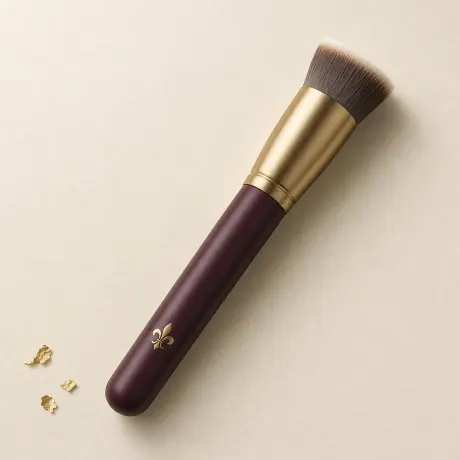
Flat-top buffing brush
A dense brush cut straight across, which buffs liquid and cream into skin with no streaks.
Read the guide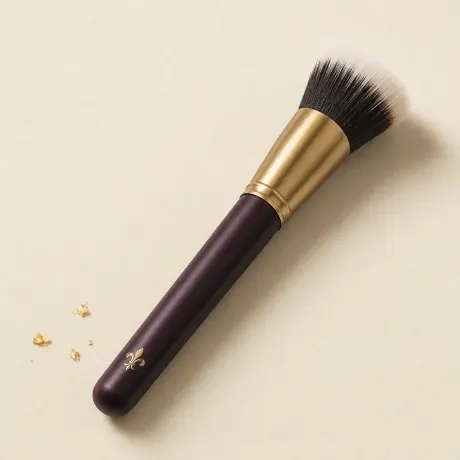
Stippling brush
Two layers of fibre — long and sparse over short and dense — that dot product on for an airbrushed finish.
Read the guide
Flat foundation brush
A flat synthetic brush with a rounded edge, for painting foundation on like a primer coat.
Read the guide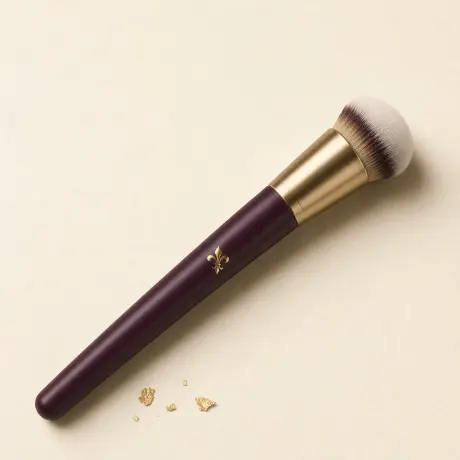
Domed buffing brush
A dense, rounded brush on a full-length handle, for buffing cream and liquid with more control than a kabuki.
Read the guide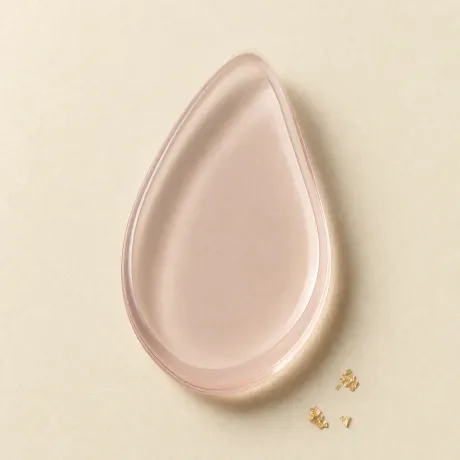
Silicone applicator
A flexible, non-absorbent silicone pad that spreads product without soaking any up.
Read the guide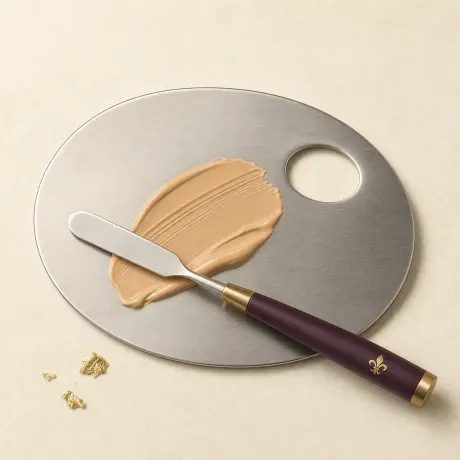
Mixing palette and spatula
A small steel palette with a thumb hole and a metal spatula, for mixing and warming product hygienically.
Read the guide
Other kinds of foundation & tinted base
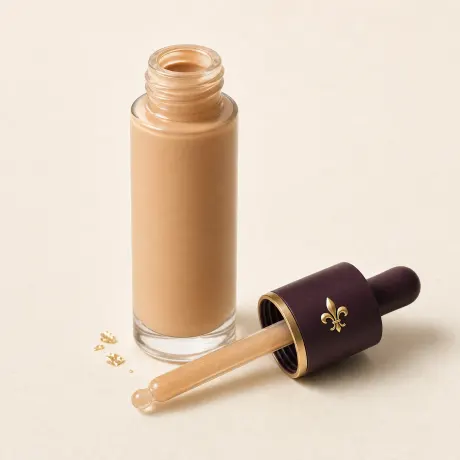
Skin tint
A watery, sheer base that evens tone while letting skin show through.
Read the guide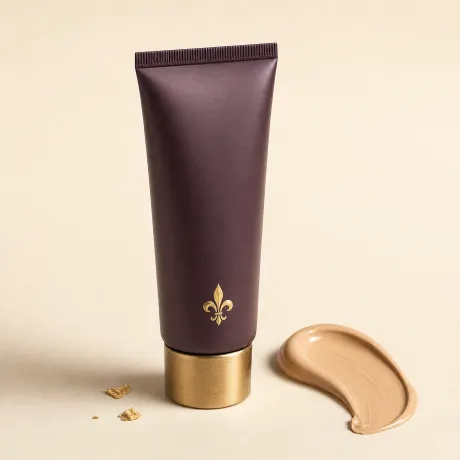
Tinted moisturiser
A moisturiser with a little pigment in it — often with sunscreen — for the lightest base.
Read the guide
BB cream
A skincare-leaning base that tints, smooths and usually protects in one step.
Read the guide
CC cream
A light base built to neutralise redness or sallowness rather than simply cover it.
Read the guide
Cream foundation
A dense, emollient base with high coverage, suited to dry skin and to photography.
Read the guide
Stick foundation
Cream foundation set into a twist-up stick, for targeted coverage and travel.
Read the guide
Powder foundation
Foundation pressed into a powder cake, for a quick matte base in one step.
Read the guide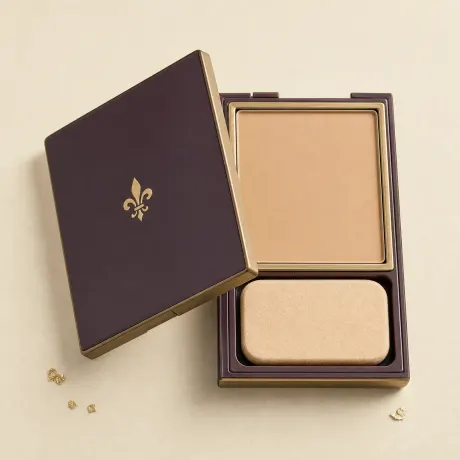
Two-way cake foundation
A pressed foundation made to be used dry for a sheer finish or with a damp sponge for coverage.
Read the guide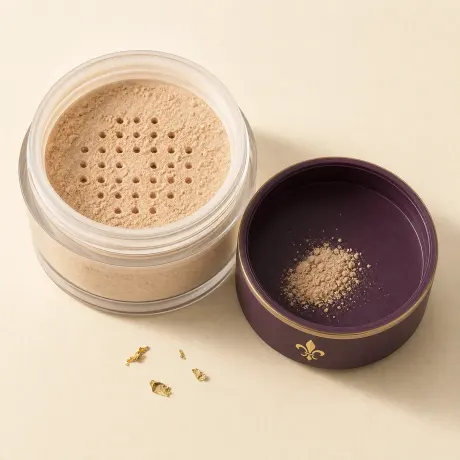
Loose mineral foundation
Foundation as a loose, finely milled mineral powder, buffed in to build coverage.
Read the guide
Cushion foundation
Liquid foundation soaked into a sponge cushion inside a compact, picked up with a puff.
Read the guide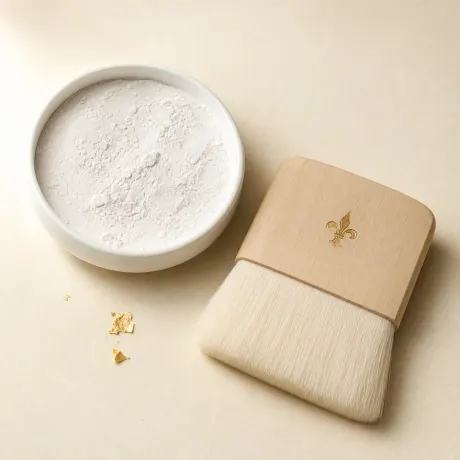
Oshiroi
Japanese white face powder, mixed with water to a paste and laid on with a broad flat brush.
Read the guide