BB cream
A tinted cream that was a German dermatologist’s balm before it was Korea’s everyday base. What a BB cream is, how it differs from a tinted moisturiser or a CC cream, how to wear one — and what the record says about its history.
A BB cream — originally a “blemish balm”, often sold in the West as a “beauty balm” — is a tinted cream that combines skincare, usually a sunscreen and light-to-medium coverage in one step: more covering than a tinted moisturiser, less than a foundation.
Our picks
Chosen to span the category’s history and its range, from the German original to Korean and drugstore versions, across budgets from drugstore to prestige. These are the BB creams we could confirm as sold in the US by their makers; each opens on Amazon, sold by the maker or by Amazon itself, or at Sephora, and you choose your shade on that page. Sunscreen figures are the makers’ claims.
As an Amazon Associate I earn from qualifying purchases. Affiliate links — we may earn a commission at no extra cost to you. How this works
German originalPrestige Dr. Schrammek
Blemish Balm Classic
The balm the category is named after, still sold by the German house that makes it as covering care.
- Covering
- Tinted balm
Everyday sheerDrugstore Maybelline New York
Dream Fresh BB Cream
A sheer, oil-free drugstore BB with a sunscreen — the Western “beauty balm” at its simplest.
- Sheer tint
- SPF 30
- Oil-free
Korean importPrestige Dr.Jart+
Premium BB Beauty Balm SPF 30
From the Korean brand that brought BB creams to Sephora in 2011, in its current formula.
- SPF 30
- Niacinamide
Gel-cream BBMid-range Kosas
BB Burst Tinted Gel Cream
A Western BB in gel-cream form, closer to a tinted moisturiser than to the Korean originals.
- Gel-cream
- Buildable
- Copper peptides
More coverageDrugstore Missha
M Perfect Cover BB Cream SPF 42
A Korean BB that covers more than most Western ones, with a high sunscreen claim, on a small budget.
- SPF 42
- Buildable
- Natural finish
Soft mattePrestige Erborian
BB Cream with Ginseng
A BB cream with a soft-matte finish, for skin that finds most BB creams too shiny.
- Soft matte
- Buildable
- SPF 20
Sheer and simpleDrugstore Physicians Formula
Super BB All-in-1 Beauty Balm Cream
A sheer, moisturising drugstore BB for days that need very little.
- Sheer
- Moisturising
Dewy, veganMid-range Purito
Cica Clearing BB Cream
A Korean BB with a dewy finish and centella, sold as vegan.
- Light to medium
- Dewy
- Vegan
A BB cream is a tinted cream that sets out to do several jobs at once: moisturise, even the tone, blur what is uneven and, in most versions, protect with a sunscreen. The trade defines it only loosely, as serum, moisturiser, primer, foundation and sunscreen in one. Most are oil-in-water emulsions, and they carry markedly less pigment than a foundation — typically between 0.5 and 5 per cent — relying on light-diffusing powders for the rest of the effect.[1]
Among the light bases it sits in the middle. It covers more than a skin tint or a tinted moisturiser, and less than a foundation, and it is sold on more skincare claims than any of them. The CC cream is its sibling, pitched at correcting colour — redness, sallowness — rather than at covering. Even the letters are loose: “blemish balm” in Asia, “beauty balm” in parts of Europe,[1] and on several of the packs on this page, “beauty balm” again.
Choosing one
Decide first how much you want it to cover. BB creams made for Asian markets have generally been made to hide more; Western ones are usually more transparent.[2] A Korean BB will often do the work of a light foundation, and a drugstore “beauty balm” the work of a tinted moisturiser. Neither is wrong, but they are not interchangeable.
Then the finish. Many BB creams are formulated with oily skin in mind, with powders that take up sebum;[2] others are dewy. If yours goes flat and dry by lunchtime, the fault is the finish, not you. Check the shade range too: BB ranges are often shorter than foundation ranges, and some stop well before the deepest shades.
Finally, read the claims as claims. The sunscreen figure is the maker’s. Formulas sold in Asia often include skin-lightening or “brightening” ingredients;[2] if you would rather not wear one, the ingredient list, not the front of the pack, is where to look.
Getting the shade right
Shade is where BB creams most often go wrong. Korean ranges are usually named by number — 21 for a light shade, 23 for light-to-medium — and have long been short at the deep end, while some drugstore BBs come in only a handful of broad shades. Swatch on the jaw rather than the hand, and judge in daylight after a few minutes: many BB creams look paler or greyer in the tube than they do once settled on the skin.
If a BB cream looks ashy on deeper skin, more blending will not fix it; the shade is too light, too pink, or both. A warmer or deeper shade from the same range will, if the range has one. Where it does not, a tinted moisturiser or a skin tint from a house with a wider range is the better choice. The letters on the tube matter less than the match.
How to apply it
Use less than you think. A BB cream is thicker than a tint, and a pea-sized amount covers most faces. Dot it on the forehead, cheeks, nose and chin, then pat it in with the fingertips, working outward; patting presses it into the skin, where rubbing drags it and leaves it streaked at the edges.
A damp teardrop sponge sheers it out and lifts off what you do not need — the easiest way to make a Korean BB look like skin. Give it a minute to settle before judging the colour, then add concealer only where something still shows. Powder the parts that shine, and leave the rest.
Where it came from
The BB cream began in Germany, though the details depend on who is telling it. The company that still sells the German original — Blemish Balm, from the house of the dermatologist Christine Schrammek — dates it to 1967 and calls it “the original”.[3] A trade account of 2013 places it in the 1960s and says she made it to protect the skin of a patient after surgery — but its only reference for the story is a piece written by Garnier’s own experts for the Huffington Post.[4] Every account agrees on a German dermatologist. The year is the company’s, and the patient and the purpose are a story retold rather than a record.
Korea is where a treatment balm became an everyday base. The same trade account puts the balm’s arrival there in 1985, and says BB creams went on to take a large share of the Korean market — typically made to cover more than Western versions, and often sold with skin-lightening ingredients.[4] By the time they reached American shops they had been sold in Korea for years as all-in-one skincare and makeup. In early 2011 the Korean brand Dr. Jart introduced two BB creams at Sephora in the United States; versions from L’Oréal, Smashbox, Clinique, Jane Iredale, Stila and Dior followed.[5]
The crossing changed the product. Western BB creams were made sheerer, and the B, for “blemish” in Asia, was often read in the West as “beauty”.[4] But what travelled was less a formula than an idea — that a base could be sold as skincare — and it opened American shelves to Korean beauty more broadly.[5] The CC cream and the cushion compact came the same way.
The techniques
- Dot and blend
- Place small dots of product, then blend them outward.
- Pat
- Tap lightly with a fingertip or damp sponge so product melts in rather than moves.
Sources
- [1, 2, 4]The Anatomy of BB Creams Global Cosmetic Industry, 2013.View source (opens in a new tab) Accessed 2026-09-25.
- [3]Blemish Balm – The Original by Dr. med. Schrammek Dr. Schrammek USA (company website).View source (opens in a new tab) Accessed 2026-09-25.
- [5]Skin Care Products From South Korea Catch On in United States The New York Times, 2014.View source (opens in a new tab) Accessed 2026-09-25.
What to apply it with

Other kinds of foundation & tinted base
Liquid foundation
The standard base: pigment suspended in a fluid, in shades matched to the skin.
Read the guide
Skin tint
A watery, sheer base that evens tone while letting skin show through.
Read the guide
Tinted moisturiser
A moisturiser with a little pigment in it — often with sunscreen — for the lightest base.
Read the guide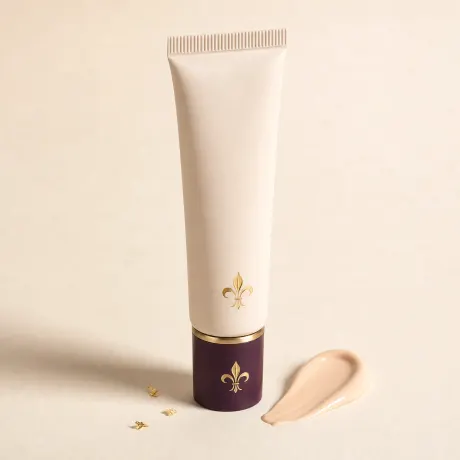
CC cream
A light base built to neutralise redness or sallowness rather than simply cover it.
Read the guide
Cream foundation
A dense, emollient base with high coverage, suited to dry skin and to photography.
Read the guide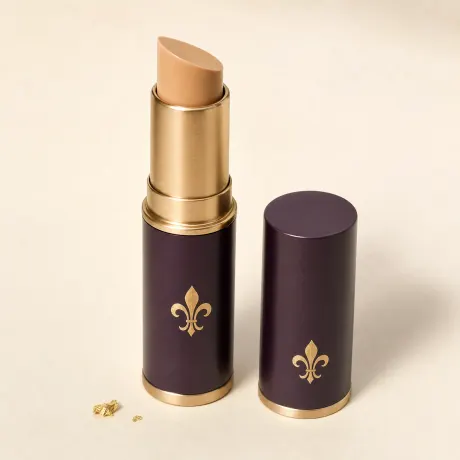
Stick foundation
Cream foundation set into a twist-up stick, for targeted coverage and travel.
Read the guide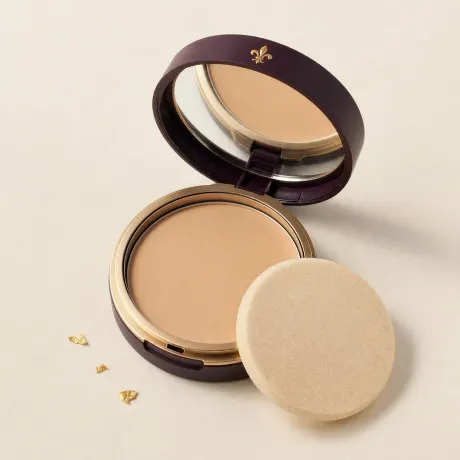
Powder foundation
Foundation pressed into a powder cake, for a quick matte base in one step.
Read the guide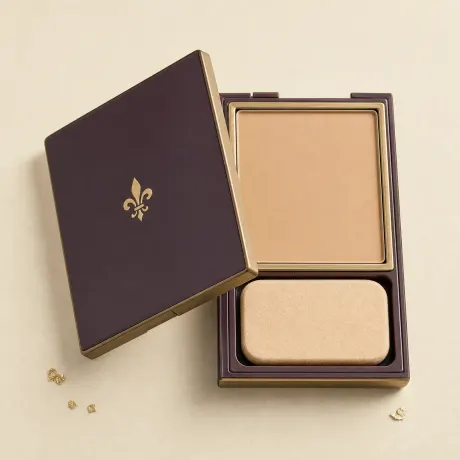
Two-way cake foundation
A pressed foundation made to be used dry for a sheer finish or with a damp sponge for coverage.
Read the guide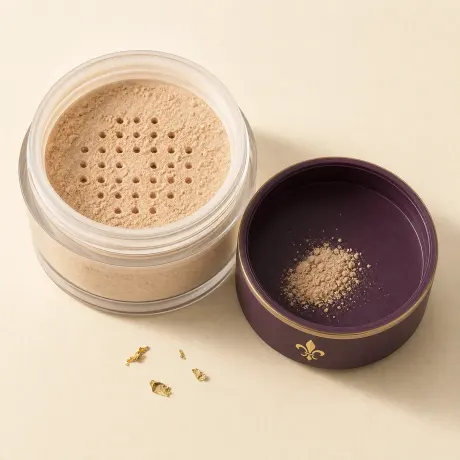
Loose mineral foundation
Foundation as a loose, finely milled mineral powder, buffed in to build coverage.
Read the guide
Cushion foundation
Liquid foundation soaked into a sponge cushion inside a compact, picked up with a puff.
Read the guide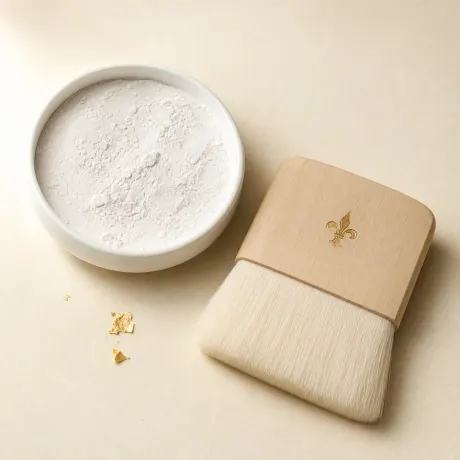
Oshiroi
Japanese white face powder, mixed with water to a paste and laid on with a broad flat brush.
Read the guide