Oshiroi
Japanese white makeup, worked with water and painted on with a broad flat brush: once ordinary makeup, now the white of kabuki, Japanese dance and maiko. What it is, how its makers say to apply it, why we link none, and what it used to be made of.
Oshiroi is Japanese white face makeup, sold as a paste, a liquid or a powder, that is worked with water and painted over the face and neck with a broad, flat brush on a base of oil to give an even, opaque white.

Oshiroi is Japanese white makeup. Specialist makers sell it as a paste, neri-oshiroi, as a liquid, mizu-oshiroi, and as a finishing powder. It is worked with water and painted on with a broad, flat brush over a base of oil, then blotted and set until the face and neck are an even, opaque white.[1][2] It is not a foundation in the Western sense. A foundation is meant to disappear into the skin; oshiroi makes a surface, and the surface is meant to be seen.
For most of its history it was ordinary makeup, the white in the palette of white, red and black that Edo women worked with.[3] Today it survives chiefly on the stage and in the geisha districts. In kabuki a white face marks a good or high-ranking character,[4] and makers still sell the white for the stage, for kabuki and for the makeup of maiko, the apprentice geisha of Kyoto.[1]
Paste, liquid or powder
The forms suit different jobs. A paste with a little oil in it, like Mitsuyoshi’s neri-oshiroi, can go straight onto the skin, or over the base oil for a stronger white.[5] The same house’s oil-free kabuki white is made to go over the oil, where it gives strong coverage, for a full stage face or Japanese dance.[6] A liquid white separates into two layers and is shaken before use; its maker says it covers yet stays translucent, and suggests it as a base as well.[7] Powder oshiroi, pressed over the top, sets the finish.[5]
How it is applied
The method has changed little. First comes a base oil. Mitsuyoshi, a Tokyo maker of stage makeup, tells users of its kabuki oil to warm it between the palms and spread it over the nape and the whole face, about two or three soya beans’ worth for the face and four or five for the nape, pressing it into the sides of the nose and around the eyes with the fingertips so that the white will go on without patches.[8]
Then the white. The maker’s instructions are to wet a flat brush until it no longer drips, work it back and forth over the paste until the bristles are loaded, add water, shape the tip and paint quickly; to press a sponge straight down on the white before the water evaporates, which lifts the moisture and fixes the colour; and to finish with powder.[9] The Edo handbook Miyako fūzoku kewaiden of 1813 gave its readers a similar order, the forehead first, then the cheeks, the nose and around the mouth, with a damp cloth to lift the white from above the eyes so that it would not look heavy.[10] In that period the white covered the face, the neck, the back of the neck and the chest.[11]
Buying it
The makers are few, and they sell at home. Mitsuyoshi, whose range includes neri-oshiroi, a powder oshiroi and the oil beneath them, takes orders and ships only within Japan,[12] and the cosmetics maker AIDA sells its liquid oshiroi under the Butaiya name through its own shop in Japan.[13] What reaches American readers comes through exporters and marketplace sellers, often as kits assembled from several makers.
If you buy that way, ask who made the white, and look for an ingredient list. The white pigments permitted in American cosmetics include titanium dioxide and zinc oxide, and no lead compound is among them.[14] A pot of unknown age or origin is not worth the risk. For a costume rather than a stage, a very pale cream foundation pressed on with a damp sponge and set with translucent powder gives an even white without the brushwork, and comes off with an ordinary cleanser.
Where it came from
The white came to Japan as a Chinese material: a history of Japanese pharmacy dates the arrival of lead white to about the middle of the fifth century, on the strength of a single source.[15] By the Edo period, when it was said that a white skin hides seven flaws, two grades were sold: lead white, the cheaper, which the skin took up more readily, and keifun, a dearer white based on mercury.[16] The cost is written in bone. In an Edo-period samurai cemetery, children of three and under carried a median of 1,241 micrograms of lead per gram of bone, against 23.6 in adult women, and the researchers attribute it to lead white face powder.[17]
Ending it took half a century. In 1887 the kabuki actor Nakamura Fukusuke, a player of women’s roles, collapsed on stage and was found to have chronic lead poisoning from white powder.[18] An ordinance of 1900 barred lead from cosmetic colours but held white powder back from the ban because no substitute existed;[19] Misono, the first lead-free white made in Japan, went on sale in 1904;[18] and an ordinance of 1930 allowed lead white to be made until the end of 1933 and sold until the end of 1934.[20] By then everyday faces were turning to Western creams and a healthier look.[18] The white stayed where a white face is a costume worn for work, on the stage and in the geisha districts, and the paste, the flat brush and the oil beneath are still made to paint it.[21]
The techniques
- Paint
- Brush or dab liquid colour directly onto the skin or lips.
- Pat
- Tap lightly with a fingertip or damp sponge so product melts in rather than moves.
Sources
- [1, 5, 9, 21]練白粉 (Neri-oshiroi), product page Mitsuyoshi stage cosmetics official online shop, Tokyo, 2026.View source (opens in a new tab) Accessed 2026-09-26.
- [2, 7, 13]舞台屋 水白粉 100mL (Butaiya mizu-oshiroi), product page AIDA Online Shop, 2026.View source (opens in a new tab) Accessed 2026-09-26.
- [3, 10, 18]Kaleidoscope of Books No. 29: Make-up Then and Now — Cosmetic Culture from Edo to Showa National Diet Library, Tokyo, 2021.View source (opens in a new tab) Accessed 2026-09-22.
- [4]Stock Characters and Makeup, Kumadori Makeup, Kabuki for Beginners Japan Arts Council, Cultural Digital Library.View source (opens in a new tab) Accessed 2026-09-25.
- [6]歌舞伎白粉 (Kabuki oshiroi), product page Mitsuyoshi stage cosmetics official online shop, Tokyo, 2026.View source (opens in a new tab) Accessed 2026-09-26.
- [8]歌舞伎油 (Kabuki-abura), product page Mitsuyoshi stage cosmetics official online shop, Tokyo, 2026.View source (opens in a new tab) Accessed 2026-09-26.
- [11, 16]Beauty Secrets in Japanese Prints Asian Art Newspaper, 27 October 2020, 2020.View source (opens in a new tab) Accessed 2026-09-22.
- [12]よくあるご質問 (Frequently asked questions) Mitsuyoshi stage cosmetics official online shop, Tokyo, 2026.View source (opens in a new tab) Accessed 2026-09-26.
- [14]Color Additives Permitted for Use in Cosmetics, 21 CFR Parts 73 and 74View source (opens in a new tab) Accessed 2026-09-22.
- [15]Background of the Fabrication of Japan's First Lead-free White Powder and the Pharmacologists Who Certified Its Harmlessness The Japanese Journal for the History of Pharmacy 57(2), 93-100, 2022.View source (opens in a new tab) Accessed 2026-09-22.
- [17]Severe lead contamination among children of samurai families in Edo period Japan Journal of Archaeological Science 38(1), 23-28, 2011.View source (opens in a new tab) Accessed 2026-09-22.
- [19]Home Ministry Ordinance No. 17 of Meiji 33 (1900): Yugaisei chakushokuryō torishimari kisoku — Regulations for the Control of Harmful Colouring Materials Home Ministry, Empire of Japan; promulgated in Kanpō no. 5034, 17 April 1900, 1900.
- [20]Home Ministry Ordinance No. 30 of Shōwa 5 (1930): ending the manufacture and sale of lead white face powder Home Ministry, Empire of Japan; promulgated in Kanpō no. 1145, 22 October 1930, 1930.
Other kinds of foundation & tinted base
Liquid foundation
The standard base: pigment suspended in a fluid, in shades matched to the skin.
Read the guide
Skin tint
A watery, sheer base that evens tone while letting skin show through.
Read the guide
Tinted moisturiser
A moisturiser with a little pigment in it — often with sunscreen — for the lightest base.
Read the guide
BB cream
A skincare-leaning base that tints, smooths and usually protects in one step.
Read the guide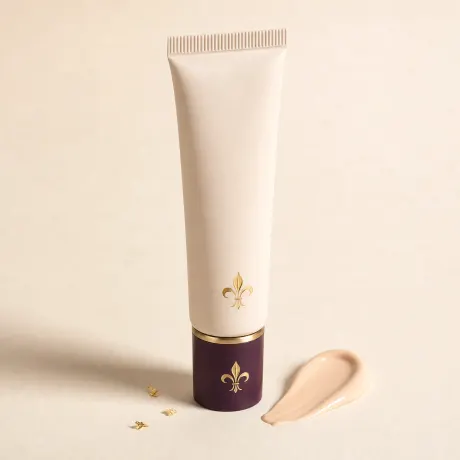
CC cream
A light base built to neutralise redness or sallowness rather than simply cover it.
Read the guide
Cream foundation
A dense, emollient base with high coverage, suited to dry skin and to photography.
Read the guide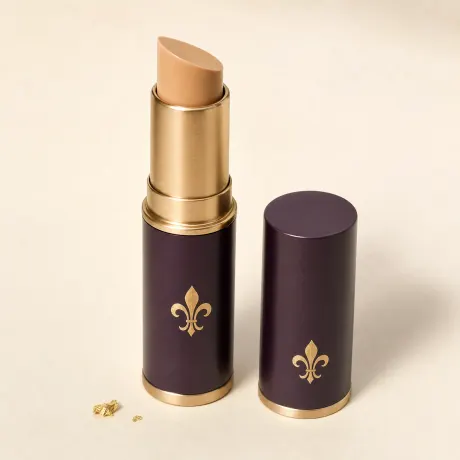
Stick foundation
Cream foundation set into a twist-up stick, for targeted coverage and travel.
Read the guide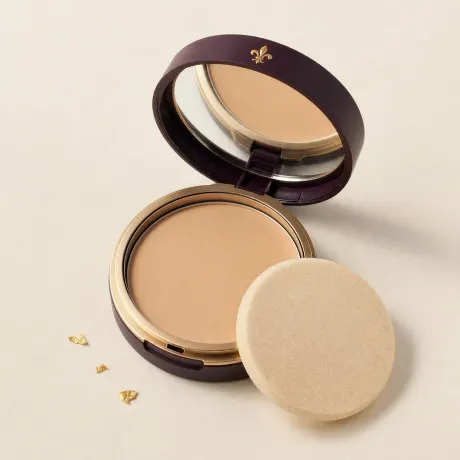
Powder foundation
Foundation pressed into a powder cake, for a quick matte base in one step.
Read the guide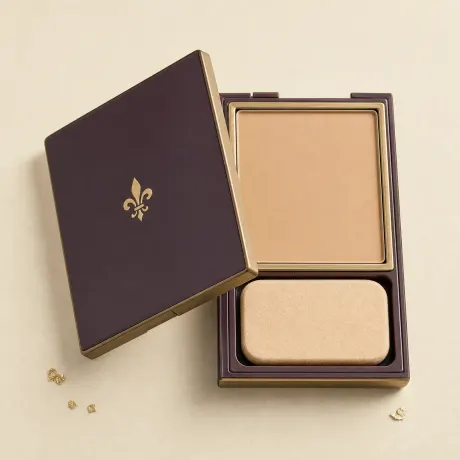
Two-way cake foundation
A pressed foundation made to be used dry for a sheer finish or with a damp sponge for coverage.
Read the guide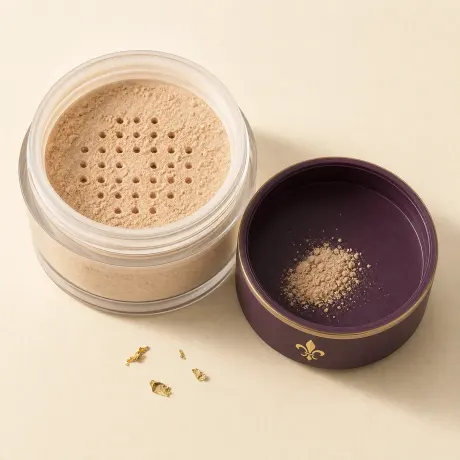
Loose mineral foundation
Foundation as a loose, finely milled mineral powder, buffed in to build coverage.
Read the guide
Cushion foundation
Liquid foundation soaked into a sponge cushion inside a compact, picked up with a puff.
Read the guide