Domed buffing brush
A dense, rounded brush on a long handle, for polishing foundation into the skin rather than painting it on. How to choose one and how to buff with it, and where the word buff comes from.
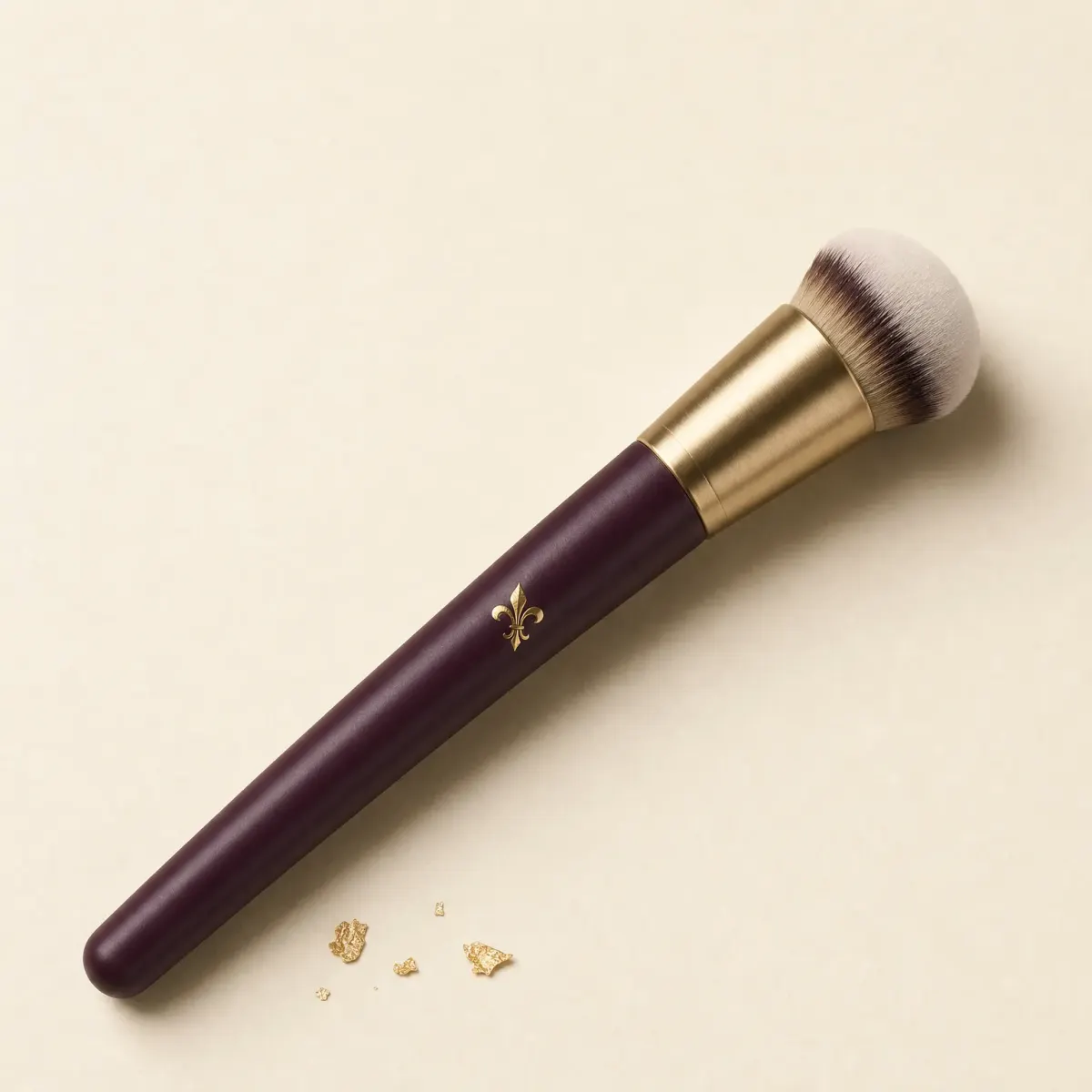
A domed buffing brush is a dense brush with a rounded, domed head on a full-length handle, used to buff liquid, cream or powder foundation into the skin in small circles, with more control around the nose and eyes than a kabuki gives.
Our picks
Chosen across the outlines the dome now takes, from the true dome to the rounded slant, the teardrop, the triangle and the double dome, and across density and size, from drugstore to prestige. Each opens where its maker sells it: on Amazon, or at the house’s own shop.
As an Amazon Associate I earn from qualifying purchases. Affiliate links — we may earn a commission at no extra cost to you. How this works
Rounded slantPrestige MAC Cosmetics
170 Synthetic Rounded Slant Brush
A dome cut on a slant, densely packed, for buffing any form of foundation to a polished finish; its maker calls it its best-selling brush worldwide.
- Rounded, slanted
- Densely packed
- Any foundation
Budget domeDrugstore Real Techniques
Bubble Blending Makeup Brush
An inexpensive dense, round, bubble-shaped head for quick all-over blending.
- Round head
- Ultra dense
- Liquid and cream
Full coveragePrestige Bobbi Brown
Full Coverage Liquid & Powder Foundation Brush
Domed, dense synthetic fibres that build liquid or powder foundation to full, even coverage.
- Domed, dense fibres
- Liquid and powder
- Buildable
Round kabukiMid-range Sigma Beauty
F82 Round Kabuki Brush
Sold as a kabuki but made on a full-length handle: a dense, rounded dome for mineral powder, cream or liquid.
- Dense, rounded head
- Mineral powder
- Sheer to full
Soft domePrestige Pat McGrath Labs
Skin Fetish: Sublime Perfection Foundation Brush
A feather-soft domed head on a long handle, from the makeup artist Pat McGrath’s complexion range, for buffing foundation evenly.
- Domed head
- Synthetic
- Kabuki-inspired
Domed classicDrugstore Morphe
M104 Domed Foundation Brush
A dense dome whose rounded edges reach around the eyes and nose; press first, then buff.
- Dense
- Rounded edges
- Powder, cream, liquid
Makeup schoolMid-range Make-up Designory
#615 Buffer Makeup Brush
A dome of densely packed synthetic bristles from a makeup school’s own line, for buffing cream and liquid without streaks.
- Dome shaped
- Densely packed
- Cream and liquid
Rounded bufferPrestige Victoria Beckham Beauty
12. Buffer Brush
A densely packed rounded head for working any cream or liquid, foundation or concealer, into the skin.
- Rounded head
- Densely packed
- Cream and liquid
Dome-shapedDrugstore e.l.f. Cosmetics
Ultimate Blending Brush
An inexpensive dome that blends foundation first and blush or bronzer after.
- Dome-shaped
- Vegan
- Foundation and cheeks
Triangular domeMid-range Anisa Beauty
Pinnacle Foundation Brush
A triangular dome whose point fits around the eyes, nose, brows and lips; its maker describes the design as patented.
- Triangular dome
- Densely packed
- Cream and liquid
Two angled sidesPrestige By Terry
Tool-Expert Foundation Brush
A dense, softly domed head with two angled sides that reach the delicate areas around the eyes and nose.
- Softly domed
- Dense
- Angled sides
BB and CC creamDrugstore EcoTools
Skin Perfecting Makeup Brush
Domed, angled bristles for buffing BB and CC creams in circles, from the centre of the face outward.
- Domed, angled
- BB and CC cream
- Circular buffing
Fluffy domeMid-range Tarte
The Buffer Brush
A fluffier dome than most, for a lighter layer: buffs foundation to a finish its maker likens to airbrushing.
- Fluffy dome
- Bamboo handle
- Cream, liquid or powder
Domed teardropPrestige Laura Mercier
Real Flawless Foundation Brush
A domed teardrop of densely packed synthetic bristles, set at an angle for control, for streak-free, skin-like coverage.
- Domed teardrop
- Angled ferrule
- Densely packed
Angled domeDrugstore Milani
Buffing Face Brush
An inexpensive angled dome of densely packed bristles that follows the contours of the face.
- Angled, domed
- Densely packed
- Liquid and cream
Double domeMid-range Bdellium Tools
Golden Triangle 972 Large Rounded Double Dome Blender
A symmetrical double dome from a professional brush maker, for every step from primer to blush without changing brushes.
- Double dome
- Vegan synthetic
- Multi-use
Compact blenderPrestige Westman Atelier
Liquid Blender Brush
A compact, rounded head for blending liquid foundation and refining its finish.
- Compact, rounded
- Liquid formulas
- Cherry-wood handle
Large domeDrugstore Crown Brush
Paris Tools Deluxe Buffer Brush GT19
An inexpensive large dome of dense synthetic bristles from a professional brush maker’s Paris Tools line, for buffing foundation over the whole face quickly.
- Large dome
- Synthetic, vegan
- Liquid, cream, powder
Pro fluffy domeMid-range Cinema Secrets
F96 Fluffy Foundation Brush
A fluffy, flexible dome from a professional makeup house, for diffusing foundation without heavy build-up.
- Fluffy dome
- Long handle
- Liquid, cream, powder
A domed buffing brush is a kabuki’s head on a long handle: a tight bundle of short synthetic fibres, rounded at the top and about two and a half centimetres across, set in a round ferrule on a full-length stem. It is pressed against the skin and turned in small circles, so that foundation is polished in rather than painted on. The centre of the dome does most of the work, and its curved edge follows the side of the nose, the corner of the eye and the line of the jaw, which a flat head reaches only by tilting.
Its neighbours share its density but not its outline. The kabuki is squat, with a stubby handle, and made above all for powder. The flat-top buffing brush is cut straight across and gives the fullest coverage; the stippling brush’s longer outer fibres dot product on more sheerly; a paddle paints. The dome is the all-rounder of the four: dense enough for coverage, curved enough for the corners of the face, and at ease with liquid, cream or powder.
Choosing one
Density decides coverage. The more tightly the fibres are packed, the more foundation the head holds and the harder it presses it into the skin; a plusher, looser dome leaves a lighter veil and forgives a heavy hand. Then look at the outline. A true dome is symmetrical and works in any direction; many are cut on a slant or drawn out to a point, like MAC’s rounded slant, Laura Mercier’s domed teardrop and Anisa’s triangular dome, and these reach more easily around the nose and under the eyes. Size is speed: a large dome covers the cheeks and forehead in a few passes, a small one gives control.
Match the brush to the formula. A thin, fast-setting long-wear liquid wants a dome that moves quickly and is not too dense, so that the first area is blended before it sets; a thick cream or a stick wants a firmer, denser head that can push it into the skin; a skin tint or a BB cream suits a fluffier dome that spreads a little a long way.
Choose synthetic fibre for liquid and cream. It is not porous, so it holds foundation at its surface instead of drinking it, and it washes clean. And read the description rather than the name. Makers sell the shape as kabukis, buffers, blenders and plain foundation brushes: Sigma still calls its dome a Round Kabuki, and Pat McGrath calls hers kabuki-inspired. What matters is a dense, rounded head on a long handle.
How to buff
Dot foundation on the forehead, cheeks and chin, or put a little on the back of your hand and touch the dome to it. Press the brush to the skin first, to set the colour down where it is needed, then buff outward in small, light circles, so that the edges of the face get least. Let the curve do the corners: roll the dome along the side of the nose and under the eyes instead of pushing harder. Build coverage in thin layers, rather than loading the brush once, and finish at the hairline and under the jaw with the brush almost empty, so that the foundation fades out instead of stopping at an edge.
If the finish looks streaky or heavy, the brush is overloaded: wipe it on a tissue and go over the area again with what remains. With powder foundation, swirl the dome in the lid, tap off the excess and buff in the same small circles. A dense head holds on to what it is given, so wash it after each use with liquid or cream, working the cleanser from the base of the fibres outward, and dry it lying flat so that water stays out of the ferrule.
Where it came from
To buff something is to polish it. Buff was first a thick, soft leather, originally of buffalo hide, known in English from the 1570s; the verb “to polish” is recorded from 1849, from rubbing with buff leather or with the buff-sticks and buff-wheels used on metal, and a buffer, “one who or that which polishes by buffing”, from 1854.[1] The Getty’s art vocabulary still defines buffs as sticks or blocks with a soft, absorbent surface, used to apply polishing material.[2]
At the dressing table, the word belonged to the nails. The V&A keeps an Edwardian nail buffer, made between 1900 and 1915 of bone and kid leather and small enough for a handbag, which the museum calls typical of the beauty accessories a woman might own,[3] and a buffer of about 1950 by Asprey of London, in tortoiseshell and chamois, from a fitted manicure set.[4] Both are soft pads on a handle, made to be worked over a surface until it shines.
Foundation came to be buffed much later, and with a brush. The kabuki page tells how loose mineral powder made the short, dense brush familiar; by 2006 Bare Escentuals had registered “Swirl, Tap, Buff” as a trademark for the way its foundation went on with a brush.[5] The domed buffing brush takes that polishing motion onto a full-length handle, and the kabuki’s name sometimes travels with it.
The techniques
- Buff
- Work in small circles with a dense brush until no edge remains.
Sources
- [1]buff (n.1), buff (v.) and buffer (n.2) Online Etymology Dictionary, 2026.View source (opens in a new tab) Accessed 2026-09-26.
- [2]buffs (finishing tools), Art & Architecture Thesaurus J. Paul Getty Trust.View source (opens in a new tab) Accessed 2026-09-26.
- [3]Nail buffer, Great Britain and France, 1900–1915, museum number T.52-2005View source (opens in a new tab) Accessed 2026-09-26.
- [4]Nail buffer, Asprey, London, about 1950, museum number T.113:2-1998View source (opens in a new tab) Accessed 2026-09-26.
- [5]Form S-1/A registration statement (amendment), filed 13 September 2006 U.S. Securities and Exchange Commission (EDGAR), 2006.View source (opens in a new tab) Accessed 2026-09-26.
What it is used with
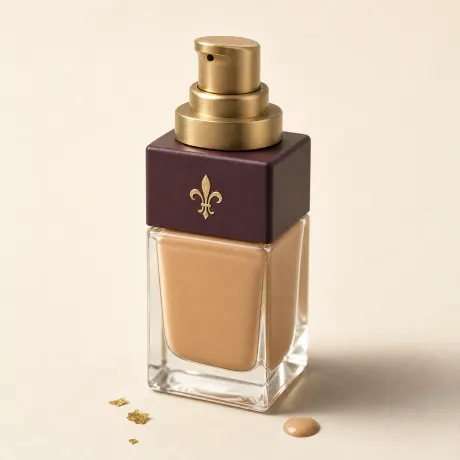
Liquid foundation
The standard base: pigment suspended in a fluid, in shades matched to the skin.
Read the guide
Cream foundation
A dense, emollient base with high coverage, suited to dry skin and to photography.
Read the guide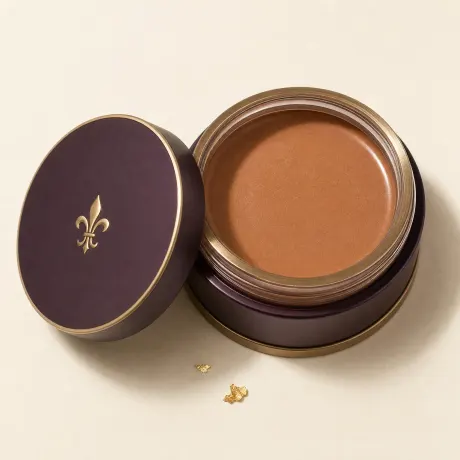
Cream bronzer
Bronzer in a cream base, which melts into skin and reads as skin rather than powder.
Read the guide
Other kinds of face brushes
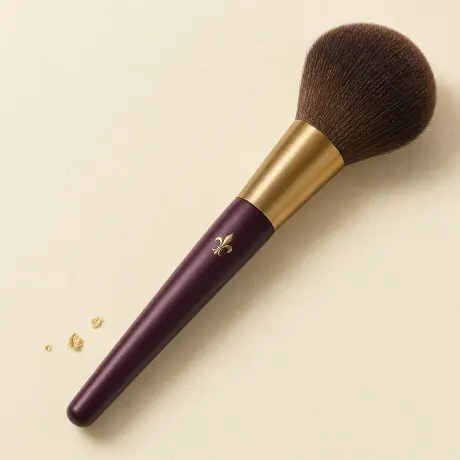
Powder brush
A large, loosely packed, fluffy brush that lays down a veil of powder rather than pushing it in.
Read the guide
Kabuki brush
A squat, palm-sized brush with a very dense dome of short bristles on a stubby handle, for buffing powders and creams into the skin.
Read the guide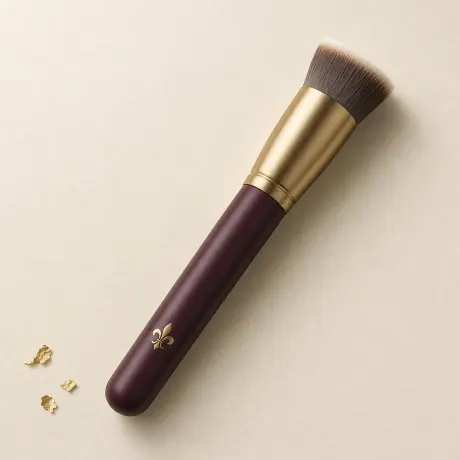
Flat-top buffing brush
A dense brush cut straight across, which buffs liquid and cream into skin with no streaks.
Read the guide
Flat foundation brush
A flat synthetic brush with a rounded edge, for painting foundation on like a primer coat.
Read the guide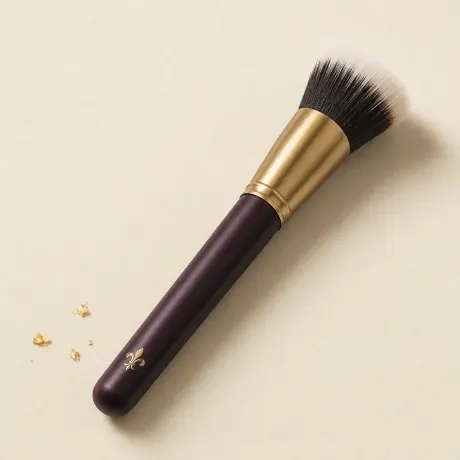
Stippling brush
Two layers of fibre — long and sparse over short and dense — that dot product on for an airbrushed finish.
Read the guide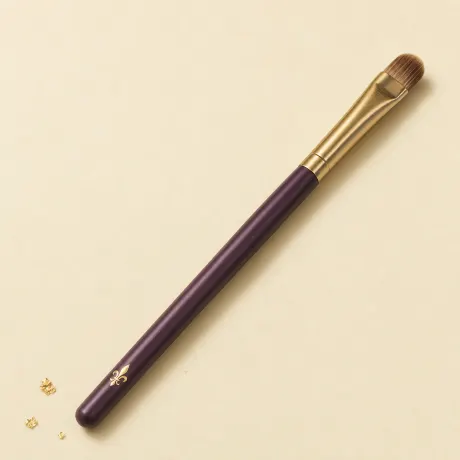
Flat concealer brush
A small, flat, tongue-shaped synthetic brush for placing concealer precisely.
Read the guide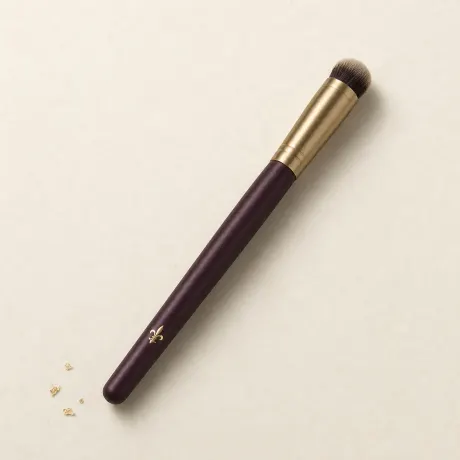
Concealer buffing brush
A small, dense, domed brush — about the size of a fingertip — that buffs concealer into skin.
Read the guide