Mixing palette and spatula
A small steel plate and a metal spatula that keep makeup out of its container once a brush has touched a face, and give it somewhere to be mixed. What they are for, how to choose, use and clean them — and the rule they grew up around.
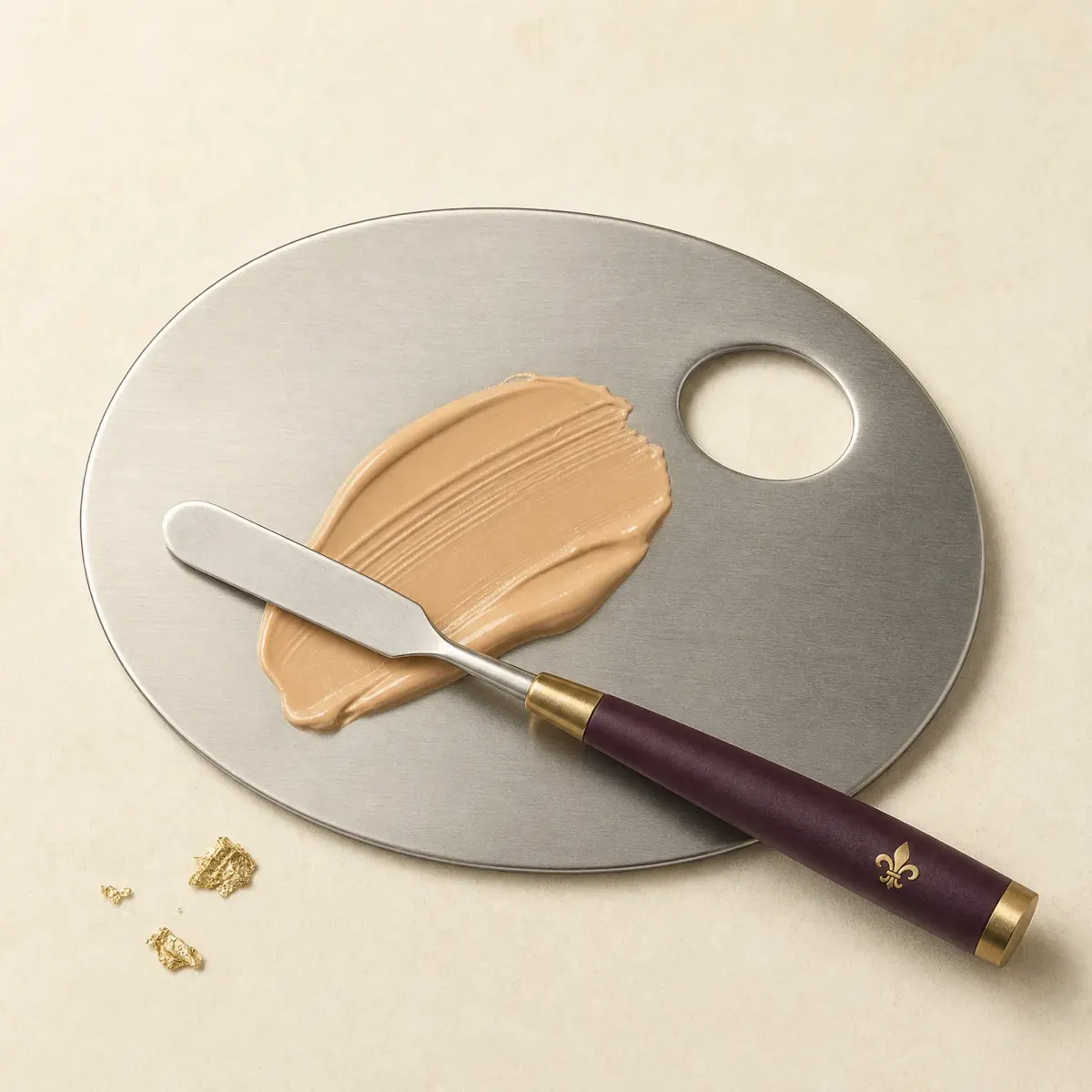
A mixing palette is a small, flat, non-porous plate, usually stainless steel and often with a grip for the thumb, onto which makeup is taken with a clean spatula so that it can be mixed, warmed and applied without the brush ever going back into the container.
Our picks
The steel mixing palettes we could confirm as sold by their makers in the US: three from professional and theatrical houses and one pocket-size set, each with a spatula. Almost everything else on sale comes from sellers that make nothing else, and the one prestige palette found, Make Up For Ever’s, was out of stock. Each opens at the house’s own shop.
Affiliate links — we may earn a commission at no extra cost to you. How this works
Palette and spatulaMid-range Cinema Secrets
Stainless Steel Makeup Mixing Palette & Spatula Bundle
A film-makeup house’s palette and spatula, sold together to stop double-dipping and to mix creams, liquids and gels on the steel.
- Non-porous steel
- Double-ended spatula
Pocket sizeDrugstore AOA Studio
AOA Stainless Steel Mixing Palette and Spatula with Protective Sleeve
An inexpensive palette the size of a playing card, with a sleeve, for carrying a clean mixing surface in a makeup bag.
- Portable size
- Protective sleeve
- Double-ended spatula
Grip openingMid-range Mehron
Stainless Steel Artist Mixing Palette with Spatula
A theatrical house’s larger palette, with an opening to hold it by, roomy enough to lay out several products for one face.
- Grip opening
- Double-ended spatula
Plate and spatulaDrugstore Crown Brush
Stainless Steel Mixing Plate and Spatula Combo MCMB1
A professional brush maker’s plain steel plate and spatula, for mixing custom shades and textures at the kit.
- Stainless steel
- Liquids, creams, gels
A mixing palette is a small, flat plate of stainless steel, often with a hole or an opening for the thumb, and its spatula is a thin metal blade, usually double-ended: one end flat for scraping and spreading, the other narrower for scooping. Together they put a step between the container and the face. The spatula takes a little product out of a pot, a pan or a tube; the palette holds it; the brush or sponge works from the palette and never goes back into the pot.
Makeup artists use them for that hygiene first, and for what the flat steel allows second: mixing two foundations into a third shade, thinning a cream with a drop of serum, warming a stiff concealer until it spreads. Steel is chosen because it absorbs nothing and wipes clean. A plastic lid or the back of the hand will do at a pinch, but neither can be cleaned as thoroughly, and the hand warms and thins some formulas more than a mixing surface should.
Choosing one
Size. A palette the size of a playing card, like AOA’s, fits a handbag and holds enough for one face. One closer to 15 by 10 cm, like Mehron’s, gives room to lay out foundation, concealer and cream colour side by side and to mix between them. Grip. A thumb hole or an opening at one end lets the palette sit on one hand while the other works; without one, it rests on the table.
Spatula. Most are double-ended. A flat, slightly flexible blade scrapes a pan cleanly and mixes on the steel; a narrower or spoon-shaped end takes product from a deep jar or cuts a sliver from a lipstick. Buy a palette that comes with one, or add one of the same steel. Travel. Check the edges are smooth, since the palette is held against the skin, and carry it in a sleeve, which keeps it clean and stops it scratching everything else in the bag.
Material. Every house here sells steel, and for good reason. Acrylic palettes are lighter and cheaper, but they scratch, and a scratch holds on to old product however well it is washed; some solvents and alcohol-based products also cloud them. Glass is smooth and easy to clean, but it chips, and it breaks when a kit is dropped. Steel does neither, and it survives the alcohol used to disinfect it.
How to use it
Start with a clean palette and spatula. Scrape a little product from the surface of the pan or pot, or squeeze a dot from a tube straight onto the steel, and take less than you think: whatever is left cannot go back. Hold the palette on the back of the hand or on the thumb, and mix with the flat of the spatula or with the brush you will apply with: two foundations for a shade between them, a cream with a drop of moisturiser to sheer it, a slice of lipstick warmed on the steel and picked up with a lip brush.
Work from the palette until the face is done. Use the spatula, never the brush, each time you go back to a container, and wipe the spatula between products so that one never carries into another. For each new face, start again with a clean palette.
Cleaning it
Wipe off what is left with a tissue, then wash the palette and spatula in warm, soapy water and dry them. Makers add a disinfecting step: Mehron tells buyers to sanitise its palette and spatula with its cosmetic sanitiser spray or with 70 per cent alcohol. Let the steel dry completely before it goes back into its sleeve, and keep the sleeve clean too. Clean the spatula’s blade and its handle, since the handle is what the fingers hold between products. Never scrape leftover product back into its container, however little was used; it has already been worked with a brush that touched skin.
Where it came from
Preparing colour on a flat stone is one of the oldest things in makeup. The cosmetic palettes of Predynastic Egypt, cut from greywacke and siltstone quarried in the Wadi Hammamat, were used to process green malachite: experiment suggests the mineral was not ground but crushed, first against an anvil stone and then to a fine powder on the palette’s smooth face, and palettes from graves still carry green stains. Scholars suggest the powder was then mixed with a drying oil, animal fat or simply water.[1]
The steel palette’s own beginnings are not recorded in any source we found. What can be dated is the rule it serves. California’s regulations for licensed cosmetologists, in the form they have taken since 2015, require that when only part of a cosmetic is to be used on a client it be taken out of its container “in such a way as not to contaminate the remaining portion”.[2] The rule names no tool; the palette and the spatula are how professionals keep it.
The reason is not squeamishness. When researchers in Tabriz sampled the shared makeup kits of ten beauty salons in 2016, every one of the 52 products they tested carried bacteria, and about one in five carried fungi or yeasts, powders and eyeliners most often; their advice was to stop sharing cosmetics altogether.[3] A palette is the professional’s way of sharing a pot without sharing what is in it.
The techniques
- Blend
- Soften an edge until one colour passes into the next without a line.
Sources
- [1]Pigment Stories: Eternal Green in Predynastic Egypt University College London, 2020.View source (opens in a new tab) Accessed 2026-09-22.
- [2]California Code of Regulations, Title 16, § 988: Liquids, Creams, Powders and Cosmetics State of California (text read at the Legal Information Institute, Cornell Law School), 2015.View source (opens in a new tab) Accessed 2026-09-26.
- [3]Investigating incidence of bacterial and fungal contamination in shared cosmetic kits available in the women beauty salons Health Promotion Perspectives 6 (3): 159–163, 2016.View source (opens in a new tab) Accessed 2026-09-26.