Flat foundation brush
The flat, tapered brush that paints foundation on in thin, even coats, and the foundation brush closest to the painter’s brush it came from. How to choose and use one, and how a brush like it is made.
A flat foundation brush, or paddle brush, is a flat synthetic brush with a rounded or tapered edge, used to paint liquid or cream foundation onto the face in thin, even strokes.

Our picks
Chosen across the shapes of the edge (rounded, tapered, angled and oval), across size and firmness, and from drugstore to prestige, with a painter’s flat filbert from a film make-up house and Japanese brushes from Kumano and Shiseido. Each opens where its maker sells it: on Amazon, or at the house’s own shop.
As an Amazon Associate I earn from qualifying purchases. Affiliate links — we may earn a commission at no extra cost to you. How this works
Classic paddlePrestige MAC Cosmetics
190S Foundation Brush
The classic flat foundation brush: smooth but firm fibres that paint liquid, cream or gel over the face, with bevelled edges for the crevices.
- Flat
- Firm fibres
- Bevelled edges
Budget paddleDrugstore EcoTools
Classic Foundation Brush
An inexpensive flat brush of dense synthetic fibre for a smooth, streak-free coat of liquid or cream.
- Flat head
- Synthetic Taklon
- Bamboo handle
Cat’s tonguePrestige Dior
Dior Backstage Brush N°11
A tapered “cat’s tongue” for fluid foundation, sold for a second-skin effect at light to medium coverage.
- Tapered
- Synthetic
- Light to medium
Plush paddleMid-range IT Cosmetics
Heavenly Luxe Plush Paddle Foundation Brush
A plush synthetic paddle for applying and blending cream and liquid foundation evenly.
- Synthetic
- Cream and liquid
Flat, angledPrestige Shiseido
HASU FUDE Foundation Brush
The latest version of Shiseido’s foundation brush: a flat, angled, tapered head for precise, streak-free application.
- Flat, angled
- Tapered
Firm budgetDrugstore wet n wild
Foundation Brush
A dense, flat brush balanced between firm and soft, for an inexpensive, streak-free coat of cream or liquid.
- Dense, flat
- Cream or liquid
Kumano syntheticPrestige Hakuhodo
G517BkSL Foundation Round & Flat
The Kumano maker’s standard synthetic foundation brush, flat with a rounded edge, for a sheer, natural finish with liquid.
- Synthetic
- Round and flat
- Sheer finish
Flat filbertMid-range Cinema Secrets
F93 Flat Filbert Foundation Brush
The painter’s shape, from a professional make-up house: a flat filbert on a long handle, for full coverage with liquid or cream.
- Flat filbert
- Two-toned synthetic
- Long handle
Tapered flatPrestige Clinique
Foundation Brush
A flat, tapered brush that reaches the narrow places around the nose, mouth, eyes and hairline.
- Flat, tapered
- Narrow areas
Paddle shapeDrugstore L.A. Girl
Flat Foundation Brush
An inexpensive flat, paddle-shaped synthetic brush for all-over liquid or cream.
- Paddle-shaped
- Synthetic
- Birch handle
Tapered paddlePrestige Westman Atelier
Foundation Brush
A paddle of tapered, flat nylon bristles on a birch handle, for precise application and for correcting.
- Paddle
- Tapered, flat bristles
- Nylon fibres
Flat ovalMid-range Make-up Designory
#940 Foundation Synthetic Brush
A large, flat oval of dense, ultra-fine synthetic bristles from a makeup school’s own line, for cream and liquid foundation.
- Large, flat oval
- Cream and liquid
Rounded flatPrestige Victoria Beckham Beauty
10. Flat Complexion Brush
A classic flat profile with a soft, rounded shape and a tapered edge for blending.
- Flat profile
- Rounded
- Tapered edge
Large paddleDrugstore Crown Brush
Deluxe Large Foundation Brush SS001
A large, flat, rounded synthetic head for full-face primer, foundation, and BB or CC cream.
- Large, flat, rounded
- Synthetic
A flat foundation brush is shaped like a painter’s brush: a flat, fairly firm head of smooth synthetic fibre, a few millimetres thick, gathered in a flattened metal collar and rounded or tapered at the tip. It is used the way a painter uses one, laying foundation on in strokes. That makes it the most precise way to place a liquid, and one of the thinnest: it spreads a little a long way, and its edge reaches the corners of the nose and the lash line where a round brush cannot.
Its weakness is the stroke itself. A paddle can leave faint lines, which is why its work is often finished with a damp sponge or a buffing brush. A flat-top buffing brush, dense and cut straight across, gives fuller coverage with no streaks but uses more product; a stippling brush gives a sheerer, airier finish. The paddle is the tool for a thin, controlled layer, and for anyone who likes to see where the foundation is going.
Choosing one
Three things vary. The edge may be rounded like a fingertip, tapered towards a point, or shaped like a cat’s tongue, as Dior describes its N°11; the rounder the edge, the softer the line it leaves, and the more pointed, the better it reaches around the nose. Firmness decides coverage: a firm, dense paddle pushes more foundation onto the skin, a softer one lays a sheer coat. Size should suit the face and the job: a broad paddle is quick over the cheeks and forehead, a small one doubles as a concealer brush. Look at the ferrule, too: on a well-made paddle the flattened metal collar is crimped tight, so the head neither wobbles nor sheds as it paints.
Choose synthetic fibre for liquids. Hair is porous and drinks foundation, which wastes it and clogs the brush;[1] a smooth synthetic paddle slides. Hakuhodo, which works in both hair and synthetic fibre in Kumano, sells its foundation brushes in synthetic on exactly that point: one of them, it says, “does not absorb much liquid”, so it glides and spreads foundation without losing coverage.
Painting it on
Put a little foundation on the back of your hand rather than on the brush, and pick it up on both sides of the tip. Start at the centre of the face and paint outward in short strokes, thinning as you go towards the hairline and jaw. Use the flat for the cheeks and forehead and the edge for the sides of the nose, the lids and the corners of the mouth. Add a second thin coat only where the first did not cover.
The paddle suits some formulas better than others. Thin and medium liquids, serum foundations and tinted moisturisers spread furthest under it; a thick cream or a stick needs a firmer, denser paddle, or warming on the back of the hand first. Fast-setting long-wear foundations need speed, so paint one area at a time and blend it before moving on. The same brush lays down primer, and some makers sell theirs for moisturiser and face masks as well.
Then finish. Pat over the face with a damp sponge, or buff lightly with a dense brush, to melt any strokes; or press the flat of the paddle against the skin, which smooths as it goes. Wash the brush after every use: foundation left to dry in a flat head spreads it into a fan that will never paint a clean line again.
Where it came from
The paddle is the foundation brush that stayed closest to its origins, because it is a painter’s brush. The Getty’s art vocabulary defines the filbert as a flat artists’ brush with rounded corners,[2] and Cinema Secrets still sells its paddle as a “flat filbert”. When Hakuhodo, in the Japanese brush town of Kumano, began developing makeup brushes around 1980, the makeup brushes on sale, by its account, were modelled on Western paint brushes: good on a flat surface, less suited to the curves of a face, and often packed free with a foundation or an eyeshadow.[3]
A Western brush of this kind is built in three parts. The fibres are gathered into a bundle and their root ends are glued, in one maker’s description with epoxy, into a “bristle knot” inside a metal ferrule, which is then crimped or glued onto the handle.[4] The ferrule also sets the shape: a patent application published in 2004 in the name of Paula Dorf describes crimping it to force the fibres into a semicircle, an oval or a rectangle,[5] and a patent filed in 2019 describes a foundation brush as a flat head with a partly semicircular edge.[6] Pinch a round ferrule flat, and a round bundle becomes a paddle.
The traditional Kumano method is slower, and done by hand. The hair is sorted and weighed, tangled hairs are lifted out one by one with a small knife, hairs cut to different lengths are mixed in thin layers, and the bundle is tied at its base with hemp thread and sealed with heat before it is glued into the handle.[7] Hakuhodo, which adapted these techniques for its makeup brushes, told Nippon.com that a typical makeup-brush process has seven stages, and that it divides its own into eighty.[3]
The techniques
- Sweep
- Long, light strokes that deposit a veil of product.
Sources
- [1, 6]US Patent 10,966,513 B2 - Synthetic goat hair brush United States Patent and Trademark Office, 2021.View source (opens in a new tab) Accessed 2026-09-26.
- [2]filberts (artists’ brushes), Art & Architecture Thesaurus J. Paul Getty Trust.View source (opens in a new tab) Accessed 2026-09-26.
- [3]Hakuhōdō: Luxury Cosmetic Brushes that Highlight Traditional Japanese Crafts Nippon.com, 28 November 2023, 2023.View source (opens in a new tab) Accessed 2026-09-26.
- [4]US Patent Application 2020/0008566 A1 - Makeup brush for cosmetic application with a concave profile United States Patent and Trademark Office, 2020.View source (opens in a new tab) Accessed 2026-09-26.
- [5]US Patent Application 2004/0168700 A1 - Cosmetic brush set with interchangeable handle United States Patent and Trademark Office, 2004.View source (opens in a new tab) Accessed 2026-09-26.
- [7]KUMANO Fude (Brushes) Traditional Crafts Aoyama Square, Tokyo.View source (opens in a new tab) Accessed 2026-09-26.
What it is used with
Other kinds of face brushes
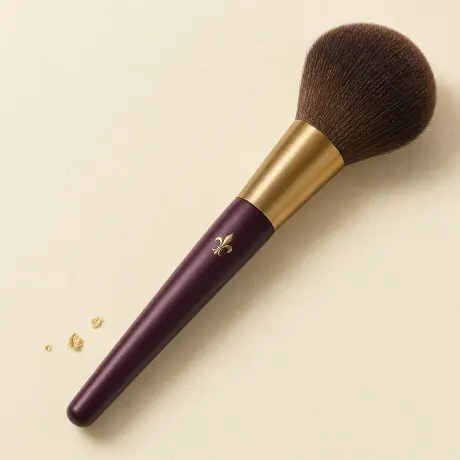
Powder brush
A large, loosely packed, fluffy brush that lays down a veil of powder rather than pushing it in.
Read the guide
Kabuki brush
A squat, palm-sized brush with a very dense dome of short bristles on a stubby handle, for buffing powders and creams into the skin.
Read the guide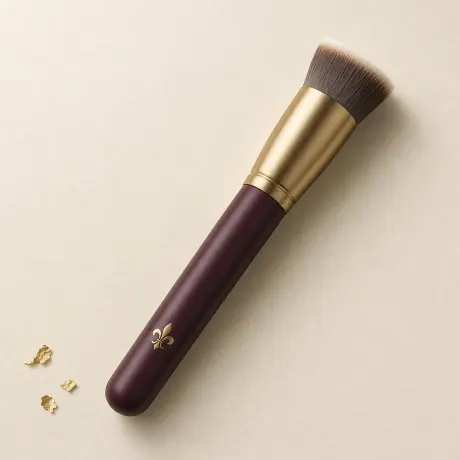
Flat-top buffing brush
A dense brush cut straight across, which buffs liquid and cream into skin with no streaks.
Read the guide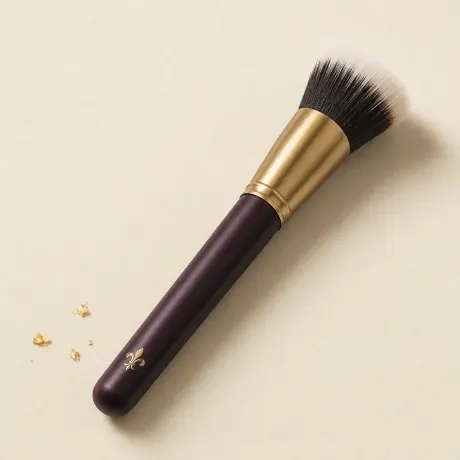
Stippling brush
Two layers of fibre — long and sparse over short and dense — that dot product on for an airbrushed finish.
Read the guide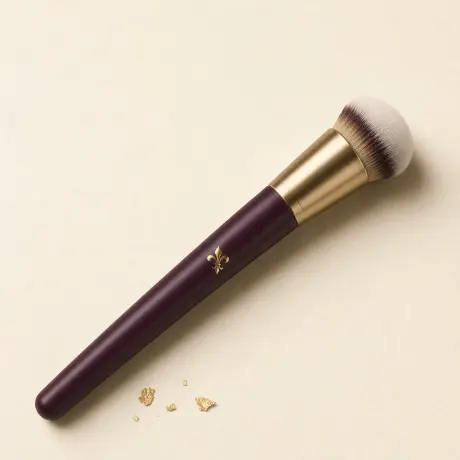
Domed buffing brush
A dense, rounded brush on a full-length handle, for buffing cream and liquid with more control than a kabuki.
Read the guide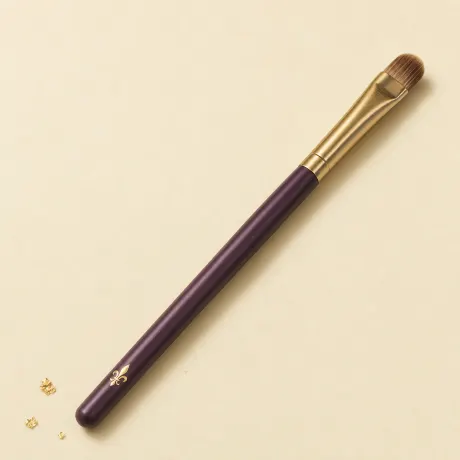
Flat concealer brush
A small, flat, tongue-shaped synthetic brush for placing concealer precisely.
Read the guide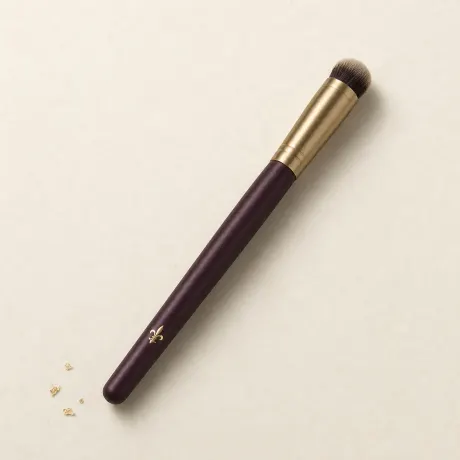
Concealer buffing brush
A small, dense, domed brush — about the size of a fingertip — that buffs concealer into skin.
Read the guide