Collyrium, Lac and the Adornment an Occasion Requires
Not one tradition but many, held together by the habit of treating adornment as something an occasion is owed.
HOM · Culturec. 2500 BCE - presentAdornment & Rite
All of The Subcontinent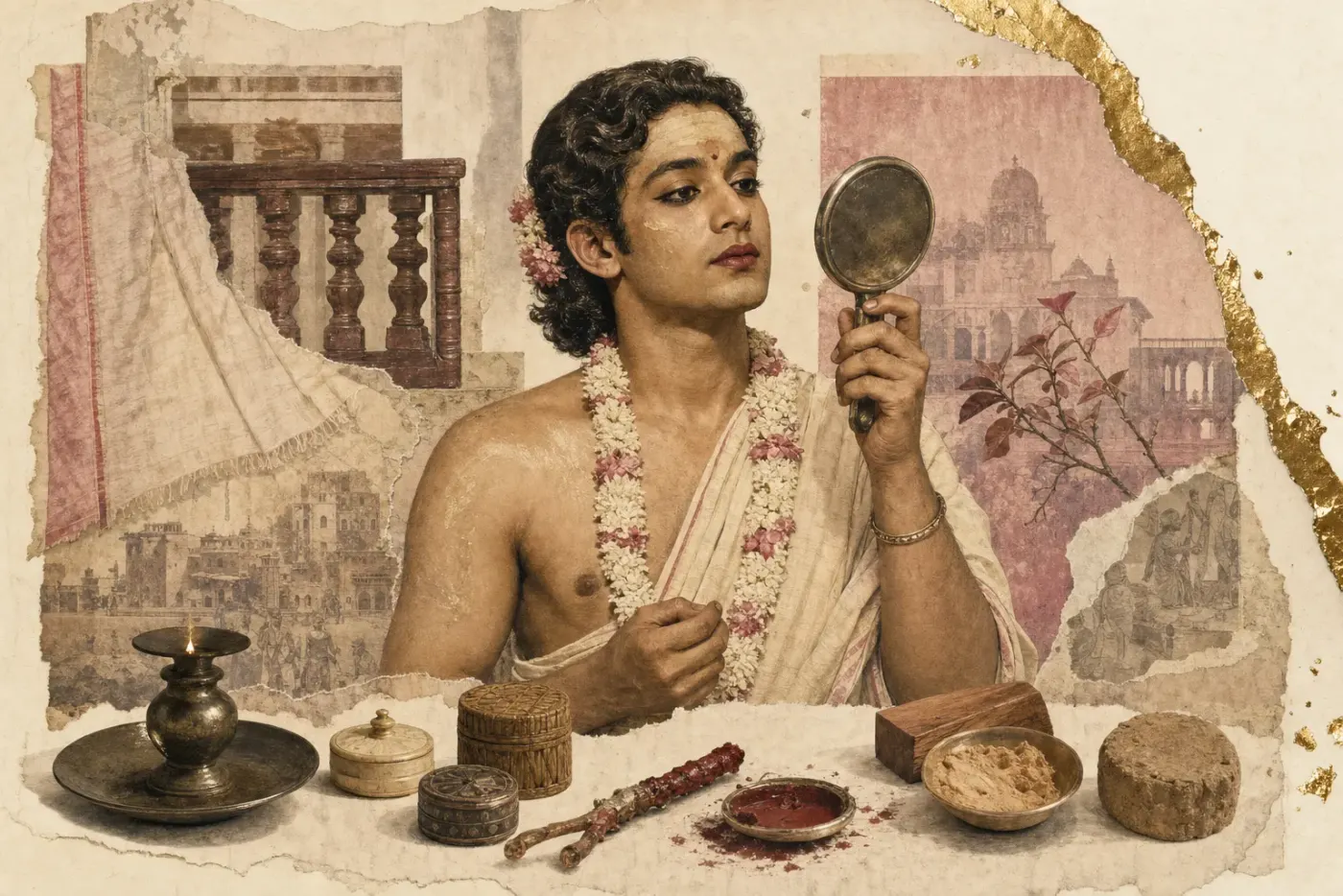
In short
The Pali Mahavagga, written down more than two thousand years ago, lists five eye ointments permitted to monks; Buddhaghosa's fifth-century commentary explains one of them, kapalla, as soot taken from the flame of a lamp — which is the household kajal of South Asia.
- 9min read
- 6chapters
- 7sources
Vivien
Your guide through time
Listen to this essay
11 min listenVivien reads our essays aloud, word for word — every date and every name in its place — so you can listen the way you would be walked through a gallery.
An AI voice, designed for History of Makeup
In the 1935-36 season Ernest Mackay's expedition at Chanhu-daro, a Harappan site in the Indus valley in Sindh, recovered rectangular slips of red ochre with bevelled ends. Mackay's published reading of them was carefully hedged: the shape, he thought, made it more than likely that they had been used as face paint, and possibly as lipstick.[1]
That hedge is the right starting point for the whole subject. Kohl pots and applicator sticks of copper, bronze, ivory and bone are common at Harappa and Mohenjo-daro, and many of the pots have narrow spouted mouths, which suggested to Mackay that the paint was poured out and mixed with water rather than kept ready in the jar. The objects are certain. The uses are inferred, and the inference is usually reasonable and never proof.[2]
Eye Paint Arrives Through the Ritual Door
The earliest South Asian textual references to eye paint are not about beauty. Anjana, an eye salve said to come from Mount Trikakuda, is mentioned repeatedly in the Atharvaveda. The Satapatha Brahmana supplies an origin for it: when Indra killed Vrtra, Vrtra's eyeball fell away and became collyrium, and the point of anointing an eye with it is that one thereby "puts eye into eye". In the Aitareya Brahmana the priest smears the eyes of the sacrificer with it, because the substance is held to give the eyes lustre.[3]
Adornment enters the Indian record through the ritual door rather than the cosmetic one, and the order matters. The later material — the marriage rites, the auspicious colours, the substances a wife is enjoined not to be without — reads more coherently as a continuation of that than as decoration which later acquired a religious gloss.[3]
Five Kinds of Eye Ointment
The Pali Vinaya is unusually specific. The Mahavagga lists five eye ointments permitted to monks: black collyrium (kalanjana), rasa ointment, sota ointment, geruka and kapalla. Three of those five are opaque without a commentary, and the commentary is centuries younger than the code. It is Buddhaghosa, writing in the fifth century CE, who explains sota as the ointment that forms in streams and rivers, glosses geruka as the yellow kind, and identifies kapalla as soot obtained from the flame of a lamp. The code itself also sets out what the ointment boxes allowed to monks may be made of: ivory, horn, reed, bamboo, wood, lac, fruit and shell. The applicator sticks in the same passage are gold and silver, and they belong to the rich rather than to the bhikkhus. The ointments were perfumed — with sandalwood, tagara, dark fragrant sandalwood, black zedoary and a grass perfume — which is a detail the code would not have bothered to regulate if the practice had been rare.[4]
The fifth ointment is the important one, and what makes it legible is that fifth-century reading rather than the text itself. Lamp-black collyrium is carbon, and it is still made in South Asian households by catching soot from a wick on a cool metal surface. It is not the same material as surma, which in the Indian and Persian tradition is an antimony or lead preparation; the antimony found near the Indus was reckoned the purest of the anjanas.[4] That distinction is routinely lost, in both directions. The United States Food and Drug Administration lists kohl, kajal, al-kahal, surma, tiro, tozali and kwalli together as materials not approved and listed in its colour additive regulations, and maintains an import alert for eye-area cosmetics that declare kohl, kajal or surma on the label.[5]
Now the householder … should wash his teeth … put some ornaments on his person and collyrium on his eyelids and below his eyes, colour his lips with alacktaka, and look at himself in the glass.
Lac, Lodhra and the Morning Routine
Red on lips and feet came from lac, the resin secreted by an insect on its host tree. One of its names is alaktaka, the word attached to the preparation used on the mouth; clotted lac coloured the soles of the feet, with saffron stained over the upper surface. The Amarakosa's names for lac dye are reported by Moti Chandra as six kinds, although the list he then prints runs to seven — laksa, raksa, jatu, kliba, yava, alaktaka, drumamaya — which is the sort of discrepancy worth noticing rather than reproducing.[7]
The routine it belonged to was not a women's routine. Vatsyayana's description of the prosperous townsman has him wake to a shelf of toilet requisites, apply sandal paste, fumigate his clothes in scented smoke, put on a garland, apply collyrium to his eyes and lac dye to his lips, satisfy himself in a mirror and go about his business. Susruta gives a chapter of the Cikitsasthana to twenty-four rules of the toilet, in which oiling, rubbing and scouring the body — udvartana, utsadana, udgharsana — come before the bath rather than after it, and the whole sequence is set down as a measure for health rather than for looks. Lodhra paste appears in the same literature as the thing that takes the oiliness off the skin and cheeks; lodhra flower pollen, separately, is described as rendering faces yellow.[7]
Henna, and What Is Not Settled
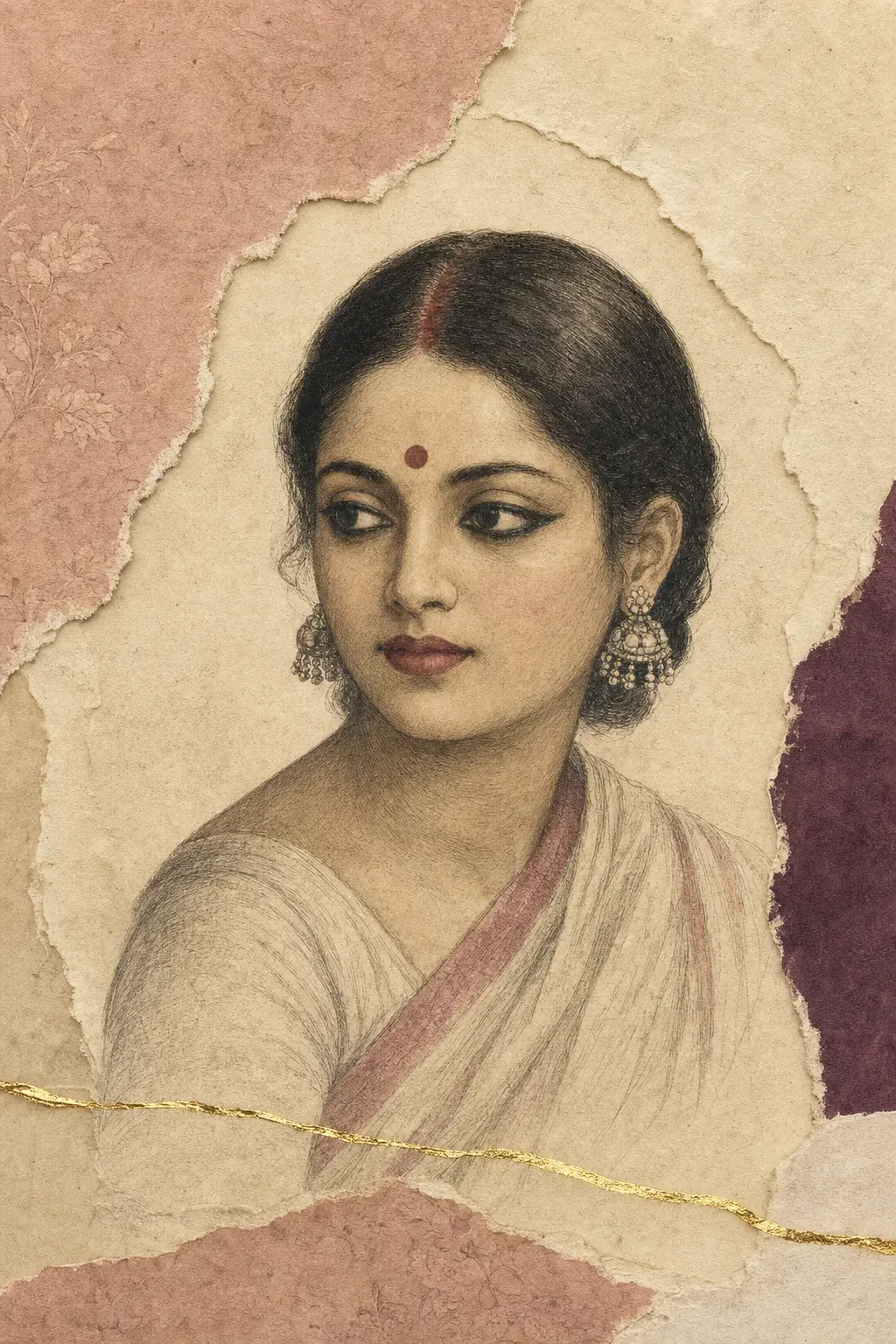
Henna is Lawsonia inermis, given its botanical name by Linnaeus in 1753 and the only species in its genus, which is monotypic. The dye molecule is lawsone, found in high concentration in the leaves and stems; it binds to protein, which is why it stains skin, hair and nails instead of sitting on top of them.[8]
Where the practice came from is not settled, and the dispute should not be manufactured out of a museum caption. The Natural History Museum places the plant's origin in the Middle East and North Africa, with a spread across Asia thousands of years ago, and notes that henna was also important in the Mughal empire, which ruled India between roughly 1526 and 1857. It takes no position on when henna reached South Asia or on when it became prominent there.[8] Set against a late reading is the Sanskrit mendhika, which lies behind the word mehndi, and claims for much older Indian use circulate widely. Settling the question would take the scholarship that actually holds the two positions, and this page does not have it in hand; a confident sentence in either direction is a preference rather than a finding.
A separate and much more recent matter: preparations sold as "black henna" commonly contain para-phenylenediamine, a hair-dye intermediate. In the European Union, Annex III to Regulation (EC) No 1223/2009 lists p-phenylenediamine and its salts at reference number 8a, permitted as a hair-dye substance in oxidative hair-dye products subject to prescribed label warnings, and again at 8b for products intended for colouring eyelashes, professional use only, at not more than 2 per cent calculated as free base after mixing. That is the annex as it stands in the consolidated text of 3 December 2020; Annex III is amended by Commission regulations on a rolling basis, so the operative wording has to be checked against the latest consolidation before it is relied on. No entry authorises the substance for application to the skin.[9]
The Colours an Occasion Requires
Adornment on the subcontinent has been keyed to events rather than to days. Moti Chandra quotes the injunction that a wife should not forgo turmeric (haridra), saffron (kumkuma), sindura and collyrium (kajjala) — a list in which two items are plant materials, one is a mineral red, and all four function as markers of status and auspiciousness at least as much as they function as colour.[10]
The sindura of the older texts is red lead. Kalidasa's account of Parvati's bridal toilet in the Kumarasambhava has lodhra paste take the oiliness off her cheeks, and then her mother, two fingers smeared with an auspicious unguent of yellow orpiment (haritala) and realgar (manahsila), imprint the marriage tilaka on her forehead. A seventh-century witness says much the same of men: Bana, in the Harsacarita, describes a young man of high society whose forehead is besmeared with red arsenic — the same manahsila, worn for ordinary display rather than for a rite. Those are the materials the sources name. What was actually in any given pot in any given century is a separate question, and the sindoor sold today is not the same product as the one the texts describe.[10]
Not One Tradition
The habit of writing about "Indian" cosmetics as a single practice does not survive contact with the sources. In the Tamil country the Silappadikaram puts hawkers in the streets of Kaveripattinam selling paints, bathing powders and cool pastes, and has women bring sandal paste, frankincense, perfumes and powders to a wedding. Sandalwood and agallochum were close at hand in the south and expensive in the north, and the cosmetic cultures differed accordingly.[11]
Aromatics make the point most clearly. James McHugh's study of smell in premodern Indian religion and culture describes sophisticated perfumery developed in temples, monasteries and courts, supplying a trade that ran across the Indian Ocean — a technical and commercial world with its own specialists and its own literature.[12] Any account of adornment here that stops at the visible has left out the part contemporaries wrote most about.
Sources
- [1]Chanhu-daro Excavations 1935-36 American Oriental Society (American Oriental Series 20), 1943.View source (opens in a new tab) Accessed 2026-09-22.
- [2, 3, 4, 7, 10, 11]Cosmetics and Coiffure in Ancient India Journal of the Indian Society of Oriental Art 8, 62-145, 1940.View source (opens in a new tab) Accessed 2026-09-22.
- [5]Kohl, Kajal, Al-Kahal, Surma, Tiro, Tozali, or Kwalli: By Any Name, Beware of Lead PoisoningView source (opens in a new tab) Accessed 2026-09-22.
- [6]The Kama Sutra of Vatsyayana Kama Shastra Society, trans. Richard F. Burton and F. F. Arbuthnot (the work of Bhagavanlal Indraji and Shivaram Parashuram Bhide); Project Gutenberg eBook #27827, 1883.View source (opens in a new tab) Accessed 2026-09-25.
- [8]The henna plant: transcending time, religion and culture Natural History Museum, London, 2026.View source (opens in a new tab) Accessed 2026-09-22.
- [9]Annex III (restricted substances) to Regulation (EC) No 1223/2009 on cosmetic products, consolidated text of 3 December 2020 Official Journal of the European Union (consolidated version 02009R1223-20201203), 2020.View source (opens in a new tab) Accessed 2026-09-22.
- [12]Sandalwood and Carrion: Smell in Indian Religion and Culture Oxford University Press, 2012.View source (opens in a new tab) Accessed 2026-09-22.
Filed under