Cosmetics of the Stars: How Hollywood Sold Its Faces
The studios were losing money. The makeup men who worked for them were measuring faces, opening salons and putting film stars in advertisements for a dollar.
In short
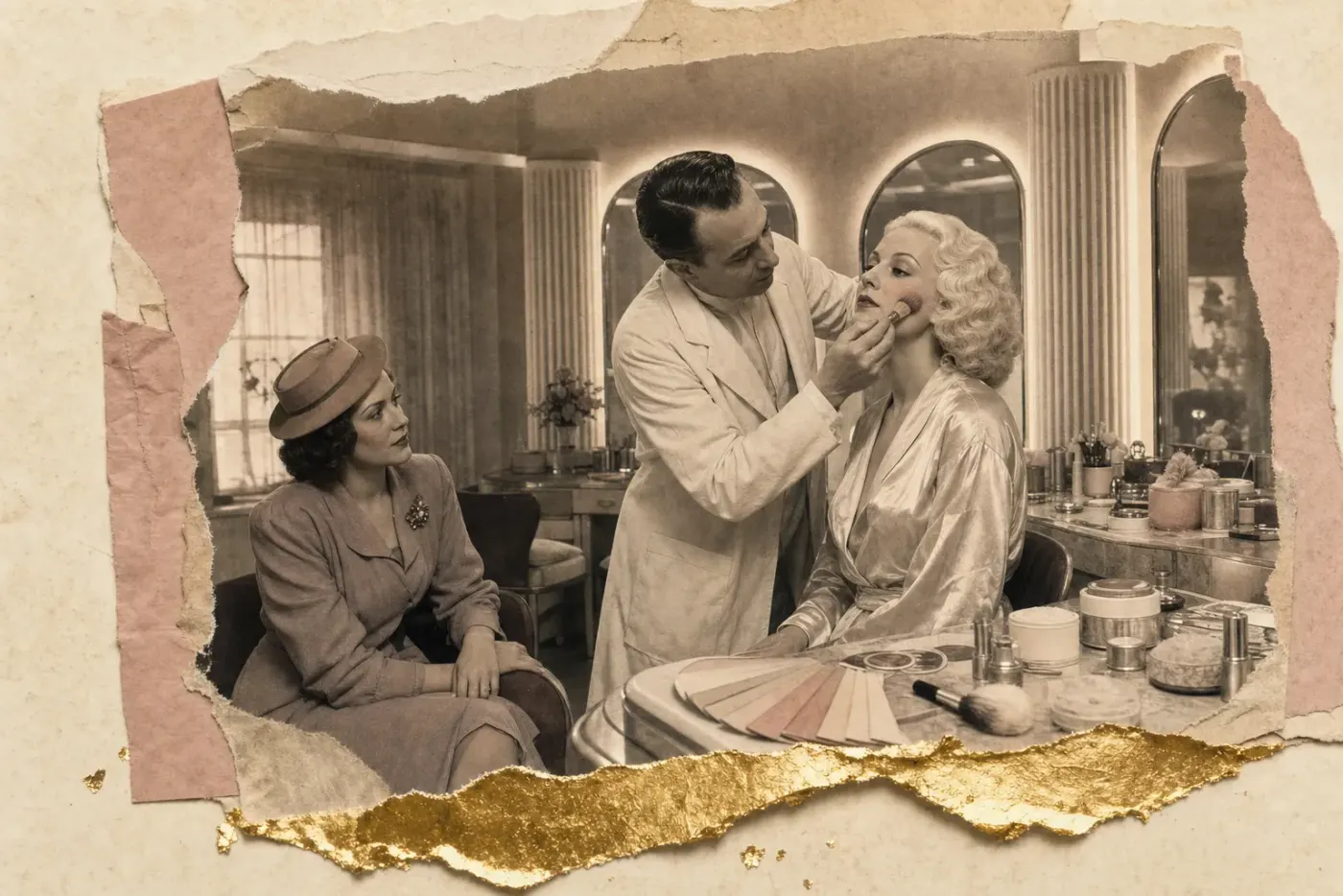
In 1935 Hollywood makeup opened to the public twice: the Westmore brothers’ Salon of Beauty on Sunset Boulevard in April, and Max Factor’s rebuilt Make-up Studio on North Highland Avenue in November, with a room for each of its four colour types.
- 6min read
- 6chapters
- 3sources
The Depression hit Hollywood hard. Paramount-Publix, Fox Film, RKO and Universal went into deficit and later receivership, and Warner Brothers avoided disaster only by ruthless cost-cutting.[1] The firm that sold them their makeup, Max Factor, did better: by 1933 it claimed that 96 per cent of the world’s film studios used its products.[1]
Over the rest of the decade the makeup men turned that position into a consumer business, and the studios’ stars became its advertisements.
A Dollar an Actress
To promote their films and keep costs down, studios including Paramount, 20th Century Fox, Metro-Goldwyn-Mayer, Columbia and Warner Brothers contracted their actresses to advertise Max Factor products for a nominal fee of $1.00. In return, Max Factor promoted the actresses and their latest films.[2] The arrangement let the firm tie its Society range to Hollywood and call it the ‘Cosmetics of the Stars’, and film stars were added to the 96 per cent claim in its advertising.[2]
When the Westmore brothers, who ran the makeup departments at several studios, later tried to sell their own cosmetics on star endorsements, they found that most actresses had already been contracted by their studios to Max Factor.[3]
Measuring the Face
Hollywood also taught a theory of the face. In 1932 Max Factor unveiled a Beauty Calibrator, a device of screws and flexible metal bands that measured how far a face departed from the ideal: oval, symmetrical and balanced in its proportions.[4] Perc Westmore built a system on the same ideal at Warner Brothers. “Within the past year,” he wrote in 1935, “we have put into practice at the Warner Brothers’ studios a new system of makeup which we call ‘Corrective Makeup.’”[4]
It borrowed the cameraman’s rule that light brings a feature forward and shade sends it back. A face too round was slimmed with greasepaint several shades darker at the hairline and under the chin; a broad nose was narrowed with lighter paint along the ridge and darker paint at the sides.[4] MGM’s head of makeup, Jack Dawn, objected that painted shadows work only from certain angles, and the camera and the actor both move.[4]
Don’t get discouraged if these proportions come out wrong. Sylvia’s is one face in a thousand where they come out right. The only thing to do is to give them the appearance of being balanced.
Two Salons
In 1935 Hollywood makeup opened its doors to the public twice. In April the four eldest Westmore brothers, Perc, Monte, Wally and Ern, opened the House of Westmore Salon of Beauty at 6638 Sunset Boulevard.[6] Ern had worked for Max Factor since 1932; he left when the salon opened, and took two of Factor’s employees with him.[6][7]
Max Factor answered in November, reopening its renovated and extended Make-up Studio on North Highland Avenue, designed by S. Charles Lee, in a blaze of publicity on 26 November 1935.[7] A short flight of steps led to an oval reception room that opened into four makeup salons, one for each of the firm’s types — Blondes, Brunettes, Redheads and Brownettes — each decorated in its own colour scheme. Laboratories lay behind them, and manufacturing on the floors above.[7]
Studio Advice for the Street
What the salons sold was the studio’s method in a smaller dose. By the 1930s street makeup was so commonplace that female stars were expected to wear it off the screen as well as on.[8] Both firms used their Hollywood connection to sell general makeup, with advice built on the oval ideal. Max Factor called its techniques ‘face shaping’ and mostly confined it to the eyes, cheeks and lips, while the Westmores gave women corrective plans for the whole shape of the face — what would now be called contouring.[8]
Max Factor registered ‘Max Factor Hollywood’ as a trademark in 1937, and by 1940 had dropped the name ‘Society Make-up’ in its favour.[9] The town’s name had become the selling point.
Glamour, Priced Low
Glamour did not always pay. The Westmores’ business was in severe financial trouble by 1938, and the brothers licensed their cosmetics to a new company in New York, which priced them for variety and chain stores at 25 and 50 cents. Bennett suggests that movie glamour may have sold well only at the lower end of the market.[10]
The regulators caught up with it too. From October 1938 Westmore advertised ‘Color-Filtered’ cosmetics, free, it said, of the hidden tones that cast “ugly aging shadows”; the Federal Trade Commission objected, and in 1940 the company agreed to stop making the claim.[10]
What Is Not Known
The Westmore salon’s opening is dated 13 April 1935 on one page of the history this account relies on and 16 April on another.[11][12] The 96 per cent figure was Max Factor’s own claim, and nothing cited here tests it.[12]
Popular accounts name the film stars who opened each of the Max Factor rooms in November 1935. The sources used here do not, and this account names none. Nor was 1935 the studio’s first opening: a photograph in the same history shows the Make-up Studio on North Highland Avenue opening in 1928.[11]
Sources
- [1, 2, 7, 9, 12]Max Factor (1930-1945)View source (opens in a new tab) Accessed 2026-09-22.
- [3, 6, 10, 11]House of Westmore Cosmetics and Skin (updated 29 April 2025), 2018.View source (opens in a new tab) Accessed 2026-10-03.
- [4, 5, 8]The Ideal Face Cosmetics and Skin (updated 10 November 2020), 2018.View source (opens in a new tab) Accessed 2026-10-03.
Filed under