A Foundation in a Stick: Max Factor’s Pan-Stik
Pan-Cake had made Max Factor’s name. Its successor needed no puff and no sponge: a creamy foundation that turned up out of its case like a lipstick.
In short
Max Factor’s Pan-Stik, a creamy, greaseless foundation in a twist-up stick, was introduced in 1947 and released for general sale in 1948 in seven shades; unlike the firm’s Pan-Cake it could be touched up, and it was among the last Max Factor products endorsed by film stars.
- 5min read
- 6chapters
- 6sources
For a decade Max Factor’s best-selling makeup had been a cake. Pan-Cake, released to the public in 1938,[1] was applied with a sponge,[2] and when it began to fail it usually had to be renewed completely.[3]
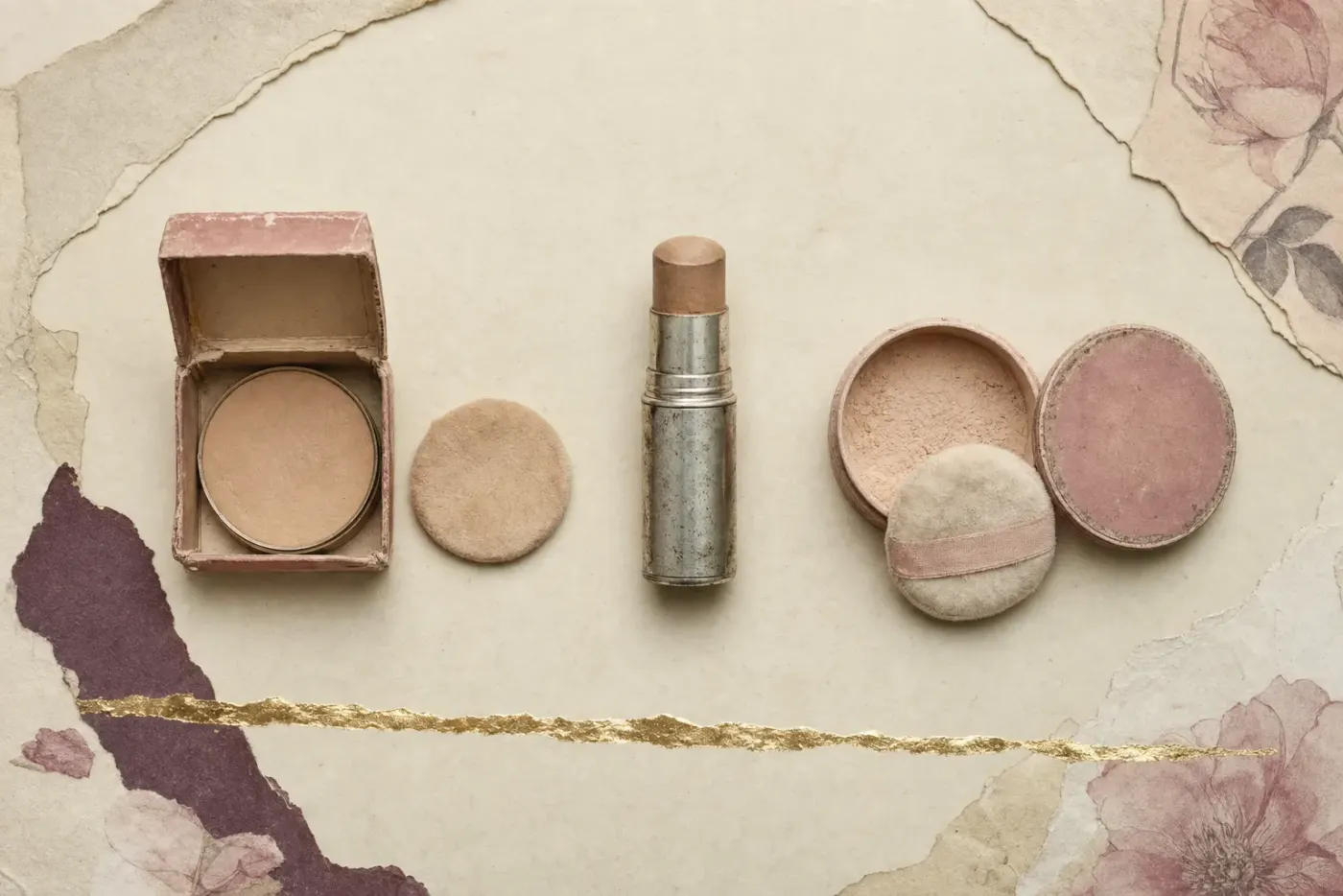
Its successor turned up out of its case like a lipstick. Pan-Stik was introduced in 1947 and released for general sale in 1948, and the advertising listed what it did without: no puff, no sponge, nothing to spill.[3]
The Cake Years
Pan-Cake set a fashion that ran through the war. Helena Rubinstein answered it in 1942 with Town and Country Filmpact, a cake makeup in two textures, one for dry skin and one for oily.[4] Other houses followed with cakes of their own: Elmo’s Photo-Finish in 1942, Pond’s Make-Up Pat and Richard Hudnut’s Du Barry Beauty Cake in 1943, Elizabeth Arden’s Pat-A-Kake in 1945.[5] In Britain, where packaging was short, Pan-Cake itself was sold only as a refill.[6]
A cake had its limits: once it began to fail it usually had to be renewed rather than repaired.[7] In 1944 Rubinstein added Cream-Tint Foundation, a creamy cake makeup that the historian James Bennett calls a presage of a type of makeup that would become popular after the war.[4]
From the Leg to the Face
The war also taught the industry a good deal about bases. Leg makeup, sold in place of stockings, had to cover evenly, dry fast and stay put, and by the end of the war trial and error had produced serviceable products. Many companies then used what they had learned to develop new liquid and cream foundations; Liquid Beauty, an oil-in-water emulsion, was first sold in 1946.[8] The historian of the leg products calls the post-war foundations the true beneficiary of that research.[9]
Max Factor had its studio work to draw on as well. In 1946 it adapted Pan-Cake for black-and-white television, and professional forms of Pan-Stik, like those of Pan-Cake, were later made for black-and-white and colour film and for television.[10]
How It Was Used
Pan-Stik was a creamy, greaseless makeup with a revolving base. The base was turned like a lipstick until the makeup stood above the case; it was then dabbed across the forehead, nose, cheeks and chin, blended upwards and outwards from the centre of the face with the fingertips, and covered with a light layer of matching powder.[11] Where Pan-Cake usually had to be renewed completely when it began to fail, Pan-Stik could be touched up.[11]
It went on general sale in 1948 in seven shades: five colour-harmony shades — Fair, Natural, Medium, Olive and Deep Olive — and two suntan shades, Golden Tan and Deep Tan.[11]
No puff, no sponge, can’t spill or leak in your purse.
Named, Not Numbered
Pan-Stik also marked a change in how Max Factor sold. Its range in 1950 was, Pan-Stik apart, much as it had been before the war, with many shades still carrying the numbers of stage and screen makeup: Cream No. 1, Natural No. 2, Tan No. 1. None of Pan-Stik’s colours had a number, and from then on the firm gave new shades names chosen for their marketing appeal.[13]
It was also one of the last of the old Hollywood products. The studio system that had supplied Max Factor with cheap endorsements began to collapse in earnest in 1948, the year Pan-Stik went on general sale. Pan-Stik and the Color-Fast lipsticks appear to have been the last Max Factor products endorsed by film stars, Elizabeth Taylor, Esther Williams and Jane Russell among them, and by 1955 the company had dropped its tag line, “Cosmetics of the Stars”.[13]
What Came After
The stick was the start of a family. In 1954 Max Factor added Erace, a concealer in stick form, and made versions of Pan-Cake and Pan-Stik for colour television, and in 1955 it launched the Hi-Fi range.[14] The post-war glut was real, too: once the demand pent up by wartime shortages had been met, Max Factor’s gross sales fell from about $17 million in 1946 to $14.4 million in 1950.[14]
The decade that began with a cake ended with a stick, and the next brought the liquids that the leg makeup research had pointed towards: emulsions such as Revlon’s Touch and Glow and, later, Hi-Fi itself.[15]
What Is Not Known
Whether Pan-Stik belongs to 1947 or 1948 depends on what is meant: it was introduced in 1947 and released as a general makeup in 1948, and both dates circulate.[16][17] The sources used here give no price and no sales figure for it, and do not name the chemists who developed it.[16]
Nor do they say how directly the leg makeup research fed into Pan-Stik itself. The historian who connects the two speaks of makeup bases and foundations in general and names no product, and this account claims no more than he does.[18]
Sources
- [1, 6]Max Factor (1930-1945)View source (opens in a new tab) Accessed 2026-09-22.
- [2, 4]Helena Rubinstein (1930-1945) Cosmetics and Skin, 2009.View source (opens in a new tab) Accessed 2026-09-22.
- [3, 7, 10, 11, 12, 13, 14, 16]Max Factor (1945–1960) Cosmetics and Skin, 2026.View source (opens in a new tab) Accessed 2026-09-22.
- [5, 17]Cosmetics Timeline Cosmetics and Skin (updated 6 August 2026), 2012.View source (opens in a new tab) Accessed 2026-10-03.
- [8, 15]Liquid Face Powders Cosmetics and Skin, 2014.View source (opens in a new tab) Accessed 2026-09-25.
- [9, 18]Cosmetic Stockings (Leg Make-up) Cosmetics and Skin, 2012.View source (opens in a new tab) Accessed 2026-09-25.
Filed under