Made for High Definition: The Camera That Saw Every Pore
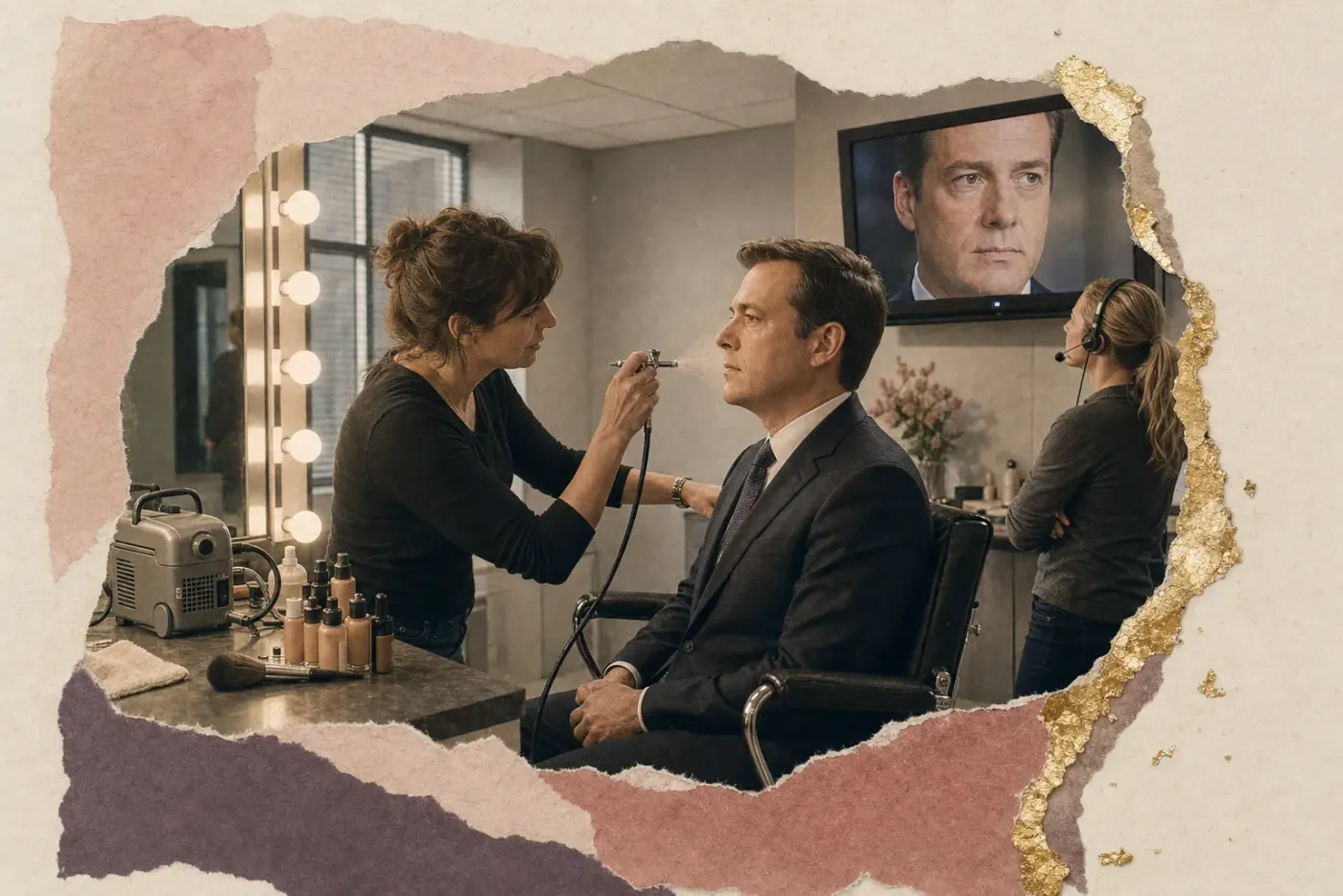
High-definition television showed presenters and actors in more detail than any picture before it. The makeup made to survive it was soon sold, with HD on the label, to people who would never appear on television.
In short
High-definition television made pores, lines and pencil strokes visible; makeup artists answered with airbrushes and thinner, better-placed makeup, and by 2008 Dior, Smashbox, Make Up For Ever and Cargo had made HD products, Cargo selling a whole line to professionals and the public alike.
- 6min read
- 6chapters
- 8sources
Every new way of picturing the face has asked for a new makeup. Colour film asked in the 1930s, when Max Factor developed Pan-Cake for Technicolor, and colour television asked again in 1954, when the same firm made versions of its bases for black-and-white and for colour cameras.[1][2]
High-definition television asked a third time, with a difference. The makeup made for it was soon on sale, with the letters HD on the label, to people who would never be filmed at all.
A Picture Too Good
Engineers saw the problem early. Writing in June 2003, the editorial director of a broadcast-engineering magazine recalled a news anchor who, years before, had hated a new generation of sharper studio cameras because his beard showed unless he shaved twice a day, and a co-anchor who thought they made her look old. High definition, he wrote, had brought the same complaint back, and with it “a new type of make-up for television called airbrushing”: super-thin layers sprayed on, designed to fool the camera.[3]
As high-definition sets reached more American homes, the complaint became general. “It is shocking when you see yourself on the monitor because it enhances every imperfection on your face,” the makeup artist Sheila McKenna told NPR on New Year’s Day 2007; under HD, the programme observed, every pencilled eyebrow looked as if it had been done with a number two pencil.[4]
Less, and Better Placed
The answer was not more makeup but less. “In the past, that used to be just put on more,” McKenna said. Her own line, sold to makeup artists for programmes such as The View and The Today Show, was applied with an airbrush, and its stated aim was products that looked “like skin and not like makeup in front of the high-definition camera.”[5]
Behind the camera the work multiplied. By February 2009, when NPR returned to the subject, there were more than 100 million high-definition televisions in the United States. A Hollywood cinematographer described taking “all the detail out of these $400,000 cameras”; the makeup artist on Nip/Tuck, Eryn Krueger, described keeping red lipsticks from “flaring” on camera, airbrushing to avoid finger marks, and entirely new lines of makeup developed especially for HD.[6]
HD on the Label
In April 2008 the Washington Times reported that Christian Dior, Smashbox and Make Up For Ever had developed products for actors filmed in high definition, and that the Toronto company Cargo had just launched an entire line of them — in what the paper thought looked like a first — sold to professional makeup artists and ordinary customers alike.[7]
The line was named blu_ray, after what the paper called “the recently victorious high-definition DVD format,” and it included a pressed powder and a blush with “micronized light diffusers,” a mattifier, plumping lip glosses and a mascara applied with a comb rather than a brush. Cargo’s founder, Hana Zalzal, said the idea had come from makeup artists asking for a version of its shimmering bronzer without the shimmer: “It’s picking up on-screen.”[7]
Like Pan-Cake, released to the public in 1938, the product found its way off the set. Some actresses, Zalzal said, “were taking this home because it looked so natural,” and she recommended it for “photographs, bridal parties and proms.”[8][7]
If [consumers] can purchase for $20 a bottle of makeup that says HD on it, even if it hasn’t been tested, they’re going to do it.
A Buzzword
Not every makeup artist was convinced. Davida Simon, who had worked in television and film and had been airbrushing since before HD became big, agreed that the camera picked up “things … that we don’t even see,” and welcomed the new foundations. The rest she doubted. “HD has become a buzzword,” she said. “Is a lip gloss really for HD?”[10]
She saw who the products would really serve. Local news could not pay for a makeup artist every day: “It’s something that in the smaller markets, anchors and reporters can put on themselves.”[10] The people least able to hide from the new cameras were the ones the products helped first. Everyone else was sold the label.
An Old Trick
Softening the picture was older than the makeup. NPR’s report of 2009 recalled The Loretta Young Show of the 1950s, for which, according to Don Tillman, a professor at the University of Southern California’s film school, someone put a thin piece of gauze across the camera lens so that its star “looked probably 20 years younger.” Cinematographers working in HD did the same with camera settings, filters, dimmer light on close-ups and focus kept a little soft.[11]
What the decade added was a product with the camera’s name on it, for a face that might only ever be seen across a table. The letters outlasted the format they came from: Make Up For Ever was still selling a foundation called Ultra HD, in forty shades, in the following decade.[12]
What Is Not Known
The sources here do not establish who sold the first HD foundation. The Washington Times thought Cargo’s line looked like the first complete one while naming three companies that had already made HD products, and it gives no dates for theirs.[13]
Nor do they say what, chemically, made a product “HD”. The claims reported — light diffusers, mattifiers, no shimmer — are the makers’ own. No source used here tested them against ordinary makeup under a high-definition camera, and the most sceptical voice in the record belongs to a makeup artist, not a laboratory.[13]
Sources
- [1]Pan-Cake Make-up Cosmetics and Skin.View source (opens in a new tab) Accessed 2026-09-22.
- [2]Max Factor and Television Cosmetics and Skin (updated 21 November 2024), 2009.View source (opens in a new tab) Accessed 2026-10-03.
- [3]Does HD make me look fat? TV Technology (first published for Broadcast Engineering), 1 June 2003, 2003.View source (opens in a new tab) Accessed 2026-10-03.
- [4, 5]New TVs Reveal On-Camera Imperfections NPR, Morning Edition, 1 January 2007, 2007.View source (opens in a new tab) Accessed 2026-10-03.
- [6, 11]HD-Enhanced Blemishes Keeps Makeup Artists Busy NPR, republished by Maine Public, 26 February 2009, 2009.View source (opens in a new tab) Accessed 2026-10-03.
- [7, 9, 10, 13]HD’s view rough on skin The Washington Times, 4 April 2008, 2008.View source (opens in a new tab) Accessed 2026-10-03.
- [8]Pan-Cake Make-up Cosmetics and Skin, 2026.View source (opens in a new tab) Accessed 2026-09-22.
- [12]The Diversity of Makeup Shades The Pudding, 2018.View source (opens in a new tab) Accessed 2026-09-22.
Filed under