Makeup for Colour Film: A Product Designed for a Camera
It was developed to solve a problem with Technicolor and then sold to people who owned no camera at all.
In short
Max Factor’s Pan-Cake was developed between 1936 and 1938 to meet the demands of Technicolor cinematography, first used on screen in Vogues of 1938, and launched to consumers the same year.
- 12min read
- 6chapters
- 3sources

Vivien
Your guide through time
Listen to this essay
6 min listenVivien reads our essays aloud, word for word — every date and every name in its place — so you can listen the way you would be walked through a gallery.
An AI voice, designed for History of Makeup
Almost every cosmetic in this history was made for a face. Pan-Cake was made for a lens, and the difference shows in everything about it — its coverage, its finish, its application method and the speed with which it could be put on.[1]
It was developed between 1936 and 1938, first used on screen in Vogues of 1938, and launched to consumers the same year. Within a short time it was being worn by very large numbers of people who would never be photographed under a Technicolor light.[1]
The Problem It Solved
Three-strip Technicolor recorded colour faithfully enough to expose everything the earlier greasepaint conventions had hidden. A base built for monochrome could read as a mask, a colour shift or a visible edge along the jaw once the film registered hue as well as value.[2]
The set was also an unforgiving environment. Technicolor required intense light, intense light produces heat, and heat defeats a grease-based base within minutes. Any solution had to survive conditions no domestic wearer would ever encounter.[3]
What Made It Different
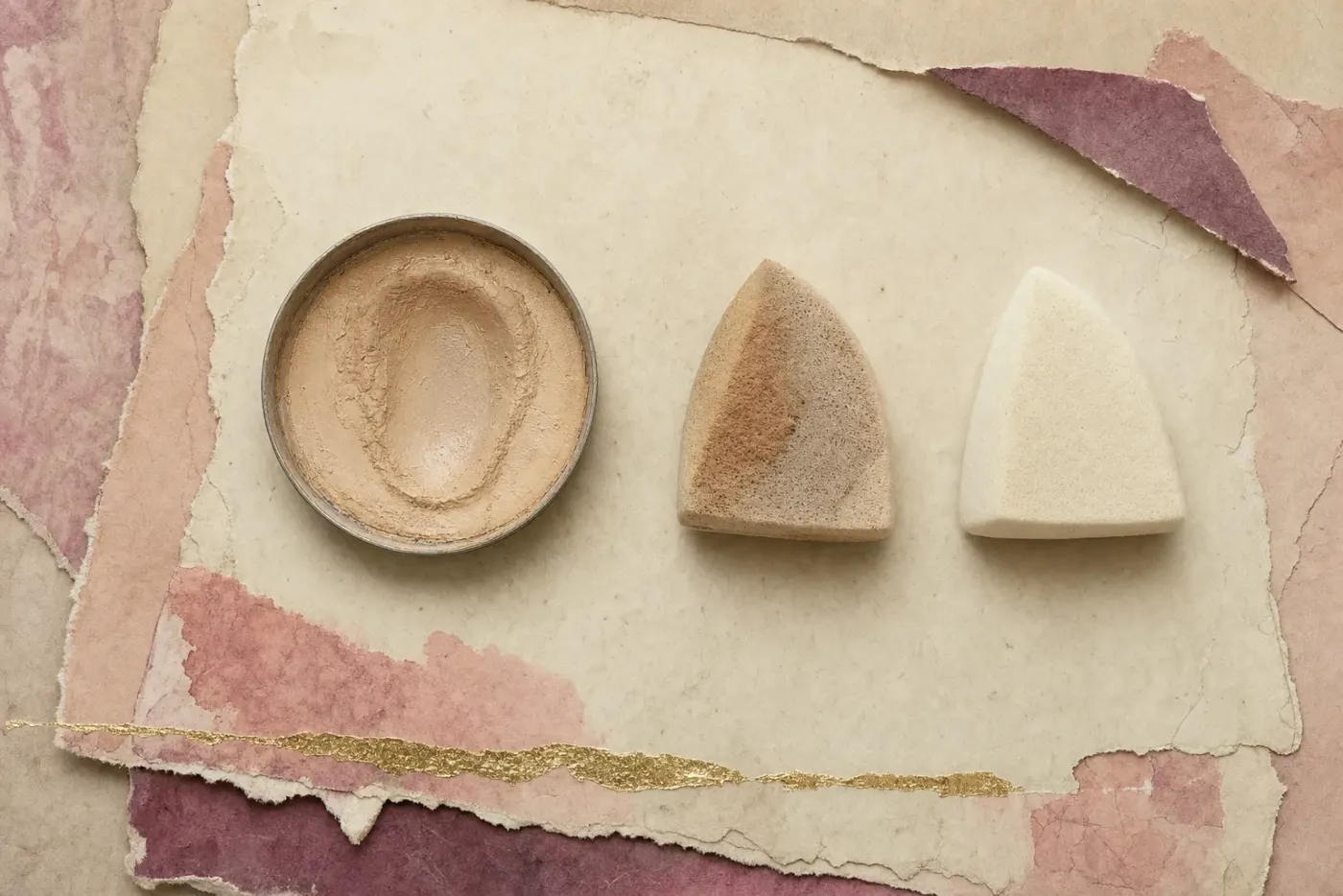
The significant change was physical rather than chemical: a solid cake applied with a damp sponge instead of a grease applied with the fingers. That single alteration governs almost every advantage the product had.[4]
A damp sponge lays a thin even film, blends its own edges, covers more per unit of thickness, and applies far faster than fingers do. It also transfers less, which on a set means fewer retouches between takes and at home means a face that survives a day.[5]
The economy of the thing is worth stating directly: a base that covers more per unit of thickness is a base that can be worn thinner, and a thinner base is one that moves with the face instead of sitting on it. Almost everything people liked about Pan-Cake follows from that single property, which is why the sponge rather than the formula is the invention.[5]
Almost every cosmetic in this history was made for a face. Pan-Cake was made for a lens.
Why the Studio Origin Sold It
The professional provenance was the whole marketing proposition, and it is a genuinely good one: a product that works under the most demanding conditions in the industry carries an implicit guarantee that nothing a buyer does will defeat it.[6]
The firm claimed that ninety-six per cent of studios used its products, and that figure is recorded as a company claim rather than as an independently established fact. The distinction matters, because a claim of near-universal professional adoption is exactly the sort of number a firm has reason to round upward.[7]
Who Actually Developed It
Not established. The fullest survey of the firm’s work states plainly that it does not say who led the Pan-Cake development, and popular accounts that name a single inventor are supplying a detail the record does not carry.[8]
The timing makes a single-inventor story harder rather than easier. Max Factor senior was struck by a delivery truck on North Highland Avenue in 1936, at the opening of the development window, and died in 1938, the year of the consumer launch — so the work spans a period in which his own involvement is exactly what is uncertain.[8]
The firm was in any case already large enough that product development was not one man’s activity. Attributing a laboratory result to the name above the door is a habit of publicity rather than a finding, and the honest position is that the record names a period and a purpose but not a person.[8]
What It Set in Motion
Pan-Cake established the pattern that governs most cosmetic innovation since: a problem arises in a professional context, a solution is engineered for it, and the solution is then sold to everybody on the strength of where it came from.[9]
Long wear, transfer resistance, high coverage and photographic finish all descend from the same lineage, and every one of them is a solution to a problem a camera has rather than to one a person has. A great deal of what a modern base is asked to do is inherited from a film set.[10]
What Is Not Known
The launch year is not agreed. The survey used here dates the consumer launch to 1938, the same year as the first screen use and as Max Factor senior’s death; 1937 circulates widely and is the year this site’s own chronology marks the moment at. Nothing cited here reconciles them, and a reader should treat either date as approximate.[11]
The formulation is not published in any source cited here, and accounts of what Pan-Cake contained should be treated cautiously unless they name an analysis rather than a retelling.[11]
Sales figures are also company figures. The product was plainly very successful; the specific numbers attached to it come from the firm and from trade press repeating the firm.[12]
Sources
- [1, 2, 4, 7, 8, 11]Max Factor (1930-1945)View source (opens in a new tab) Accessed 2026-09-22.
- [3, 5, 10]Max Factor: The Man Who Changed the Faces of the World Arcade Publishing, 2008.
- [6, 9, 12]Beauty Imagined: A History of the Global Beauty Industry Oxford University Press, 2010.
Filed under