Charles Revson and the Matched Set
He sold a nail enamel, matched it to a lipstick, and taught customers to replace both every season.
HOM · Person1906 – 1975Co-founder of Revlon
In short
Charles Revson co-founded Revlon in 1932 on nail enamel, sold lips and nails in matched shades, and in 1952 launched Fire and Ice, the campaign that turned a new colour into an event.
- 3min read
- 5chapters
- 5sources

Vivien
Your guide through time
Listen to this essay
4 min listenVivien reads our essays aloud, word for word — every date and every name in its place — so you can listen the way you would be walked through a gallery.
An AI voice, designed for History of Makeup
Revlon was founded in 1932 by Charles Revson, his brother Joseph and the chemist Charles Lachman, who supplied the L in its name. It began with a single product, a nail enamel, sold to beauty salons in the depths of the Depression.[1]
Revson was not a chemist and did not pretend to be. What he understood better than anyone else in his industry was colour as a commodity with a shelf life, and he built a company on it.[2]
Opaque Enamel
Nail varnish in the early 1930s was mostly a transparent tint. Revlon's was an opaque cream enamel made with pigments, which could carry a strong, even colour, and could therefore be sold in a range of shades the way a lipstick was.[3]
That was the commercial point. A colour that could be matched could be sold as a set, and a set could be replaced.
Lips and Fingertips
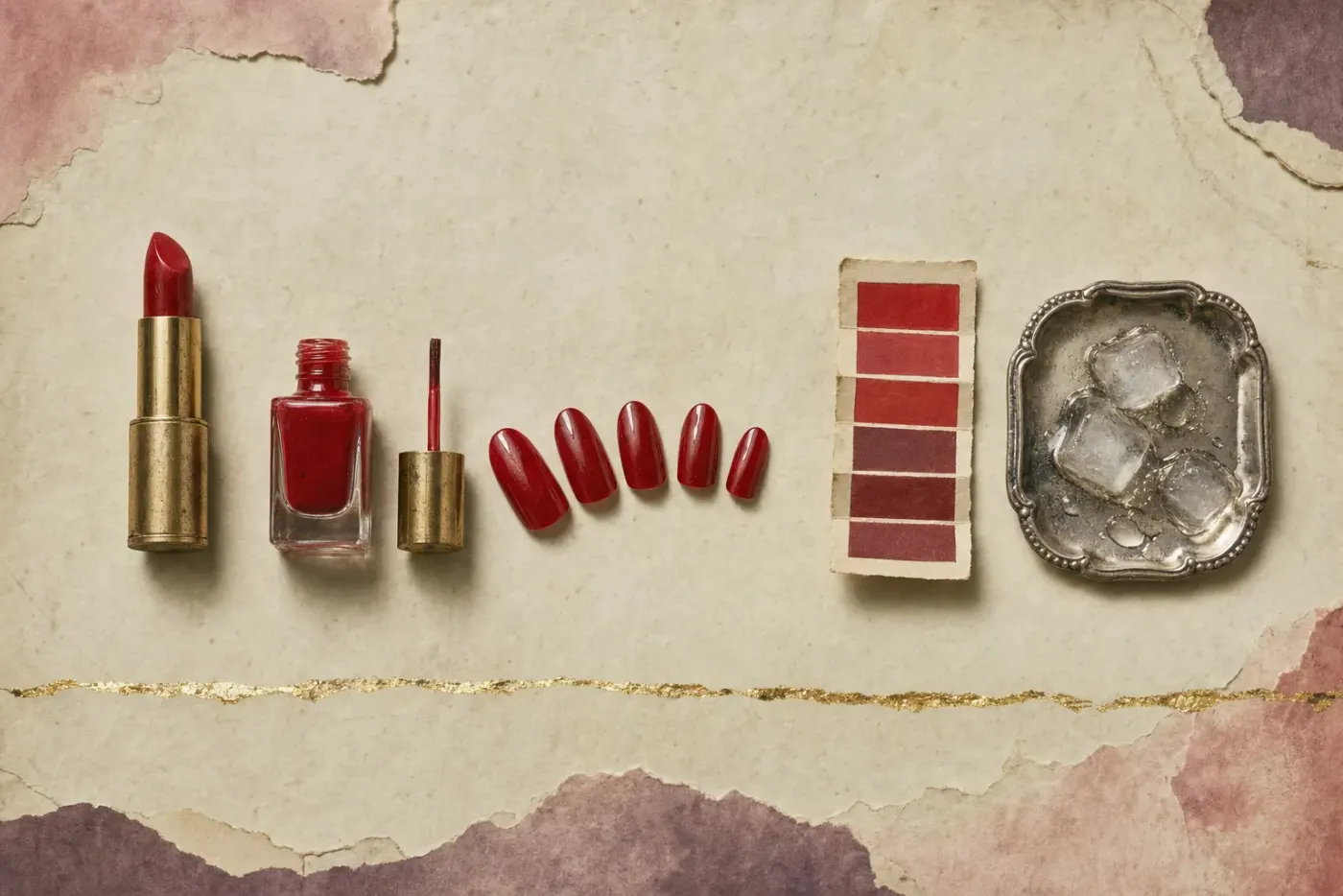
Revlon carried its enamel shades into lipstick and sold the two as a pair, lips and fingertips in the same colour.[4] A customer who wanted the new nail shade now needed the lipstick to go with it, and the other way round.
The logic is the one the counters of the 1920s had used for complexions, when customers were sorted into types and sold matched sets, applied here to a smaller surface and a faster cycle.[5]
Fire and Ice
The campaign that made the method famous ran in 1952. Fire and Ice was a matched red for lips and nails, launched with a photograph of the model Dorian Leigh and a questionnaire that asked the reader whether she was made for it.[6] The product was a red. The campaign sold a temperament.
It became the template for seasonal colour promotion across the industry: a named shade, launched as an event, carried by an image and a story, and replaced by the next one.[6] The cycle has a history of its own on this site. Revson is the man who proved it could be run every year.
The product was a red. The campaign sold a temperament.
Television
From 1955 Revlon sponsored the television quiz The $64,000 Question, which put the brand in front of a national audience every week, until the quiz-show scandals at the end of the decade tarnished the format.[7] Revson ran the company until his death in 1975.[7]
A colour that expires needs a way to announce its successor, and a weekly audience of millions was the most efficient announcement the decade offered. The shade and the medium grew up together.[8]
After Revson
The company outlived him and kept his habit of treating a lipstick as a technical problem with a commercial answer. A Revlon patent with a priority date in 1992, granted in 1996, claimed cosmetics with improved resistance to transfer, built on a volatile solvent chosen from volatile silicones and isoparaffins: colour meant to stay on the lips rather than on the cup.[9]
In 2016 the company he built bought Elizabeth Arden, the house whose founder had defined the generation of American beauty before his.[10] The matched set had outlasted the salon.
Sources
- [1, 3, 4, 6, 7]Fire and Ice: The Story of Charles Revson William Morrow, 1976.
- [2, 8]Beauty Imagined: A History of the Global Beauty Industry Oxford University Press, 2010.
- [5]Hope in a Jar: The Making of America’s Beauty Culture Metropolitan Books, 1998.
- [9]Cosmetic compositions with improved transfer resistance. United States Patent 5,505,937, assigned to Revlon, priority 15 December 1992, granted 9 April 1996 United States Patent Office, 1996.View source (opens in a new tab)
- [10]Cosmetic Entrepreneur Elizabeth Arden Born, This Month in Business HistoryView source (opens in a new tab) Accessed 2026-09-22.
Filed under