The Empress Dowager Cixi at Her Dressing Table
The fullest account of her make-up was written by a lady-in-waiting who was not always a reliable narrator.
HOM · Person1835 – 1908Empress Dowager of China and regent
In short
According to her lady-in-waiting Der Ling, the Empress Dowager Cixi dressed her hair first, then washed, sprayed her face with a glycerine made of honey and flower petals, and finished with a strongly scented pink powder.
- 3min read
- 5chapters
- 3sources

Vivien
Your guide through time
Listen to this essay
4 min listenVivien reads our essays aloud, word for word — every date and every name in its place — so you can listen the way you would be walked through a gallery.
An AI voice, designed for History of Makeup
The Empress Dowager Cixi lived from 1835 to 1908, and for much of the second half of the nineteenth century she was the real power at the Qing court.[1] She is also the rare ruler whose dressing table was described in detail by someone who stood beside it.
That someone was Der Ling, who served at her court for two years and published an account of it in 1911.[2] The account is vivid and specific, and it has to be read with a clear view of its author.
The Toilette
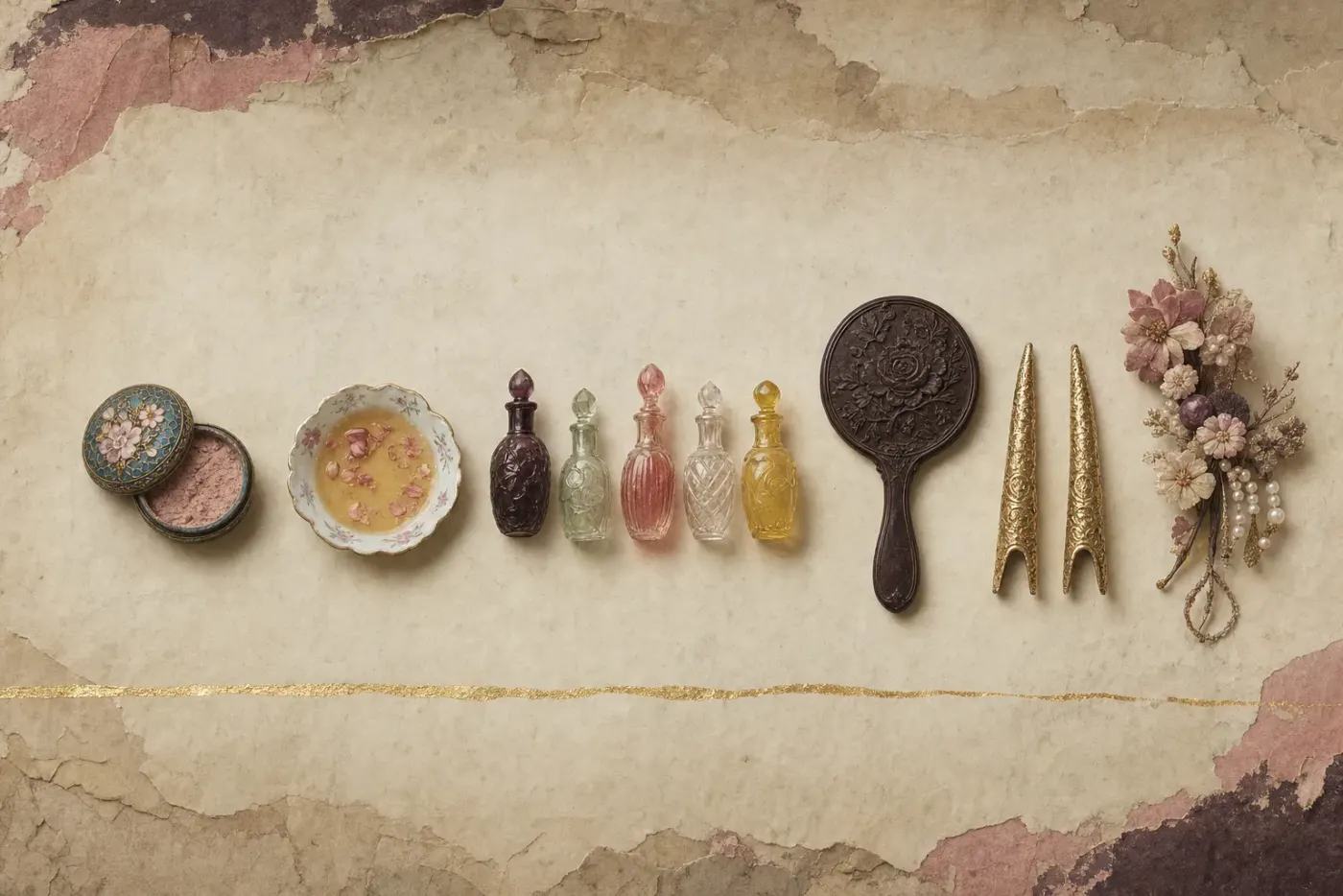
By Der Ling's account the routine had an order. The empress dressed her hair first, parted in the centre and brought low behind the ears, with the back braid twisted into a tight knot to take the Manchu headdress, and only then washed her face. She kept dozens of bottles of perfume and perfumed soap. After washing she dried her face on a soft towel, sprayed it with a kind of glycerine made of honey and flower petals, and then put on some kind of strong scented pink powder.[3]
The toilette travelled with her. When she was carried through the palace, eunuchs followed her chair with her clothes, combs and brushes, powder boxes, looking glasses of several sizes and perfumes.[3]
Paint as a Signal
The most revealing passage is about someone else's face. The empress told Der Ling that she never put enough paint on: People might take you for a widow. You will have to paint your lips, as that is the custom. Der Ling went back to her room, painted herself like the other ladies, and could not help laughing at how changed she looked.[4]
The remark treats make-up as information. At that court an unpainted face said something specific about a woman's circumstances, and a lady-in-waiting who under-painted was sending the wrong message. The paint was less a matter of beauty than of being read correctly by everyone who looked.
People might take you for a widow. You will have to paint your lips, as that is the custom.
Managing the Image
Her attention to her appearance extended to its reproduction. The only surviving photographs of her were taken by Xunling in 1903 and 1904, and she took an active part in directing the content and composition of each one. Carefully beautified and elaborately painted prints were made from them, and some went abroad as gifts, to President Theodore Roosevelt in 1904 and to his daughter Alice in 1905.[5]
The painted prints and the painted face belong to the same project. Both present a ruler as she chose to be seen.
How Far to Trust Der Ling
Der Ling's later career was built partly on the story of her service. Her biographer calls her life a legend in the title of his book, and describes her as a victim of too much publicity, much of it prompted by Der Ling herself.[6]
That does not make her toilette scenes false. The order of hair and washing, the honey glycerine, the pink powder and the widow remark are the kind of small practical details an insider notices and an inventor has little reason to supply. But they come from one witness, writing years later for Western readers, and nothing cited here corroborates them independently.[7]
What Is Not Known
What was in the powder. Der Ling describes its colour and its scent, not its composition, and does not say where it came from.[8] Nor does she say how the routine changed with the occasion, the season or the empress's age.
Sources
- [1, 5]The Empress Dowager and the Camera MIT Visualizing Cultures, 2011.View source (opens in a new tab) Accessed 2026-09-25.
- [2, 3, 4, 7, 8]Two Years in the Forbidden City Project Gutenberg eBook #889; introduction by Thomas F. Millard dated Shanghai, 24 July 1911, 1911.View source (opens in a new tab) Accessed 2026-09-25.
- [6]Imperial Masquerade: The Legend of Princess Der Ling Hong Kong University Press, 2008.View source (opens in a new tab) Accessed 2026-09-25.
Filed under