The Face on Duty
Never rationed, always short: a decade in which lipstick was defended as good for morale, stockings came out of a bottle, a uniform set the colour of a mouth, and peace brought new skirts and a foundation in a stick.
HOM · Era1940 – 1949Morale & Make-Do
All of The 1940s Era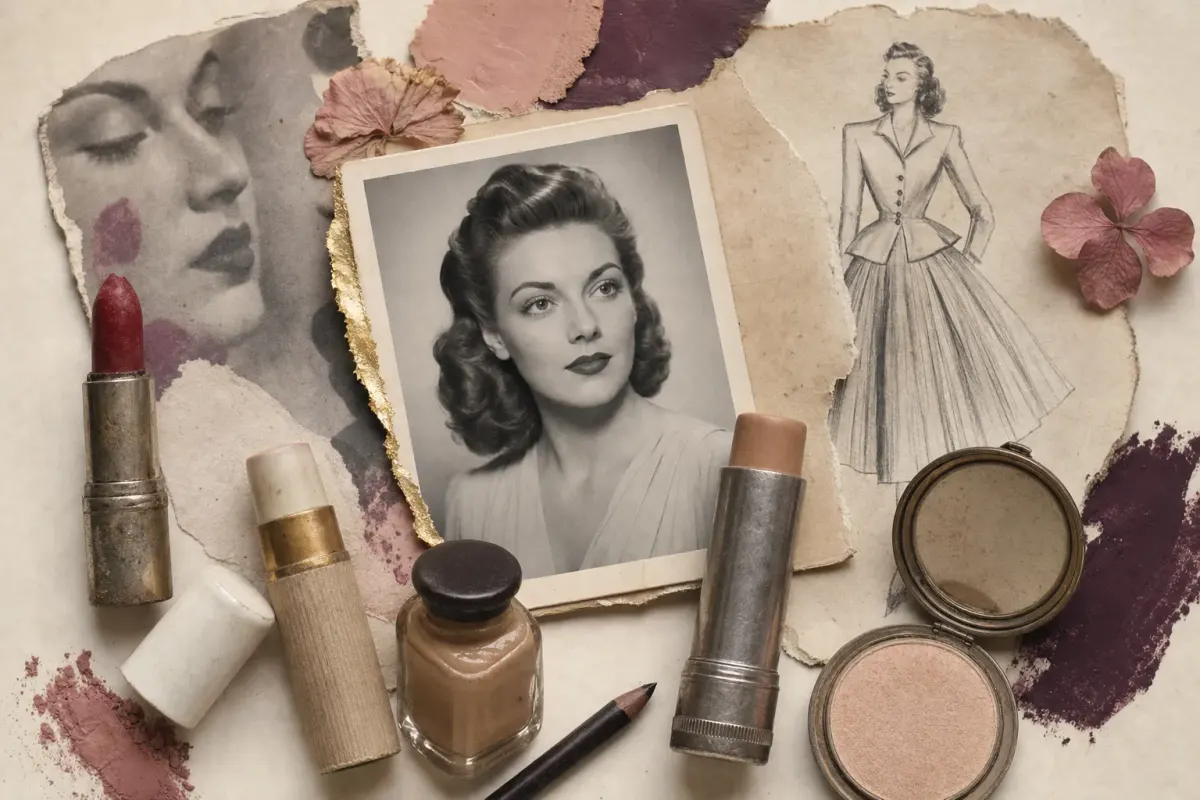
In short
In the 1940s makeup was never rationed in Britain, nor lipstick in the United States, but both were made under wartime shortages — in smaller quantities, in cardboard and plastic — and defended as good for morale; peace brought Dior’s New Look in 1947 and Max Factor’s Pan-Stik foundation on general sale in 1948.
- 9min read
- 7chapters
- 20sources
The 1940s did not take makeup away. In Britain it was never rationed, and in the United States lipstick never was either. What the war took was almost everything around it — the metal for the case, the silk and nylon for stockings, much of the factory time — and what was left was made in smaller quantities, packed in cardboard and plastic, and defended by government and advertiser alike as good for morale.[1][2]
Then the war ended, and the decade started again. Paris sent out a new silhouette, a new cosmetics house won its first department-store counter, and Hollywood’s makeup firm put its foundation into a stick. This is the story of a decade that made do, and of what it made when it no longer had to.
Never Rationed
In Britain the case was made by government. Clothes were rationed from 1 June 1941, but makeup never was: it carried a luxury tax and was very expensive, and the Imperial War Museum records that official concern for women’s morale was a major factor in the decision to keep cosmetics in production at all, though in much reduced quantities.[3] Manufacturers worked under rigid limits on how much they could make, and Boots, whose No7 range had taken its first steps into colour cosmetics only in 1937, found that sharing out the limited supply fairly became a real concern.[4] Metal compact cases stopped being made in 1942.[5]
In the United States lipstick was not rationed at all. The historian Einav Rabinovitch-Fox writes that the War Production Board treated it as essential, to women’s well-being and to national morale alike.[6] What ran short was everything around it. Women were encouraged to buy refills in cardboard boxes — in Britain Max Factor’s Pan-Cake came only as a refill — and from 1943 to 1946 its Tru-Color lipstick wore a white plastic top where the metal had been.[7] Other makers went back to cardboard cases or tried the newer plastics, with mechanisms so unsatisfactory that many women moved their lipsticks into their old metal cases, often breaking them on the way.[8]
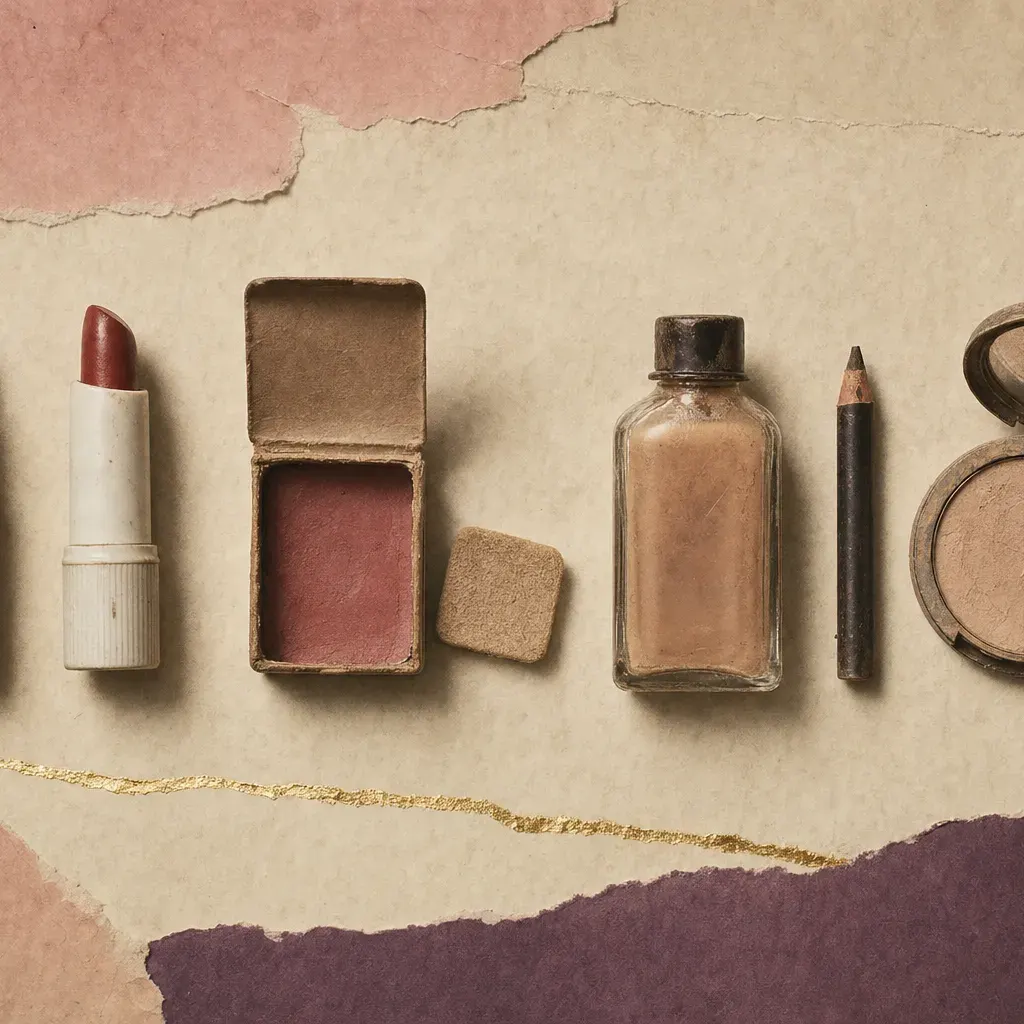
Don’t feel guilty when you buy cosmetics and toilet goods. It’s every woman’s duty to look as pretty as she can.
Stockings From a Bottle
Stockings went to war before lipstick could. Nylon stockings had been launched nationally in the United States only in 1940; when the country entered the war, DuPont’s nylon went to parachutes and bomber tyres, and silk was gone too, trade with Japan having ceased.[10] In Britain a pair of stockings cost two clothing coupons, from an allowance that began at sixty-six points a year and shrank as the war went on.[11]
The cosmetics industry offered paint. Leg makeup was not new — lotions to give the legs a tan had been sold since the late 1920s — but in wartime a long list of houses sold it as a stand-in for stockings: Revlon’s Leg Silk, Helena Rubinstein’s Leg Stick, Dorothy Gray’s Leg Show, Cyclax’s Stockingless Cream.[10] It was hard to make well and slow to put on. It had to dry quickly, cling to the skin, survive a skirt hem and still wash off, and many brands separated in the bottle. The seam was drawn on afterwards with an eyebrow pencil, by those with a steady hand.[10]
A Regulation Red
For some women the face itself became regulation. The Marine Corps Women’s Reserve, publicly announced in February 1943, allowed and in fact encouraged lipstick and nail polish, provided the colour harmonised with the red cord on the winter service cap.[12][13] Rouge and mascara were permitted if they were inconspicuous, and leg makeup, allowed in some other services, was not allowed at all. The favourite shade was Montezuma Red, made in the Women Marines’ honour.[13]
Elizabeth Arden is credited with it, and with a Victory Red. Their dates are less settled than their names, and the timeline story on Montezuma Red sets out what the sources do and do not agree on.[14][15] The industry’s war work went well beyond the counter: Revlon assembled first-aid kits and made dye markers for the navy and hand-grenades for the army, Max Factor made camouflage makeup for the Marine Corps, and in 1942 Helena Rubinstein won a contract for army kits that included camouflage and sunburn creams.[16][17][18]
The New Look
Peace did not end the shortages. In Britain clothes rationing lasted, gradually relaxed, until March 1949, and the Utility scheme for price-controlled clothing, begun in 1942, ran until 1952.[19] Into that economy, on 12 February 1947, Christian Dior launched his house with a collection he called La Ligne Corolle. Carmel Snow, editor of the American Harper’s Bazaar, christened it the New Look on the spot: rounded shoulders, a hand-span waist and enormous skirts, the antithesis of lean, boxy wartime clothes.[20]
A New Look day dress in wool typically took fifteen metres of fabric, and a short taffeta evening gown twenty-five, which caused outrage where rationing was still in place; the Board of Trade tried to suppress it, without success.[20] The clothes say plainly what the end of the decade wanted. The sources cited here describe the silhouette rather than the face that went with it, and this account does not supply one they do not record.
Starting Again
The post-war counter filled quickly. Max Factor returned its lipsticks to metal cases in 1946, and found that once the demand pent up by wartime shortages had been met there was a glut: its gross sales fell from about $17 million in 1946 to $14.4 million in 1950.[21] The work that had gone into leg makeup was not wasted. Its true beneficiary, in the judgement of the historian James Bennett, was the new generation of makeup bases and foundations, and companies used what they had learned to make new liquid and cream face powders; Liquid Beauty, an oil-in-water emulsion, was first sold in 1946.[22][23]
Max Factor’s own answer was Pan-Stik, a creamy makeup in a stick, introduced in 1947 and released for general sale in 1948; unlike Pan-Cake, it could be touched up rather than renewed.[21] In New York, meanwhile, Estée Lauder, whose company was founded in 1946, won a place at Saks Fifth Avenue — in 1947 according to Bennett, who reproduces the first invoice,[24] and to the company’s own account of its first order,[25] in 1948 according to PBS.[26]
The Face of the Decade
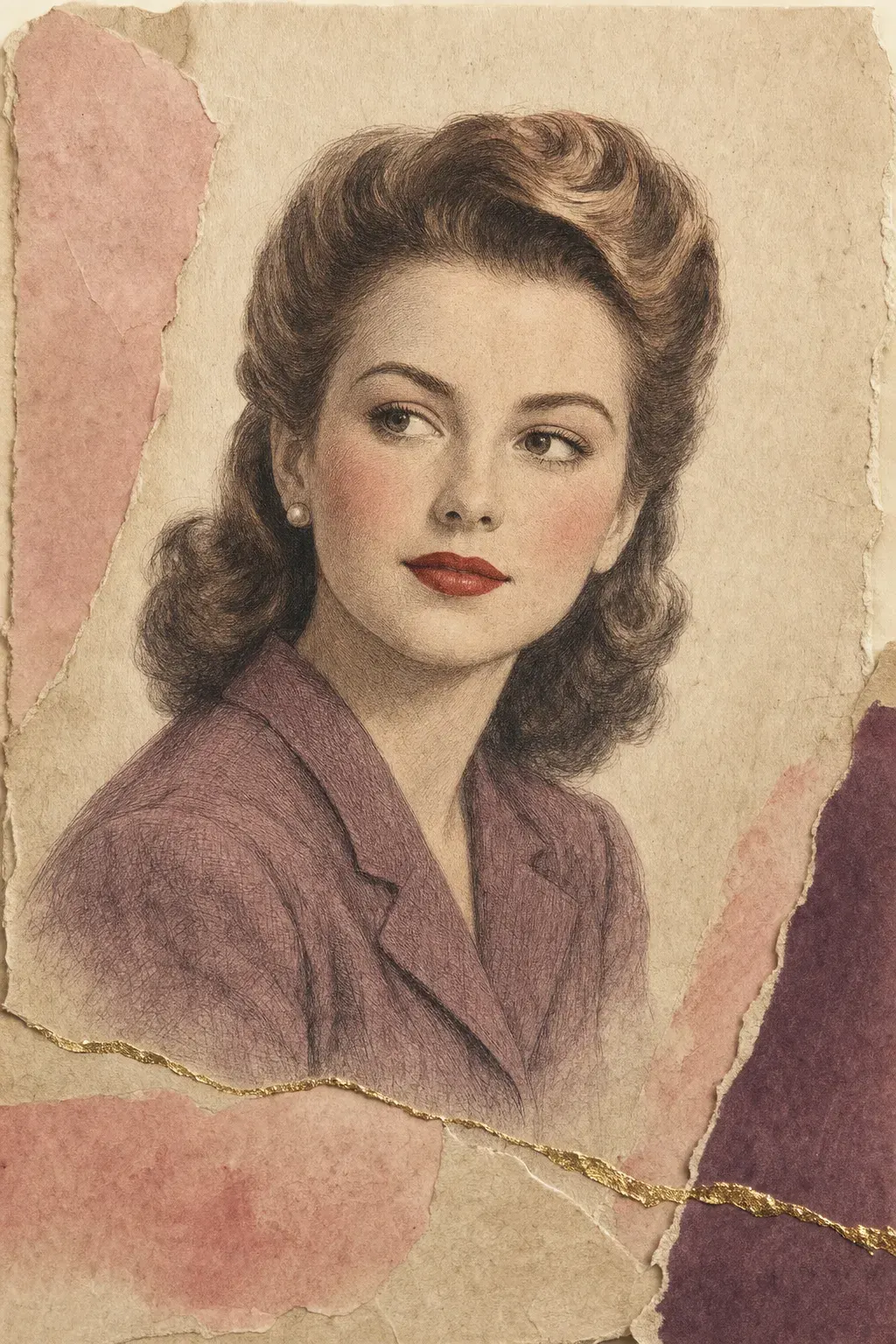
The products describe the face. At the start of the decade Max Factor sold Pan-Cake, to be worn over an invisible foundation; face powder, to be patted on with a puff and never rubbed; rouge in four shades; an eyebrow pencil in black or brown; eye shadow in brown, grey or blue; mascara in black or brown; and a lipstick, Tru-Color, sold on giving the lips “a lifelike red tone, with no purple or bluish undertones.”[27] The Women Marines’ rules give the same face its emphasis from the other side: a red mouth to match the uniform, rouge and mascara kept inconspicuous.[28]
The plate here is reconstructed from those products and those rules rather than from any one woman’s routine, and the steps beside it say what each takes to do now. By the end of the decade the base was moving into the stick: Pan-Stik was dabbed across the forehead, nose, cheeks and chin, blended upwards and outwards from the centre of the face with the fingertips, and covered with a light layer of matching powder.[29]
What Is Not Known
The decade’s most repeated details are often its least documented. The Imperial War Museum’s own popular guides say that British women stained their lips with beetroot juice and used boot polish for mascara; neither page gives a period source, this account has not found one, and the story is recorded here as the museum tells it rather than as established practice.[30][31]
The American side has a gap of its own. Lipstick was not rationed in the United States, and a historian of the period writes that the War Production Board treated it as essential to morale.[32] Whether the Board ever moved to restrict cosmetics and then thought better of it is a story this archive has not been able to check against the Board’s own orders, and it is not told here.
The dates of the decade’s famous shades disagree. A Marine Corps museum education sheet dates Montezuma Red to 1942 and has Victory Red follow it; the cosmetics historian James Bennett dates Victory Red to 1941 and Montezuma Red to 1943.[33][34] And the New Look is better recorded than the face that went with it. One historian’s timeline lists, under 1949, an oeil de biche — a doe-eyed look — credited to Fernand Aubrey (so spelled), with no further detail; it belongs to the story of the next decade, if it belongs anywhere.[35]
Sources
- [1, 3, 11, 19, 31]Clothes Rationing in Britain During the Second World War Imperial War Museums.View source (opens in a new tab) Accessed 2026-10-03.
- [2, 6, 9, 32]Common Threads: The History of Lipstick The Saturday Evening Post (22 April 2026), 2026.View source (opens in a new tab) Accessed 2026-10-03.
- [4]Inspiring Beauty, exhibition board 4 (Boots No7 and the Second World War) University of Nottingham, 2015.View source (opens in a new tab) Accessed 2026-10-03.
- [5, 30]10 Top Tips For Winning At World War 2 ‘Make Do And Mend’ Imperial War Museums.View source (opens in a new tab) Accessed 2026-10-03.
- [7, 17, 27]Max Factor (1930-1945)View source (opens in a new tab) Accessed 2026-09-22.
- [8]Lipsticks Cosmetics and Skin, 2009.View source (opens in a new tab) Accessed 2026-09-22.
- [10, 22]Cosmetic Stockings (Leg Make-up) Cosmetics and Skin, 2012.View source (opens in a new tab) Accessed 2026-09-25.
- [12]Free a Marine to Fight: Women Marines in World War II — The First WRs Marine Corps History and Museums Division (Marines in World War II Commemorative Series); npshistory.com mirror.View source (opens in a new tab) Accessed 2026-10-03.
- [13, 28]Free a Marine to Fight: Women Marines in World War II — Uniforms Marine Corps History and Museums Division (Marines in World War II Commemorative Series); npshistory.com mirror.View source (opens in a new tab) Accessed 2026-10-03.
- [14, 33]Montezuma Red: Women Marines in WWII National Museum of the Marine Corps.View source (opens in a new tab) Accessed 2026-09-22.
- [15, 34]Elizabeth Arden (1930-1945) Cosmetics and Skin.View source (opens in a new tab) Accessed 2026-09-22.
- [16]Revlon Cosmetics and Skin (updated 26 April 2021), 2012.View source (opens in a new tab) Accessed 2026-10-03.
- [18]Helena Rubinstein (1930-1945) Cosmetics and Skin, 2009.View source (opens in a new tab) Accessed 2026-09-22.
- [20]‘Bar’ suit, Christian Dior, designed 1947 (T.376&A-1960) Victoria and Albert Museum.View source (opens in a new tab) Accessed 2026-10-03.
- [21, 29]Max Factor (1945–1960) Cosmetics and Skin, 2026.View source (opens in a new tab) Accessed 2026-09-22.
- [23]Liquid Face Powders Cosmetics and Skin, 2014.View source (opens in a new tab) Accessed 2026-09-25.
- [24]Estée Lauder Cosmetics and Skin (updated 12 March 2025), 2023.View source (opens in a new tab) Accessed 2026-10-03.
- [25]Our Founder The Estee Lauder Companies.View source (opens in a new tab) Accessed 2026-09-22.
- [26]Who Made America? Innovators: Estée Lauder PBS (They Made America).View source (opens in a new tab) Accessed 2026-10-03.
- [35]Cosmetics Timeline Cosmetics and Skin (updated 6 August 2026), 2012.View source (opens in a new tab) Accessed 2026-10-03.
Continue in The 1940s Era
Morale & Make-Do
Browse all 10 articles