Patriotic to Be Pretty: Lipstick Goes to War
Lipstick was never rationed. It came in cardboard and plastic, in shades named for the war, and with an argument attached: that looking well was part of the war effort.
In short
Lipstick was never rationed in the Second World War: in the United States it was treated as essential to morale and sold as a duty — “It’s Patriotic to Be Pretty!” announced a Cosmopolitan advertisement of November 1942 — while metal shortages put it into cardboard and plastic cases.
- 6min read
- 5chapters
- 11sources
In November 1942 an advertisement in Cosmopolitan announced that it was patriotic to be pretty, and told its readers not to feel guilty about buying cosmetics.[1] The United States had been at war since the end of 1941.[2] Stockings, girdles and hairpins were rationed. Lipstick, in the United States, never was.[1]
It stayed on sale with an argument attached, and the argument was made on both sides of the Atlantic: that how a woman looked was part of how a country kept its nerve.
Essential to Morale
The historian Einav Rabinovitch-Fox writes that the War Production Board treated lipstick as essential, not only to women’s well-being but to national morale and to the Allies’ ability to win the war.[3] The advertising agreed. Women in uniform, in overalls or in slacks were often barred from heels, frills and jewellery for safety’s sake, and lipstick became a way of keeping femininity inside the uniform. A Tangee advertisement made the point in so many words.[3]
In Britain the case was made by government. Clothes were rationed but makeup never was, and the Imperial War Museum records that concern for women’s morale was a major factor in keeping cosmetics in production, in much reduced quantities and under a luxury tax.[4] At Boots, given the power the products were felt to have over morale, sharing out the limited supply fairly became a real concern.[5]
[I]t’s a reflection of the free democratic way of life that you have succeeded in keeping your femininity — even though you are doing a man’s work!
Shades for the Duration
The shade cards followed the news. Elizabeth Arden added a Victory Red to her lipsticks in 1941, a nail polish called Blackout in 1942, and Winged Victory in 1945.[7] Revlon’s best-known wartime shade borrowed a film: Mrs. Miniver Rose, released after MGM’s Mrs. Miniver of June 1942 without asking the studio, and soon matched by print fabrics and real and artificial roses in stores all over America.[8]
In Britain, Australia and other Commonwealth countries Helena Rubinstein sold a patriotic Regimental Red, which Bennett dates to 1939 and which, as far as he can tell, was not available in the United States.[9] The names were the cheapest part of the war effort. The cases were harder.
Cardboard and Plastic
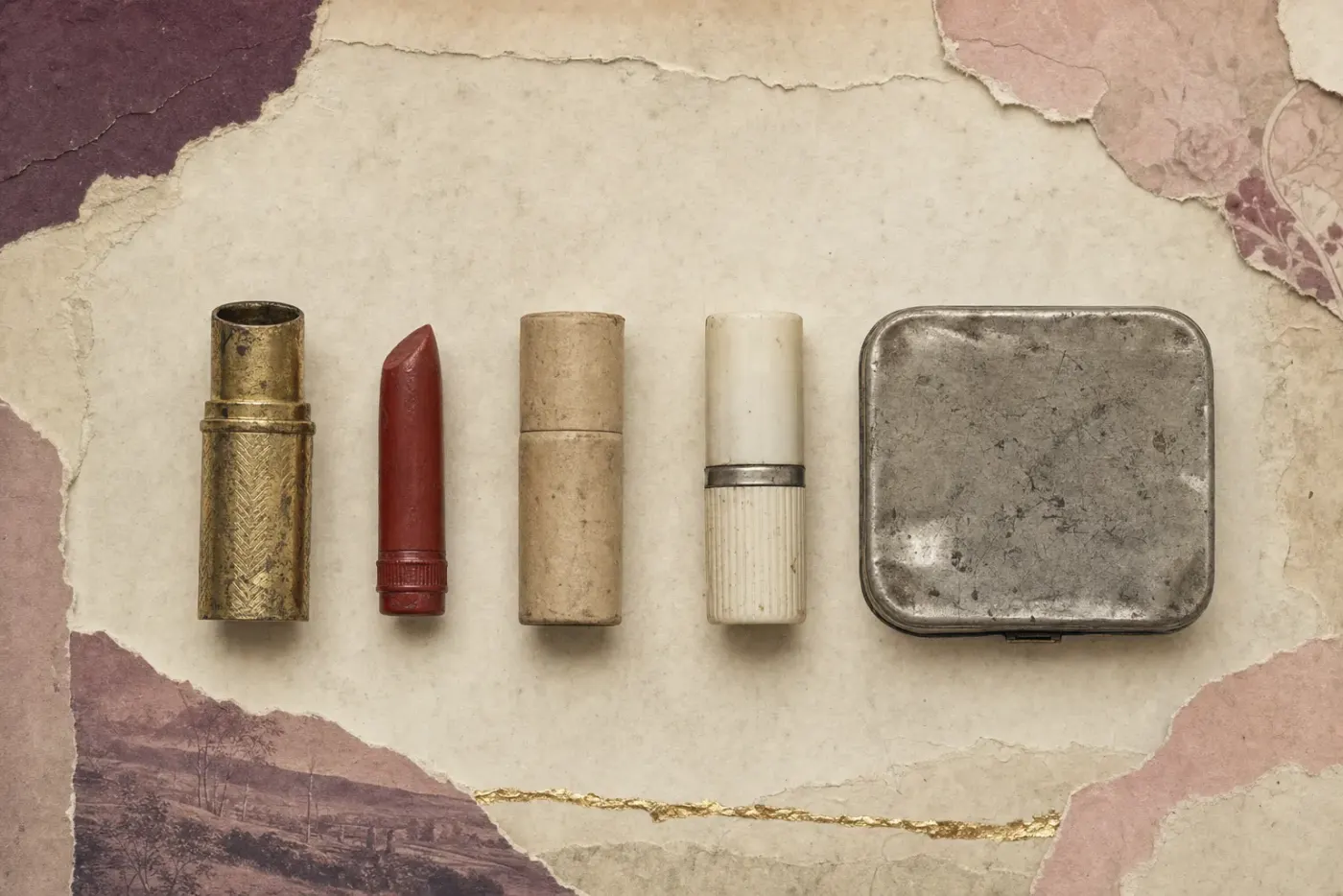
The war took the metal. Most automatic lipsticks went out of production under wartime packaging restrictions, and makers went back to cardboard or tried the newer plastics.[10] Revlon’s Mrs. Miniver Rose came in a plastic case;[11] Max Factor’s Tru-Color lipstick had its metal top replaced with white plastic from 1943 to 1946, and in Britain and America alike women were encouraged to buy refills sold in cardboard boxes.[12] In Britain the production of metal compact cases ceased in 1942, and many face powders came without a puff.[13]
The substitutes were not much liked. Their mechanisms were often unsatisfactory, and many women brought out their old metal cases and moved the new sticks into them — not easily, since the lipstick often broke, and some asked the salesgirl on the cosmetics counter to do it for them.[10] Revlon cut seven shades of nail enamel and matching lipstick from its line in 1943, perhaps because of shortages of glass, metal and ingredients.[11]
The Factories Go to War
The companies that sold the morale also made munitions. Revlon assembled first-aid kits, made dye markers for the navy and manufactured hand-grenades for the army.[14] Max Factor made camouflage makeup for the Marine Corps.[15] In 1942 Helena Rubinstein won a contract to supply the army with kits that included camouflage and sunburn creams, used in Operation Torch, the invasion of North Africa, that November.[16] In Britain Coty, known for its face powder and perfume, made army foot powder and anti-gas ointment.[17]
Some products simply stopped. The Kurlash eyelash curler, improved as recently as 1941, went out of production in 1943 when its factory was turned over to the war effort, and did not come back until after the war.[18]
What Is Not Known
The War Production Board’s view of lipstick is reported here as one historian gives it.[19] Whether the Board ever moved to restrict cosmetics and then thought better of it is not something this archive has been able to check against the Board’s own orders, and no such episode is told here.
Nor is the origin of Victory Red settled. Bennett lists it among Arden’s lipsticks of 1941; a Marine Corps museum education sheet says Arden created it for the public after Montezuma Red became popular, which would put it later; and Rabinovitch-Fox has Arden reveal it in an article in The Saturday Evening Post, without a date.[20][21][19] Regimental Red is dated to 1939 and to Britain by Bennett, and to 1941 by the museum sheet.[22][21]
The home-front stories of beetroot juice for lip colour and boot polish for mascara appear in the Imperial War Museum’s own popular guides, without a period source; this account has not found one.[23]
Sources
- [1, 3, 6, 19]Common Threads: The History of Lipstick The Saturday Evening Post (22 April 2026), 2026.View source (opens in a new tab) Accessed 2026-10-03.
- [2, 8, 11, 14]Revlon Cosmetics and Skin (updated 26 April 2021), 2012.View source (opens in a new tab) Accessed 2026-10-03.
- [4, 17]Clothes Rationing in Britain During the Second World War Imperial War Museums.View source (opens in a new tab) Accessed 2026-10-03.
- [5]Inspiring Beauty, exhibition board 4 (Boots No7 and the Second World War) University of Nottingham, 2015.View source (opens in a new tab) Accessed 2026-10-03.
- [7, 20]Elizabeth Arden (1930-1945) Cosmetics and Skin.View source (opens in a new tab) Accessed 2026-09-22.
- [9, 16, 22]Helena Rubinstein (1930-1945) Cosmetics and Skin, 2009.View source (opens in a new tab) Accessed 2026-09-22.
- [10]Lipsticks Cosmetics and Skin, 2009.View source (opens in a new tab) Accessed 2026-09-22.
- [12, 15]Max Factor (1930-1945)View source (opens in a new tab) Accessed 2026-09-22.
- [13, 23]10 Top Tips For Winning At World War 2 ‘Make Do And Mend’ Imperial War Museums.View source (opens in a new tab) Accessed 2026-10-03.
- [18]Kurlash Cosmetics and Skin.View source (opens in a new tab) Accessed 2026-09-25.
- [21]Montezuma Red: Women Marines in WWII National Museum of the Marine Corps.View source (opens in a new tab) Accessed 2026-09-22.
Filed under