Montezuma Red: The Women Marines’ Lipstick
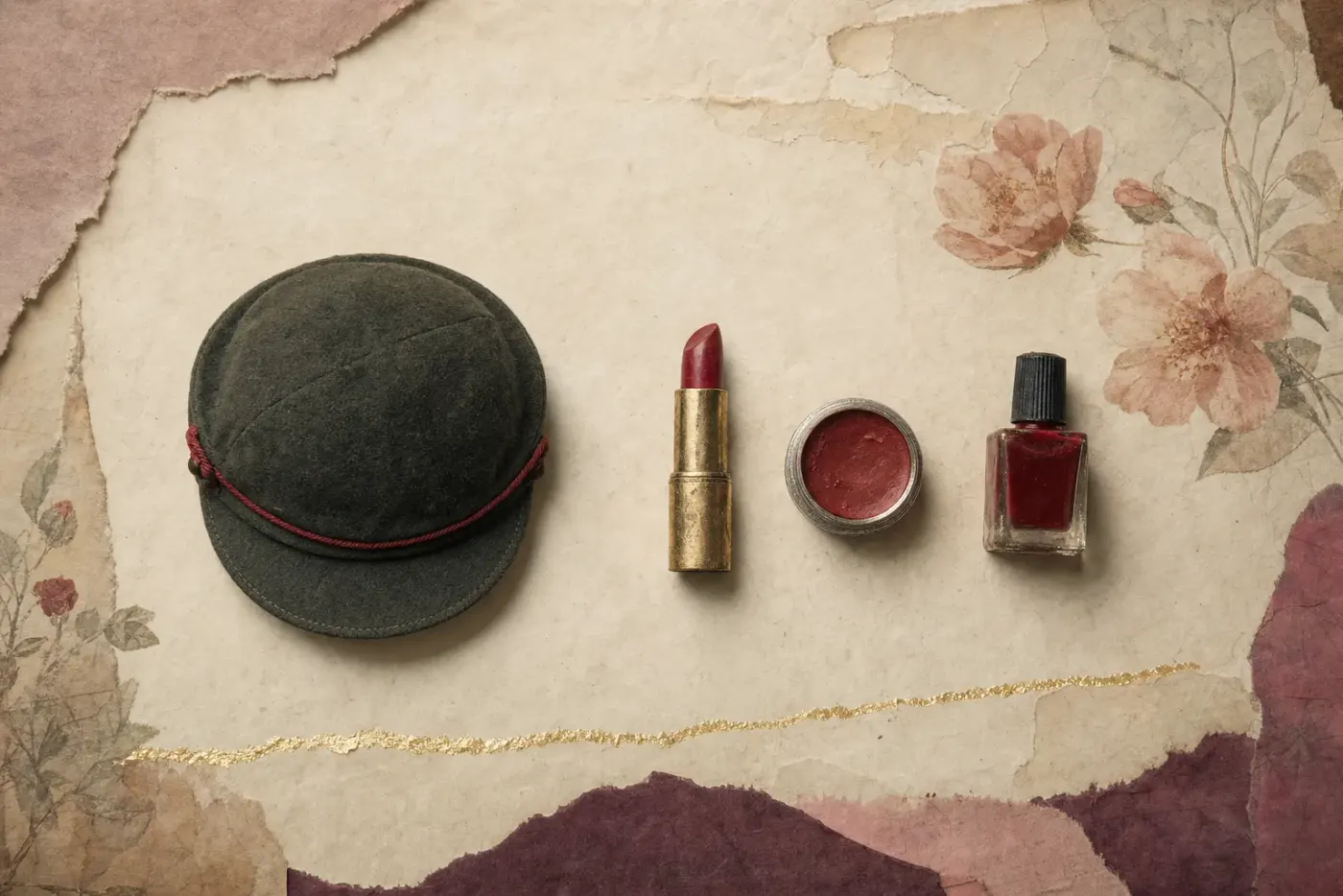
The Marine Corps Women’s Reserve made lipstick part of the uniform: worn, encouraged, and matched to a red cord on the cap. The shade has a famous name and an unsettled date.
In short
Montezuma Red was the favourite lipstick of the US Marine Corps Women’s Reserve, whose rules required lipstick and nail polish to harmonise with the red cord on the winter cap; credited to Elizabeth Arden, it is dated to 1942 by a museum education sheet and to 1943 by the cosmetics historian James Bennett.
- 6min read
- 6chapters
- 7sources
Most uniforms tell the wearer what to put on. The Marine Corps Women’s Reserve also told her what colour to wear on her mouth. Lipstick and nail polish were allowed — encouraged, in fact — but the colour had to harmonise with the red cord on the winter service cap, whatever the season.[1]
The shade the women favoured was called Montezuma Red. Its name is famous. Its date, and the story of how it was made, depend on which source is read.
A Reserve for Women
The Marine Corps came to women reluctantly. The law that created the navy’s women’s reserve, Public Law 689, signed on 30 July 1942, also authorised a Marine Corps Women’s Reserve, but the Marines were not ready to concede; the matter was settled only on 7 November 1942, when President Roosevelt gave his assent to the plan.[2]
Ruth Cheney Streeter was commissioned a major and sworn in as the reserve’s director on 29 January 1943, and the official announcement came on 13 February 1943, with the call to “Be a Marine . . . Free a Man to Fight!” The first recruits were sent to New York for training at Hunter College.[3] By the end of the war almost 22,000 women had served in the Corps.[4]
Rules for Everything
One of the first lessons women Marines learned, in the words of Mary V. Stremlow’s history of the reserve, was that there were rules for everything.[5] The uniform was Marine forest green with red chevrons, and the women’s visored, bell-crowned cap was trimmed with a red cord that set them apart from the other women’s services. Lipstick and nail polish had to harmonise with that cord; rouge, mascara and hair colouring were permitted, but had to be inconspicuous, and since a woman’s hair colour had to match her identification card, tinting it was all but impossible. Hair could touch the collar but not cover it.[5]
Even the nail polish had an official name. A photograph in the same history shows a corporal wearing regulation “Lipstick Red” nail polish, formulated to match the cap cord.[5] Leg makeup, which some women in other services were allowed in place of scarce stockings, was not permitted to women Marines.[5]
Lipstick and nail polish could be worn, and in fact were encouraged, but the color absolutely had to harmonize with the red cap cord of the winter cap, regardless of the season.
Arden’s Kit
The fullest account of the lipstick itself comes from an education document of the National Museum of the Marine Corps. In it Streeter approaches Elizabeth Arden for a line of makeup made for Women Marines, secures an initial budget of $3,000 after much lobbying, and negotiates the contract herself. Arden already had a shade, Vibrant Red, that matched the red piping and chevrons of the uniform; renamed Montezuma Red, it became the standard-issue lipstick, in a kit with a matching cream rouge and nail polish.[7]
Every recruit, the document says, was issued a kit in boot camp with instructions on how to apply it, and was expected to take no more than two minutes over it; a replacement cost $2.27 at the post exchange. Women Marines were five times more likely than men to be punished for a dress-code violation, and Bernice Frankel — later the actress Bea Arthur — received two such punishments as a private in 1943.[7]
Two Dates
The museum document dates the renaming to 1942, and has Streeter, as director, approaching Arden “with women returning to the Marine Corps in 1942”.[8] The reserve’s own history makes that hard to square: the Corps did not accept the plan until November 1942, and Streeter was not sworn in as director until 29 January 1943.[9][10] James Bennett, the cosmetics historian, lists Montezuma Red among Arden’s lipsticks and nail polishes of 1943.[11]
The later date fits the reserve’s chronology, and it is the one given here. The two accounts differ in another way too. Stremlow’s history does not name Arden at all; it calls Montezuma Red the women’s favourite colour, “designed in their honor”, rather than the colour every recruit was issued.[12]
Victory Red and the Others
Montezuma Red was not the war’s only patriotic red, and the others are easily confused with it. The museum document names Helena Rubinstein’s Regimental Red of 1941, and her Fighting Red, Commando and Jeep Red; Bennett dates Regimental Red to 1939 and says it was sold in Britain and the Commonwealth, not, as far as he can tell, in the United States.[13][14] Arden’s Victory Red, which the museum document says she created for the public after Montezuma Red’s success, appears in Bennett’s list two years before it, in 1941.[13][15]
The Corps bought makeup of another kind as well. Max Factor, the Hollywood house, made camouflage makeup for the Marine Corps during the war.[16]
What Is Not Known
No source used here gives the date of Arden’s contract, or says how many kits were issued. The museum document that tells the kit’s story most fully is headed “For Internal Use Only”, though it is publicly posted, and its bibliography sets a magazine article of 2017 beside archival files; it is used here for what it says, with its dates set against the reserve’s own history.[17]
The same document ends by naming a modern reproduction, a “1941 Victory Red” made by the Bésame company in 2016.[17] Whether that date reflects a dated original, or only the year most often attached to the story, the sources here do not say.
Sources
- [1, 5, 6, 12]Free a Marine to Fight: Women Marines in World War II — Uniforms Marine Corps History and Museums Division (Marines in World War II Commemorative Series); npshistory.com mirror.View source (opens in a new tab) Accessed 2026-10-03.
- [2, 9]Free a Marine to Fight: Women Marines in World War II — Introduction Marine Corps History and Museums Division (Marines in World War II Commemorative Series); npshistory.com mirror.View source (opens in a new tab) Accessed 2026-10-03.
- [3, 10]Free a Marine to Fight: Women Marines in World War II — The First WRs Marine Corps History and Museums Division (Marines in World War II Commemorative Series); npshistory.com mirror.View source (opens in a new tab) Accessed 2026-10-03.
- [4, 7, 8, 13, 17]Montezuma Red: Women Marines in WWII National Museum of the Marine Corps.View source (opens in a new tab) Accessed 2026-09-22.
- [11, 15]Elizabeth Arden (1930-1945) Cosmetics and Skin.View source (opens in a new tab) Accessed 2026-09-22.
- [14]Helena Rubinstein (1930-1945) Cosmetics and Skin, 2009.View source (opens in a new tab) Accessed 2026-09-22.
- [16]Max Factor (1930-1945)View source (opens in a new tab) Accessed 2026-09-22.
Filed under