The Screen and the Statute
A depression that emptied the salons and filled the manicure trade, a film industry that sold its stars’ faces for a dollar, and a law that finally reached the cosmetics counter.
HOM · Era1930 – 1939Screen & Statute
All of The 1930s Era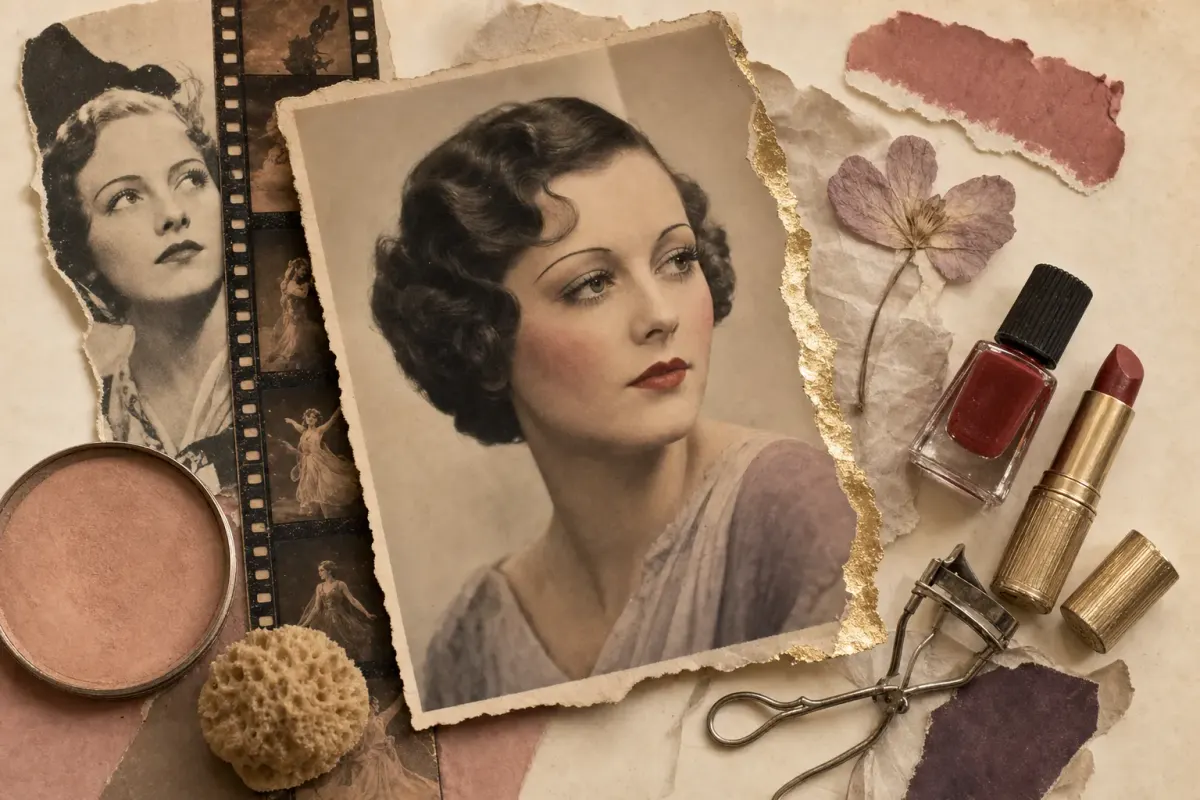
In short
The 1930s hit the salon houses hard while a new trade in cream nail enamel grew from nothing, sold Hollywood’s makeup and methods to the public, and ended with the Federal Food, Drug, and Cosmetic Act of 1938, which brought cosmetics under federal law for the first time.
- 9min read
- 7chapters
- 17sources

Vivien
Your guide through time
Listen to this essay
9 min listenVivien reads our essays aloud, word for word — every date and every name in its place — so you can listen the way you would be walked through a gallery.
An AI voice, designed for History of Makeup
The 1920s made makeup an everyday habit. The 1930s tested whether the habit would survive a depression, and it did, though not evenly. The salon houses that sold treatment and exclusivity lost money; a new business, built on a single bottle of nail colour, grew from almost nothing. Hollywood, short of money itself, lent its actresses to cosmetics advertising for a nominal fee and sold its makeup to people who would never stand in front of a camera.
The decade also ended a long exemption. When it began, a cosmetic that blinded the woman who wore it was beyond the reach of federal law in the United States. When it ended, cosmetics were inside the law, and the industry was rewriting its labels.
The Depression at the Counter
The expensive end of the trade felt the slump first. Helena Rubinstein had sold her American business to Lehman Brothers in 1928; by 1931 its shares had fallen from $18 to $2, and she took control of it again. Its net profits fell from $500,200 in 1929 to $56,494 in 1935.[1] Elizabeth Arden cut her prices more than once and introduced cheaper salon treatments, and by one account her American business was $500,000 in the red by 1935.[2]
Both answered by selling harder. Rubinstein gave approved retailers local monopolies in 1932, ran beauty schools for the public inside department stores from 1933, and in 1937 opened a school at her Fifth Avenue salon to train the demonstrators who sold her products behind their counters.[1] Arden’s rescue came in a bottle: Blue Grass, a perfume introduced for Christmas 1934, which sold well enough to bring in much-needed cash.[2]
Lips and Fingertips
The decade’s new business started at the fingertips. In March 1932 Charles Revson, his brother Joseph and Charles Lachman set up Revlon in New York with a single product, an opaque cream nail enamel.[3] Most American polishes were still transparent, coloured with dyes and painted across the middle of the nail with the half-moon and the tip left bare; a cream enamel, made opaque with pigments such as titanium dioxide, went over the whole nail and hid its flaws.[3][4] Revlon did not invent it. Cream polishes were already becoming fashionable in Europe by 1930, and Cutex, the best-selling American brand, sold one from 1934.[4]
Nail colour seems to have escaped the slump that other cosmetics suffered. Revlon’s sales rose from about $4,000 in its first ten months to $1.2 million by 1940, much of its early trade won in beauty salons, where women had a manicure while their hair set.[3]
The mouth was made to match. Glazo and Peggy Sage sold polishes matched to lipsticks by 1930, Cutex added lipsticks to match its cream polish in 1935, and Revlon followed with lipsticks of its own in 1939.[4][3] Elizabeth Arden went further, telling women from 1931 to choose their makeup by the colour of the dress rather than of their complexion: “Any Woman Can Wear Any Colour.”[5]
Cosmetics of the Stars
Hollywood began the decade in trouble: several studios went into deficit and then receivership as the Depression deepened. Max Factor, which supplied them, did better, and by 1933 claimed that 96 per cent of the world’s film studios used its makeup.[6] To keep their costs down, studios contracted their actresses to advertise Max Factor for a nominal $1.00, in return for publicity for the actresses and their films, and the firm sold its general range as the ‘Cosmetics of the Stars’.[6]
The studio’s methods went on sale with its faces. In 1932 Max Factor unveiled a Beauty Calibrator to measure how far a face departed from an oval ideal, and at Warner Brothers Perc Westmore shaded and highlighted faces towards that oval as a cameraman would with light.[7] In 1935 both opened salons to the public: the Westmore brothers on Sunset Boulevard in April, and Max Factor in November, in a rebuilt Make-up Studio on North Highland Avenue with a room for each of its four colour types.[8][6] By then street makeup was so commonplace that female stars were expected to wear it off the screen as well as on.[7]
Made for the Camera
Colour film set the hardest test. Under the bright lights that three-strip Technicolor needed, greasepaint’s sheen picked up colour from the set, and many stars refused to appear in colour.[9] Max Factor’s answer, developed for Technicolor in 1936, was Pan-Cake, a cake makeup applied with a damp sponge that dried to a matt film; it was first used on screen in 1937, in Vogues of 1938.[9][10] In 1938 the firm added it, in lighter shades, to its range for the public. By one account its sales soon outstripped those of all Max Factor’s other cosmetics combined, and other firms copied it.[10]
The Face by Day
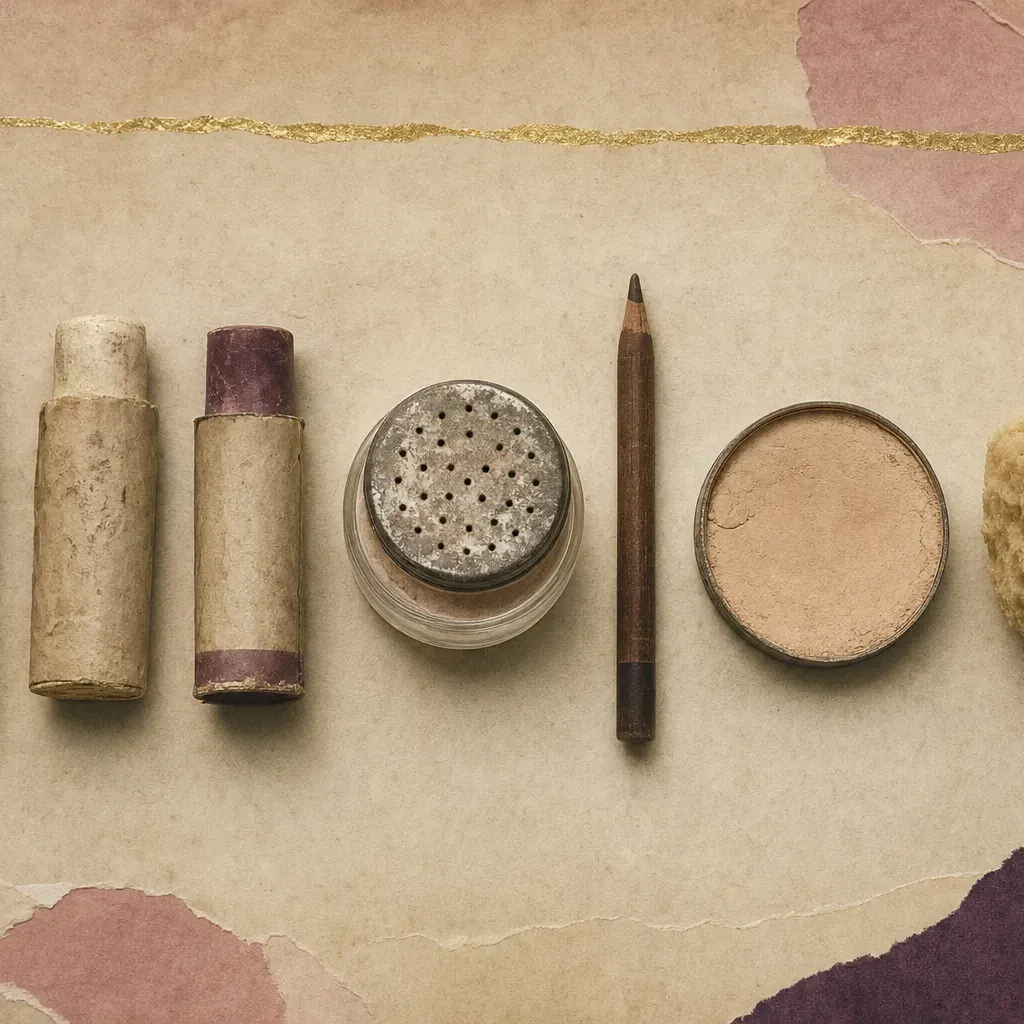
Off the screen, eye makeup, long an evening matter, became more common by day: when hats went off the face, the bare forehead made the eyes look smaller, and beauty writers recommended shadow, mascara and liner to bring them forward. Even so, most women still wore eye shadow only at night, and it was not a big seller before the war.[11] The Kurlash company’s routine of 1936 gives the order: tweezers to make the brow “clear cut”, eye shadow “lightly for day time (with deeper shading in evening)”, the lashes curled, and mascara on the upper lashes only.[12]
The rest followed studio advice. Max Factor’s face powder was patted on with a puff, never rubbed, and the surplus brushed away; its eyebrow pencil came in black and brown; and its Tru-Color lipstick of 1938 promised “a lifelike red tone, with no purple or bluish undertones.”[13] The plate here is reconstructed from those products and routines, not from any one woman’s face.
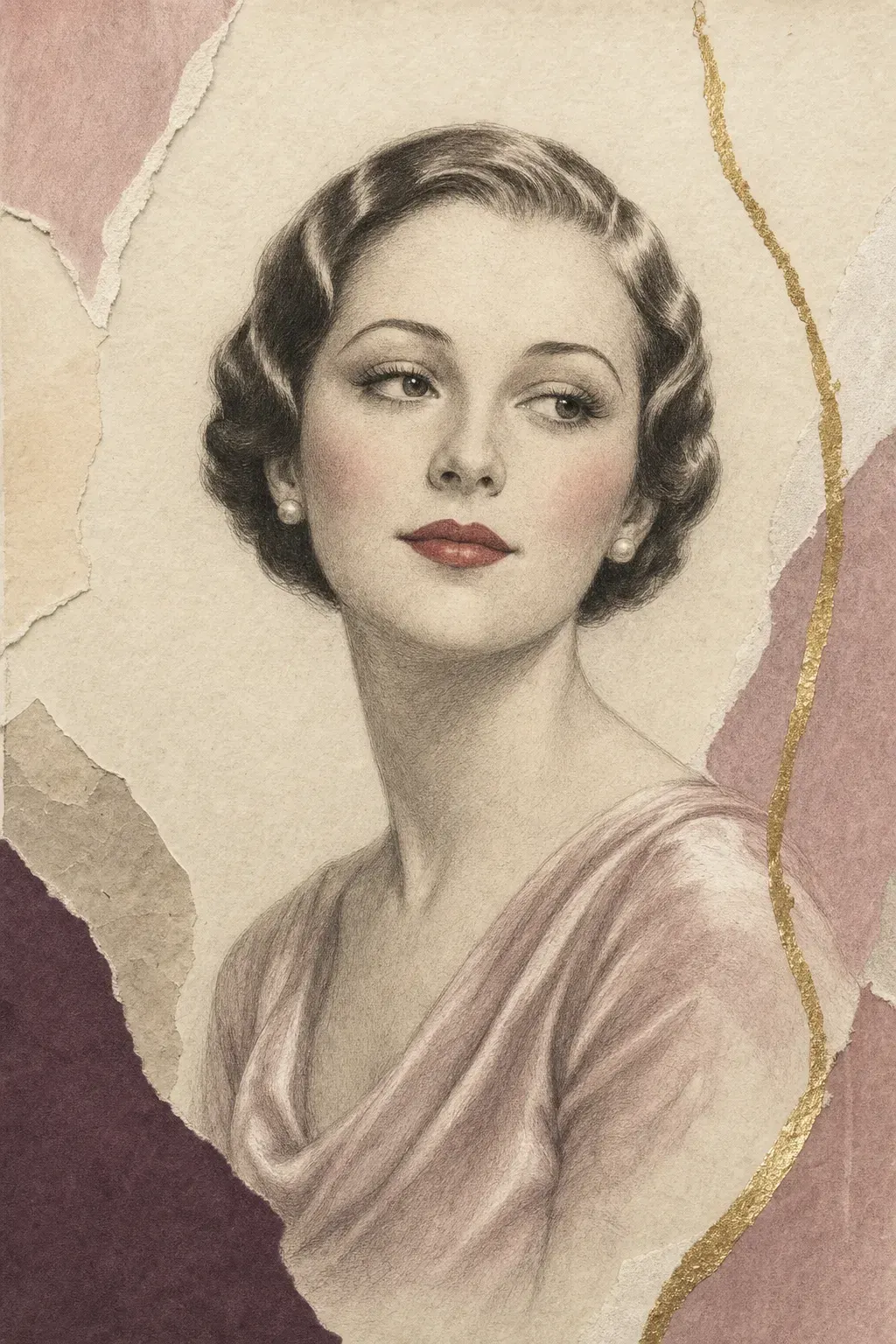
Your Government has not the legal right under the present Food and Drugs Act to protect you against dangerous cosmetics. The law does not apply to toilet preparations and those which are harmful cannot be taken off the market no matter what pain and disfigurement they inflict.
A Law for Cosmetics
The Pure Food and Drugs Act of 1906 gave the government no authority over cosmetics, so a product that injured its users could not be taken off the market.[15] The clearest case was Lash Lure, an eyelash and brow dye sold only through beauty salons, which ulcerated users’ eyes and blinded at least one woman; in 1933 photographs of her went on show in a government exhibit that a reporter named “The American Chamber of Horrors.”[16]
The bill to replace the old law took five years to pass, and was carried in the end by a drug disaster: in 1937 a medicine made with a poisonous solvent killed 107 people.[17] On 25 June 1938 Franklin Roosevelt signed the Federal Food, Drug, and Cosmetic Act, which brought cosmetics under federal control for the first time.[18] It set rules for their ingredients, labels, packaging and coal-tar colours, while advertising went to the Federal Trade Commission, and creams could no longer claim to feed the skin: Elizabeth Arden’s Orange Skin Food became Orange Skin Cream.[19]
What Is Not Known
The Depression is often said to have sold more lipstick: the ‘lipstick effect’, the idea that women spend more on small beauty purchases when times are hard. The sources used here do not show it for the 1930s. The historian this essay relies on most writes of a slump in cosmetics sales that nail polish appears to have escaped, and the one figure for a rise, 28 per cent more Cutex manicure sales in the three years after 1929, comes from an advertisement placed by Cutex’s own agency.[20] A study of 2012 offered what it called the first experimental demonstration of the effect, with people today; its abstract says nothing of the 1930s.[21]
The face is less certain than its products. Popular accounts give the 1930s a brow plucked to a pencil-thin arc; the sources here document tweezers, pencils and, in one medical report of 1934, a brow plucked away entirely before it was dyed. They do not measure a fashion, and the plate above does not exaggerate one.[22][23]
Dates disagree, too. Pan-Cake belongs to 1937 by its first appearance on screen and to 1938 by its sale to the public, and this archive keeps both.[24]
Sources
- [1]Helena Rubinstein (1930-1945) Cosmetics and Skin, 2009.View source (opens in a new tab) Accessed 2026-09-22.
- [2, 5]Elizabeth Arden (1930-1945) Cosmetics and Skin.View source (opens in a new tab) Accessed 2026-09-22.
- [3, 20]Revlon Cosmetics and Skin (updated 26 April 2021), 2012.View source (opens in a new tab) Accessed 2026-10-03.
- [4]Nail Polishes/Enamels Cosmetics and Skin (updated 7 August 2024), 2014.View source (opens in a new tab) Accessed 2026-10-03.
- [6, 10, 13, 24]Max Factor (1930-1945)View source (opens in a new tab) Accessed 2026-09-22.
- [7]The Ideal Face Cosmetics and Skin (updated 10 November 2020), 2018.View source (opens in a new tab) Accessed 2026-10-03.
- [8]House of Westmore Cosmetics and Skin (updated 29 April 2025), 2018.View source (opens in a new tab) Accessed 2026-10-03.
- [9]Pan-Cake Make-up Cosmetics and Skin, 2026.View source (opens in a new tab) Accessed 2026-09-22.
- [11]Eye Shadow Cosmetics and Skin.View source (opens in a new tab) Accessed 2026-10-03.
- [12, 22]Kurlash Cosmetics and Skin.View source (opens in a new tab) Accessed 2026-09-25.
- [14]American Chamber of Horrors: The Truth About Food and Drugs Farrar & Rinehart, New York; Internet Archive scan (in.ernet.dli.2015.77374), 1936.View source (opens in a new tab) Accessed 2026-10-03.
- [15]80 Years of the Federal Food, Drug, and Cosmetic Act United States Food and Drug Administration, FDA History Exhibits (content current as of 11 July 2018).View source (opens in a new tab) Accessed 2026-10-03.
- [16, 23]Lash Lure and Paraphenylenediamine: Toxic Beauty Past and Present American Academy of Ophthalmology.View source (opens in a new tab) Accessed 2026-09-22.
- [17]Milestones in U.S. Food and Drug Law United States Food and Drug Administration.View source (opens in a new tab) Accessed 2026-09-22.
- [18]Part II: 1938, Food, Drug, Cosmetic Act United States Food and Drug Administration (content current as of 27 November 2018).View source (opens in a new tab) Accessed 2026-10-03.
- [19]The FDA, FTC and Cosmetics Cosmetics and Skin (updated 1 October 2023), 2022.View source (opens in a new tab) Accessed 2026-10-03.
- [21]Boosting beauty in an economic decline: mating, spending, and the lipstick effect Journal of Personality and Social Psychology 103(2), 275–291, 2012.View source (opens in a new tab) Accessed 2026-10-03.
Continue in The 1930s Era
Screen & Statute
Browse all 10 articles