Lash Lure: The Eyelash Dye No Law Could Stop
In May 1933 a woman had her lashes dyed before a dinner given in her honour. Within weeks she was blind, and the government could do nothing about the product that blinded her.
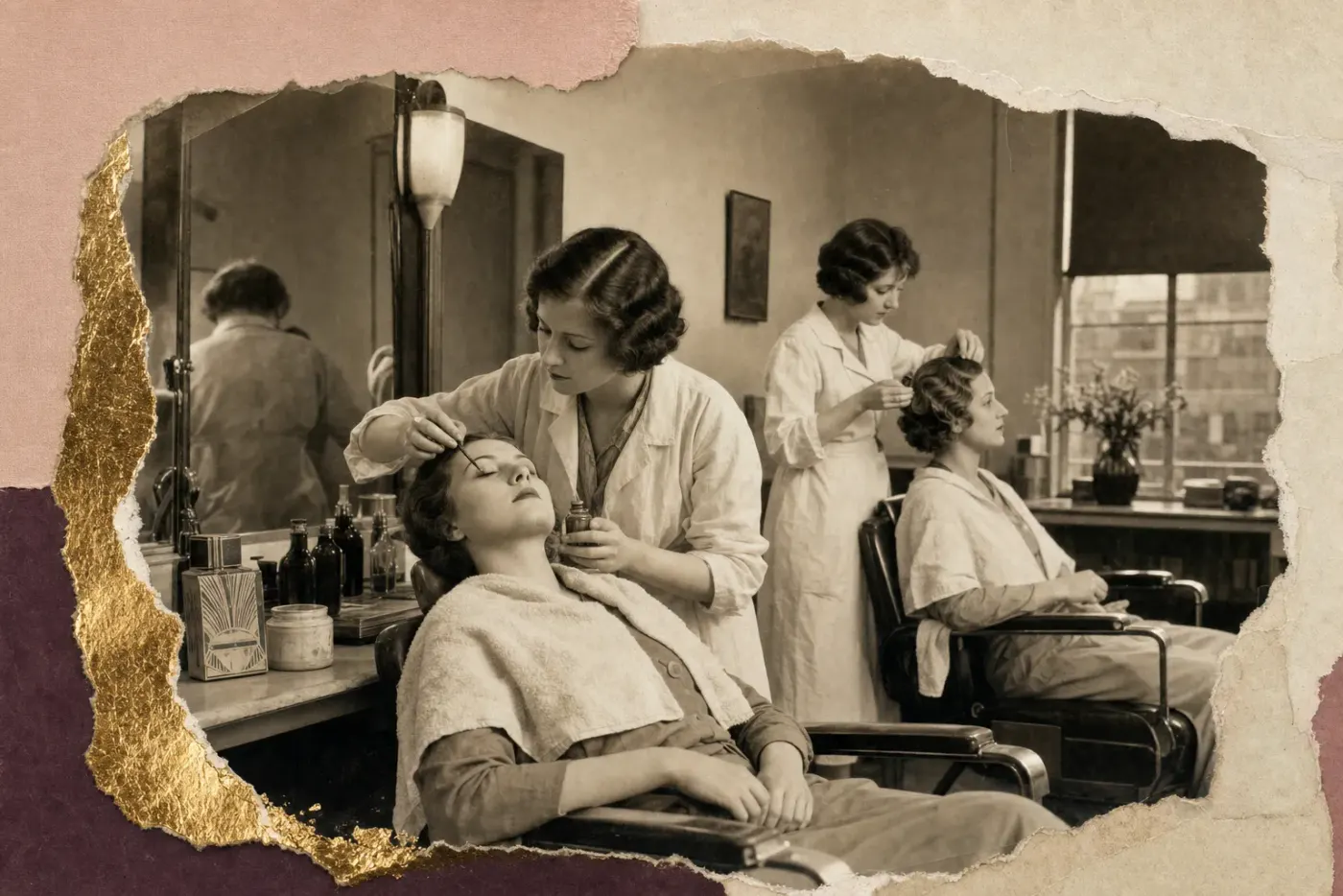
In short
Lash Lure, an aniline eyelash and brow dye of the paraphenylenediamine group sold through beauty salons, blinded a woman in May 1933 and killed another in 1934; beyond the reach of the 1906 law, it became the first product seized under the Federal Food, Drug, and Cosmetic Act of 1938.
- 6min read
- 7chapters
- 6sources
On the morning of 17 May 1933 a woman drove into town to have her photograph taken. Her colleagues were giving a banquet in her honour that evening and wanted a picture for a magazine. An hour later she stopped at a beauty shop for a shampoo and a haircut, and was persuaded to have her brows and lashes touched up as well.[1]
The woman, whom the Food and Drug Administration’s Ruth deForest Lamb called only “Mrs. Brown,” never saw again. The dye that blinded her was entirely legal.[1]
Weeks of Pain
Her eyes began to smart on the drive home. Two hours later they were so irritated that she could hardly see, and by the next morning she could not open them.[2] Ulcers formed on both eyes. No antidote was known. The corneas of both eyes sloughed away, and operations failed to save them.[2]
Her nurse’s notes, which Lamb printed, run on for weeks: “Severe pain. . . . Severe burning sensation. . . . Rash on arms has spread to large area.”[2]
The Product
The dye was Lash Lure, sold as a “new and improved eyebrow and lash dye” and available only through beauty salons; its advertisements promised that it “will give you a radiating personality, with a before and after.”[3] It was an aniline dye of the paraphenylenediamine group, a coal-tar chemical, and it offered more lasting results than mascara or an eyebrow pencil. It had not been tested for safety, and its ingredients were not disclosed.[4][5]
Its makers were small: Lamb found a Los Angeles firm with a total investment of less than $1,000, apparently run as a sideline by men who also ran a beauty school and a permanent-wave business.[4]
More Cases
Mrs. Brown was not alone. In July 1933 the Journal of the American Medical Association reported severe dermatitis of the eyelids, relieved only when every lash was removed; four months later it reported four more cases, with corneal ulceration among them.[6]
In 1934 the journal reported a death. A healthy 52-year-old woman had her right eyebrow plucked away completely and the dye applied to the brow and lashes; within hours the eyelids had swollen shut, and on the eighth day she died. The plucking was thought to have let the dye in, and her death was put down to a secondary infection.[6] According to Lamb, the dye had been put on by the woman’s own daughter, a beauty-parlour operator.[7]
I am willing to and do assume the risk involved in this treatment, and I agree to make no claim against the beauty shop or Lash-Lure Research Laboratories, Inc., and to hold them harmless in the event of the occurrence of such possible consequences.
Beyond the Law
The Pure Food and Drugs Act of 1906 gave the Food and Drug Administration no authority over cosmetics.[9] Because Lash Lure’s label claimed to cure nothing, the agency could not seize it. It could only warn the public, and in Buffalo, Lamb wrote, not one newspaper would print the warning.[10]
The maker’s answer was a waiver for customers to sign. When publicity and damage suits came, the firm went into hiding while its dye went on being shipped from another address; only local health authorities, as in Chicago and New York, could outlaw it.[10]
The Chamber of Horrors
In 1933 Lamb, the agency’s chief education officer, and George Larrick, its chief inspector, assembled a travelling exhibit of about a hundred dangerous, deceptive or worthless products that the law could not touch.[11] At the Chicago World’s Fair that year it showed photographs of a woman blinded by Lash Lure, before and after, and a reporter named the display “The American Chamber of Horrors.”[12]
Eleanor Roosevelt, shown the photographs, said, as Time reported it, “I cannot bear to look at them.”[12] Among the letters the agency received was one from a ten-year-old girl whose mother had been blinded: “I don’t want anything to happen to other ladies like has happened to my mother.”[13]
Seized
The Federal Food, Drug, and Cosmetic Act became law in 1938, and the first product seized under it was Lash Lure, alleged to be adulterated with “a poisonous or deleterious substance, a coal tar preparation, paraphenylenediamine.”[14]
The law left one door open. Coal-tar hair dyes were exempted from its ban on harmful cosmetics, provided their labels warned that the product “must not be used for dyeing the eyelashes or eyebrows; to do so may cause blindness.” The same section laid down that “the term ‘hair dye’ shall not include eyelash dyes or eyebrow dyes.”[15]
What Is Not Known
How many people Lash Lure injured is not known. The ophthalmologists’ account counts six cases in the Journal of the American Medical Association in 1933 and 1934; Lamb, writing in 1936, counted at least seventeen in the same journal, and supposed there were many more.[16][17] The FDA’s own history speaks of “one confirmed case of permanent blindness.”[18]
The sources also disagree about the maker. One names the Cosmetic Manufacturing Co. of Los Angeles and has the dye first made in 1933; Lamb names Lash-Lure Laboratories, also of Los Angeles, incorporated in 1932.[16][17] And “Mrs. Brown” was Lamb’s name for her, not her own; this account does not supply another.[17]
Sources
- [1, 2, 4, 7, 8, 10, 17]American Chamber of Horrors: The Truth About Food and Drugs Farrar & Rinehart, New York; Internet Archive scan (in.ernet.dli.2015.77374), 1936.View source (opens in a new tab) Accessed 2026-10-03.
- [3, 6, 12, 14, 16]Lash Lure and Paraphenylenediamine: Toxic Beauty Past and Present American Academy of Ophthalmology.View source (opens in a new tab) Accessed 2026-09-22.
- [5, 9, 11]80 Years of the Federal Food, Drug, and Cosmetic Act United States Food and Drug Administration, FDA History Exhibits (content current as of 11 July 2018).View source (opens in a new tab) Accessed 2026-10-03.
- [13]Public Outreach Remains Powerful Agency Tool United States Food and Drug Administration (content current as of 27 March 2023).View source (opens in a new tab) Accessed 2026-10-03.
- [15]21 U.S.C. 361 — Adulterated cosmetics (Federal Food, Drug, and Cosmetic Act, section 601) United States Code, 2010 edition, US Government Publishing Office, 2010.View source (opens in a new tab) Accessed 2026-09-26.
- [18]Part II: 1938, Food, Drug, Cosmetic Act United States Food and Drug Administration (content current as of 27 November 2018).View source (opens in a new tab) Accessed 2026-10-03.
Filed under