Safflower Red, White Lead and the Painted Brow
Twenty-three centuries of cosmetic practice, recorded in tombs, pharmacopoeias and an unusual quantity of poetry about eyebrows.
HOM · Culture8th century BCE - 16th century CEBrow & Bloom
All of East Asia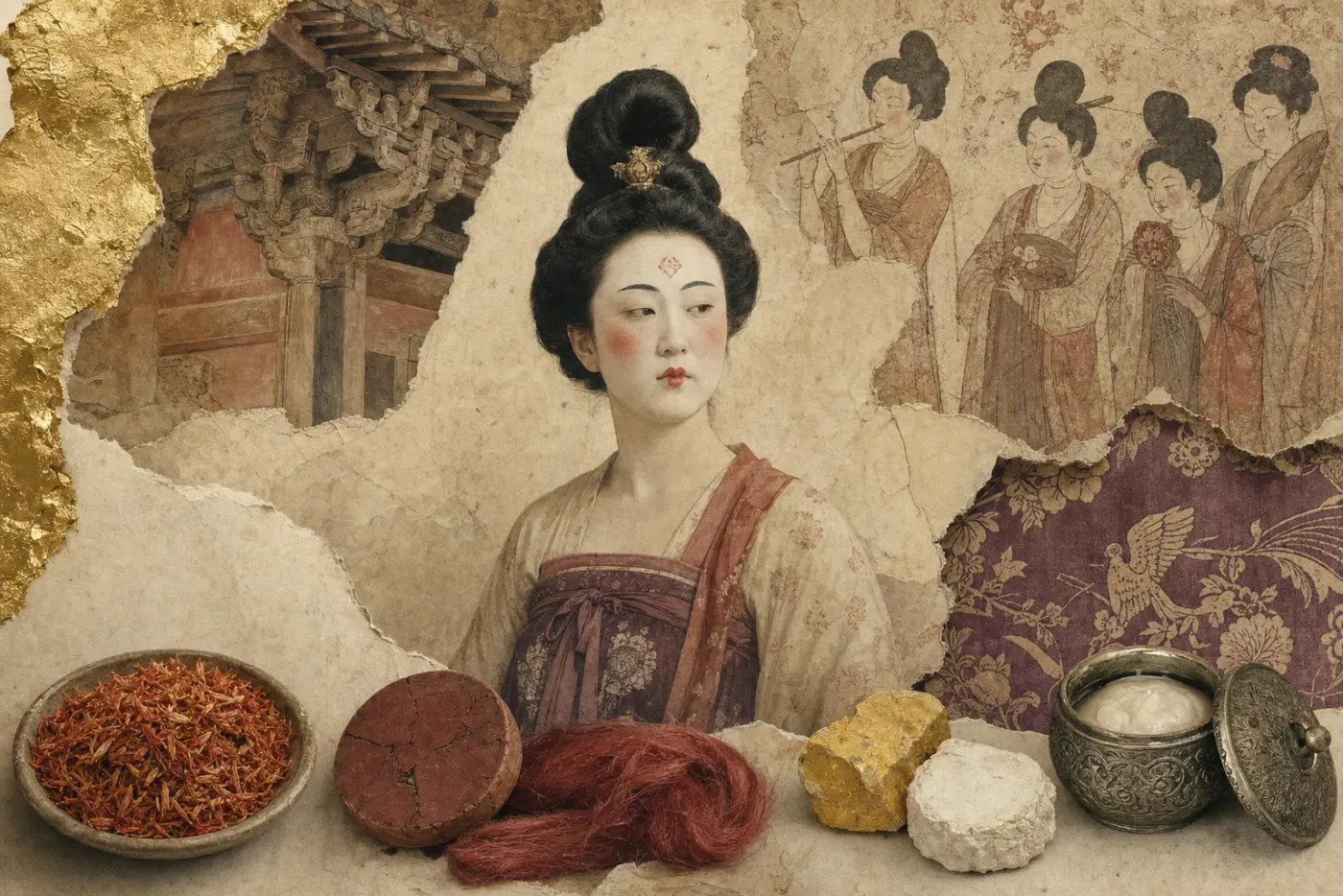
In short
Residues from bronze vessels at Liangdaicun in Shaanxi, dated to the eighth century BCE, were identified in 2022 as synthetic lead white made by precipitation in solution — a different chemistry from the corrosion method used in Greece, and several centuries earlier.
- 8min read
- 6chapters
- 8sources
Vivien
Your guide through time
Listen to this essay
10 min listenVivien reads our essays aloud, word for word — every date and every name in its place — so you can listen the way you would be walked through a gallery.
An AI voice, designed for History of Makeup
In 2021 a research team reported the contents of a sealed bronze jar from tomb M49 at the Liujiawa site in Shaanxi, a cemetery of the Rui state of the Spring and Autumn period. The residue was ruminant fat mixed with monohydrocalcite taken from cave moonmilk, a soft white carbonate deposit that dries to a powder. The occupant of the tomb was a man of the aristocratic class.[1]
The find does two useful things at once. It puts a compounded face cream in China at around the seventh century BCE, and it attaches that cream to a male aristocrat — which is not where the popular picture of Chinese cosmetics usually begins.[1]
The White Was Made, Not Found
One of the materials behind the pale Chinese complexion was lead, and it was manufactured rather than dug up. In 2022 the same research group published residues from bronze vessels at the Liangdaicun site, another Rui state cemetery in Shaanxi, dated to the eighth century BCE, and identified them as synthetic lead white. The route was precipitation in solution: litharge reacted with vinegar to give lead acetate, which was then carbonated.[2]
That is not how Europe did it. The Mediterranean method corroded metallic lead over vinegar fumes and scraped off the crust. The authors argue that lead white was arrived at twice, independently, at the two ends of Eurasia, and that the Chinese material predates the Greek and Mediterranean evidence by several centuries. It is their claim, from their samples, and it is the current state of an open question rather than a closed one.[2]
Lead was never the only white, and this page's own opening find is the proof of it: the Liujiawa face cream is a calcium carbonate, monohydrocalcite scraped from cave moonmilk, with no lead in it at all.[3] Powders ground from rice and other plant starches belong to the same record of Chinese face whites. Nothing in the analytical work weighs any of these against the others, and it was not designed to. What the Liangdaicun residues establish is that synthetic lead white existed in Shaanxi in the eighth century BCE, and how it was made — not what the pale face in general ran on.
Red From a Thistle
The classic Chinese red was safflower — Carthamus tinctorius, a thistle-like plant whose florets yield an abundant water-soluble yellow and a scarce, valuable red. The yellow has to be washed out before the red is any use; what remains was worked into cakes or soaked into silk floss, and became yanzhi, the rouge used on cheeks and lips.[4]
Its working life in China is better documented than its arrival. Manuscripts from Dunhuang show safflower operating at once as a food colouring, a textile dye and an offering, which is a useful corrective to reading it as a cosmetic that happened to have other uses.[4] The story that the envoy Zhang Qian carried it back from the Western Regions in the second century BCE is repeated everywhere. It is a traditional attribution, and it has the same shape as every other single-founder origin story this subject produces more readily than it produces evidence.
The Painted Brow
The best-known early episode in the history of Chinese brows is not about a woman's vanity. Zhang Chang, appointed Metropolitan Governor of the capital region in 61 BCE and dead by 48 BCE, made a habit of painting his wife's eyebrows. He was reported to Emperor Xuan for it. Asked to account for himself, he answered that what passed between a husband and a wife went considerably further than eyebrows, and the matter was dropped.[5]
The Hanshu is the source for the episode. Modern retellings usually supply a reason — that a childhood accident had scarred one of her brows — and that explanation appears to be a later addition rather than part of the Han account.[5]
By the Tang the brow had become a field of variation in its own right, one element in a fashion system that scholarship now reconstructs from excavated textiles, funerary figurines, tomb painting and poetry rather than from anecdote.[6] A set of ten brow designs is traditionally said to have been commissioned by Emperor Xuanzong. The names are transmitted through later compilations rather than through a contemporary document, and the commission itself cannot be checked. The same is true of most of the named cosmetic fashions attached to the Tang: they are recorded, they are repeated, and the record is later than the fashion.
Huadian, the Mark Between the Brows
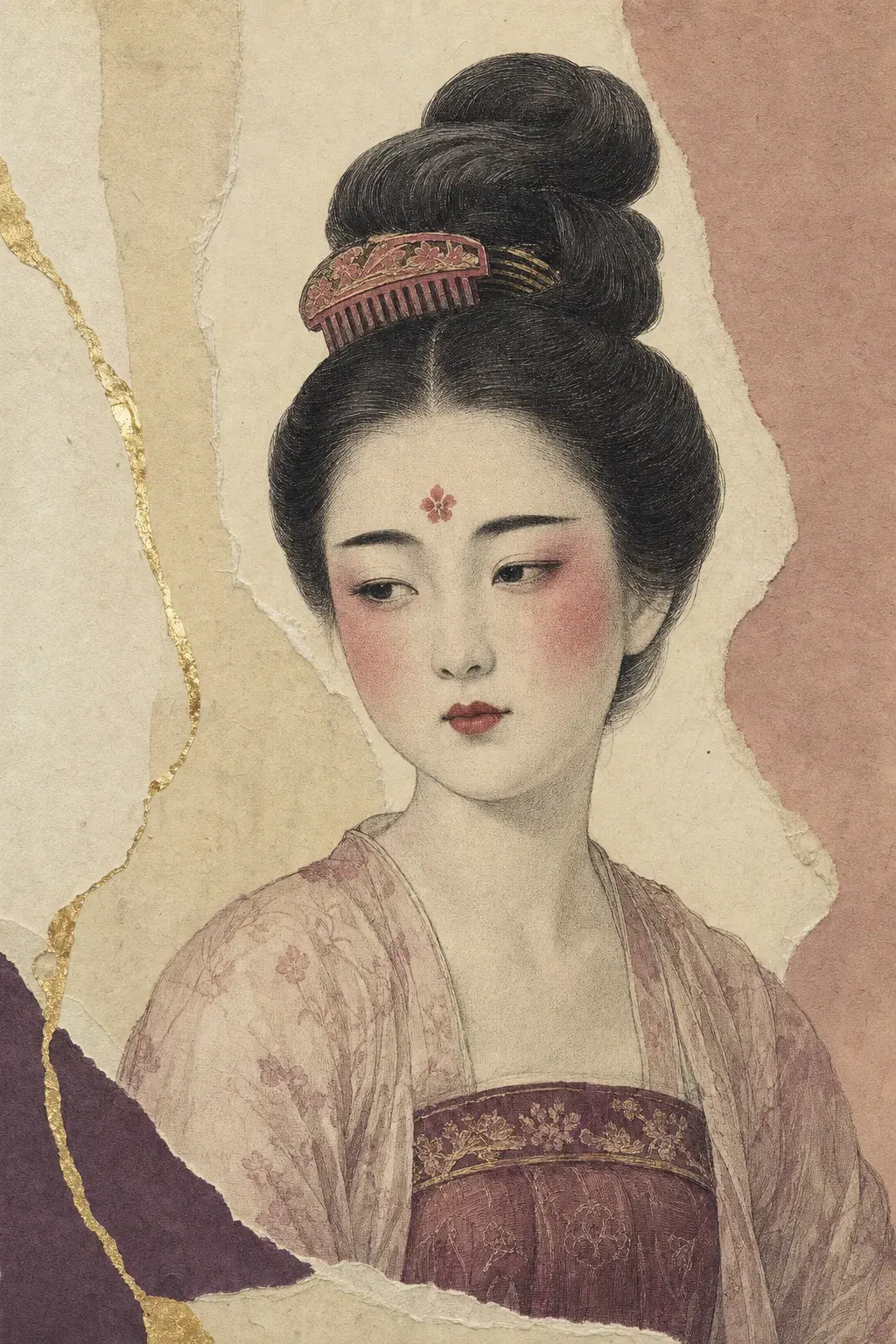
Huadian were small ornaments applied to the forehead between the brows, and sometimes at the ends of the brows. They appear widely in Tang funerary painting and in tomb figurines, which is where most of the evidence for them is, and that excavated material is the ground on which Tang adornment is now studied as a fashion system rather than as a sequence of anecdotes.[7] Descriptions of what they were cut from, and of the shapes they took, come from later literary compilation rather than from the objects, and are not repeated here.
Their origin is usually given as a story. A plum blossom fell on the forehead of Princess Shouyang, daughter of Emperor Wu of the Liu Song, and left a five-petalled mark that took three days to wash off; her attendants competed to copy it. The story reaches us through the Taiping yulan, an encyclopedia compiled between 977 and 983, quoting an earlier work now lost.[8] Its earliest surviving witness is therefore about five hundred years later than the events it reports. It is a charming story about the fifth century and a reliable source only for the tenth.
Pearl, and the Pharmacopoeia
Cosmetics and medicine were not kept on separate shelves in China, but the pharmacopoeia is not therefore a cosmetic manual. Li Shizhen's Bencao gangmu, printed at Nanjing in 1596 after nearly three decades of compilation, covers some 1,892 medicinal substances with more than a thousand illustrations, organising them by what they are and by what they are held to do. Pearl is among them. It is recorded as sweet and salty in sapor, cold in thermostatic character and non-poisonous; administered in powdered form it is given for settling the heart and calming the mind, clearing heat and extinguishing wind, improving vision and removing nebula, and dispelling poisons and healing wounds — used against mental derangement, heart palpitations, nebula of the eye, and pox and septic lesions.[9]
Those are cardiac, ophthalmic and wound indications. Ground pearl powder is sold today on a reputation for complexion, and complexion is not among the uses the Bencao gangmu records for it. What the work sets down is a sixteenth-century pharmacological judgement about a material, made by a careful compiler working with the evidence available to him. It is neither a modern finding nor, in this instance, a cosmetic claim: the modern trade has supplied that continuity rather than inherited it.
The rose-red face is older than it was yesterday, / The hair is whiter than it was last year. / The white-lead powder is neglected, / It is useless to look into the mirror. I am utterly miserable.
What the Poems Do Not Prove
A great deal of what circulates about Chinese makeup comes from poetry, and from encyclopedias compiled centuries after the practices they describe. Both are valuable. Neither is a photograph. A Tang poem about a woman at her mirror is good evidence that the image of a woman at her mirror was available to a Tang poet. It is weak evidence about what an ordinary woman in Chang'an did on an ordinary morning.[11]
The material record is narrower and firmer, and it is worth being exact about which part of it carries what. Sealed vessels with their residues still in them have been analysed directly, by infrared spectroscopy, X-ray diffraction and electron microscopy, and that work is barely a decade old.[12] Funerary figurines and tomb painting carry images rather than substances, and they are the excavated evidence a study of Tang adornment actually works from.[11] The two answer different questions, and neither answers the other's. Where the written and the material records disagree, or where only one of them speaks, the honest thing is to say which.
Sources
- [1, 3]The Rise of the Cosmetic Industry in Ancient China: Insights from a 2700-Year-Old Face Cream Archaeometry 63 (5), 1042-1058, 2021.View source (opens in a new tab) Accessed 2026-09-22.
- [2, 12]Beauty and Chemistry: The Independent Origins of Synthetic Lead White in East and West Eurasia Humanities and Social Sciences Communications, vol. 9 (2022), 2022.View source (opens in a new tab) Accessed 2026-09-22.
- [4]Cooking, Dyeing, and Worship: The Uses of Safflower in Medieval China as Reflected in Dunhuang Documents Asia Major, 3rd series, 17 (1), 2004.View source (opens in a new tab) Accessed 2026-09-22.
- [5]Hanshu (Book of Han), biography of Zhang Chang Completed at the Han court, c. 111 CE, 111.View source (opens in a new tab) Accessed 2026-09-22.
- [6, 7, 11]Empire of Style: Silk and Fashion in Tang China University of Washington Press, 2019.View source (opens in a new tab) Accessed 2026-09-22.
- [8]Taiping yulan (Readings of the Taiping Era) Compiled by imperial commission, Song dynasty, 977-983, 983.View source (opens in a new tab) Accessed 2026-09-22.
- [9]Bencao gangmu (Compendium of Materia Medica) Printed at Nanjing; Wellcome gives 1,892 medicinal substances and 1,109 illustrations, 1596.View source (opens in a new tab) Accessed 2026-09-22.
- [10]Fir-Flower Tablets: Poems Translated from the Chinese Houghton Mifflin, Boston; Project Gutenberg eBook #48222, 1921.View source (opens in a new tab) Accessed 2026-09-25.
Filed under