The Face in High Definition
A European law that put an open jar on the label, a mineral powder sold on home-shopping television, red lipsticks tested for lead, cameras that showed every pore — and, by the end of the decade, makeup lessons filmed at home in Florida.
HOM · Era2000 – 2009Screens & Scrutiny
All of The 2000s Era
In short
The 2000s opened with a European directive that banned testing finished cosmetics on animals from 2004 and put an open-jar symbol on the label, sold mineral powder through home-shopping television, argued in public about lead in lipstick, made makeup for high-definition cameras and ended with lessons on YouTube.
- 8min read
- 7chapters
- 16sources
Vivien
Your guide through time
Listen to this essay
9 min listenVivien reads our essays aloud, word for word — every date and every name in its place — so you can listen the way you would be walked through a gallery.
An AI voice, designed for History of Makeup
The 1990s opened the counter. The 2000s moved it. In ten years makeup was demonstrated on home-shopping television, judged under cameras sharp enough to show a pore, tested for lead by a campaign and then by the regulator the campaign appealed to, and taught, at the end of the decade, by amateurs filming themselves at home.
It was read more closely, too. A European law changed what the box had to say and what the laboratory behind it was allowed to do. What follows is the story of a face put under a closer look — by the law, by the camera and by its own customers.
The Law Reads the Label
The decade’s most lasting change to makeup was made in Brussels. Directive 2003/15/EC, adopted on 27 February 2003, amended the European Community’s cosmetics law for the seventh time.[1][2] Its best-known provisions concerned animals. It prohibited testing finished cosmetic products on animals, and set limits for ending the testing of ingredients and the sale of anything so tested: six years at most from its entry into force, or ten for the three kinds of test for which, in its words, there were “no alternatives yet under consideration”.[1] The Commission dates the testing ban on finished products from 11 September 2004 and the first marketing ban from 11 March 2009.[3]
The same text changed the box. A product that kept for more than thirty months was to carry a small open jar followed by a number of months: the period after opening in which it could be used “without any harm to the consumer.” Twenty-six fragrance substances, identified as an important cause of contact allergy, were to be named in the ingredients whenever they passed a set concentration, and substances classified as carcinogenic, mutagenic or toxic for reproduction were prohibited.[1] The argument over animal testing was older. What was new was a label written for a customer who read it.
The Counter on the Television
In America the counter moved into the living room. Bare Escentuals, a San Francisco company that had opened its first boutique in 1976, had sold its i.d. bareMinerals line on QVC since 1997 and through a long-form infomercial since 2002. When it went public in the autumn of 2006, its prospectus showed infomercials accounting for 37.4 per cent of the previous year’s net sales and home-shopping television for another 14.7.[4] Its product was a loose powder made, the company said, “primarily from finely milled minerals,” and it had to be shown to be sold: the company trademarked its instruction, “Swirl, Tap, Buff.”[4]
The mass market followed it. By one tracker’s count, American mass-market stores sold $4.5 million of mineral-based cosmetics in 2005 and $149 million in 2007, and Bare Escentuals’ own sales reached $511 million.[5] Not everyone was persuaded that the minerals did anything for the skin. A dermatologist told USA Today that the claim was “mainly marketing hype.”[5]
… our goal is to create products that look like skin and not like makeup in front of the high-definition camera.
The Sharper Screen
Then the screen changed. High-definition television showed what ordinary broadcasting had blurred, and the people who made up its presenters noticed early. Writing in 2003, the editor of a broadcast-engineering magazine described the answer already in use: “a new type of make-up for television called airbrushing,” sprayed on in super-thin layers to fool the camera.[7] “It is shocking when you see yourself on the monitor,” the makeup artist Sheila McKenna told NPR in 2007, “because it enhances every imperfection on your face.”[8]
By 2008 the answer was on sale to everyone. Christian Dior, Smashbox and Make Up For Ever had developed products for actors filmed in high definition, and the Toronto company Cargo had launched a whole line of them for professionals and the public alike. One makeup artist was unconvinced: “HD has become a buzzword.”[9]
The printed page went the other way. In October 2006 Dove released Evolution, a short film in which an ordinary woman is transformed by hair, makeup and lighting teams and then digitally retouched for a billboard; it ended, ABC News reported, with the words “No wonder our perception of beauty is distorted.”[10] In 2008 a retoucher’s remark in The New Yorker suggested that the campaign’s own photographs had been retouched too. Unilever denied it, and the retoucher said he had only removed dust and corrected colour, on a different Dove campaign.[11] The screen showed every pore; the billboard showed none; and both were now argued about in public.
The Argument Goes Public
The safety argument left the laboratory as well. In October 2007 the Campaign for Safe Cosmetics, a coalition of health, environmental and consumer groups, published tests of 33 red lipsticks bought in four American cities. Sixty-one per cent contained detectable lead, at between 0.03 and 0.65 parts per million, and a third were above the level the Food and Drug Administration recommended for lead in sweets. None listed lead among its ingredients.[12]
The FDA’s answer was to measure for itself. It found lead in every lipstick of the same brands and shades, at between 0.09 and 3.06 parts per million — more than the campaign had found — and concluded that these were the levels permitted colours made under good manufacturing practice would produce, and no safety concern. Comparing lipstick with sweets, it said, was “not scientifically valid.”[13] Its method was published in 2009;[13] a survey of 400 more lipsticks followed, and in 2016 the agency recommended a maximum of 10 parts per million for lead as an impurity, in draft guidance rather than a binding rule.[14][15] The same numbers reassured one side and alarmed the other, and both made their case where customers could read it.
The Lesson Moves Online
The last move was the largest. In May 2007 Michelle Phan, an art student in Florida, made her first makeup video, for friends. By August 2009 she had 230,000 subscribers on YouTube, and one video of the singer Lady Gaga’s eye makeup had been clicked six million times. A Florida newspaper described a “burgeoning crew of outlaw makeup tutors — ‘gurus,’ they’re called, popping up in droves this year alone.”[16]
The tutorial took over the counter’s job, showing a customer how, and did it without a counter. Phan had once applied for a part-time job at a Lancôme counter and not got it; in February 2010 Lancôme signed her as its official video makeup artist.[17]
The Face on the Screen
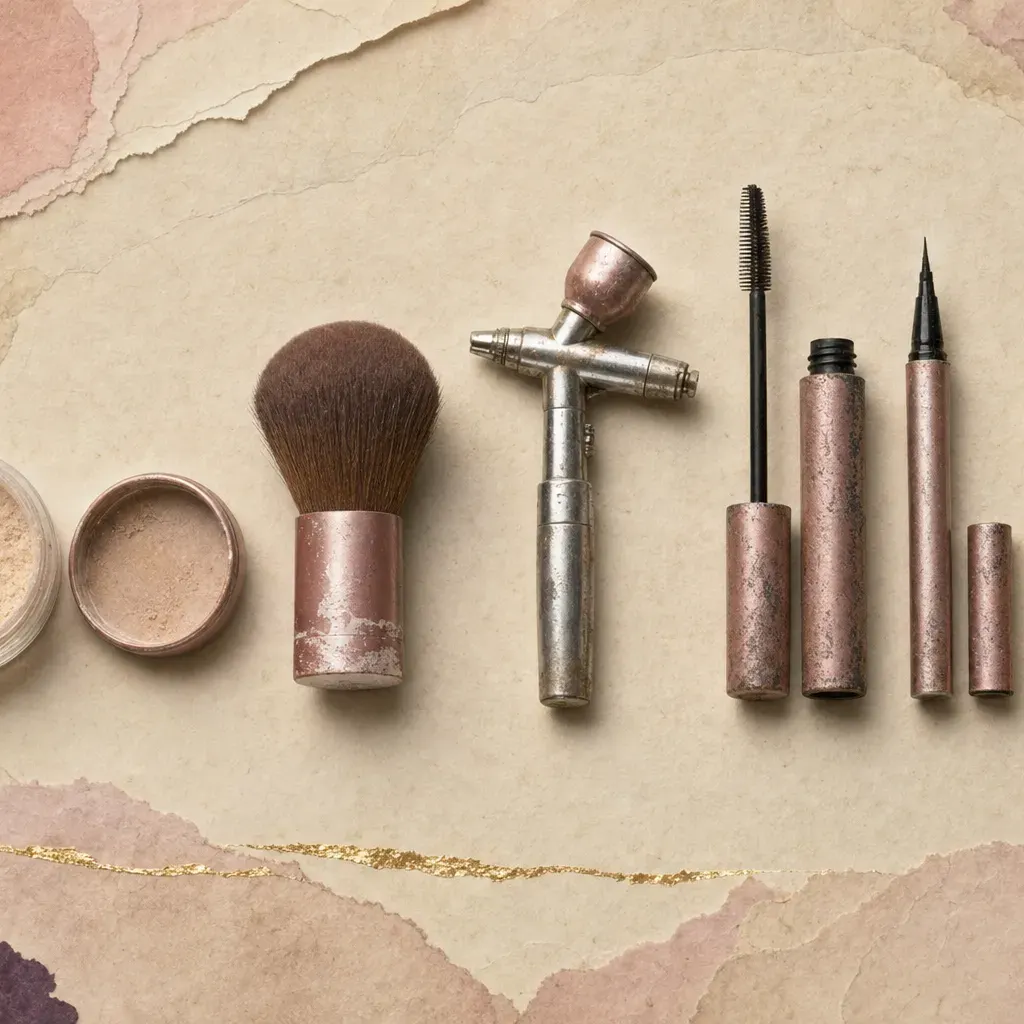
Put together, the decade’s documented products describe a face made for close inspection: a sheer base of loose mineral powder, buffed on with a brush;[18] a bronzer without shimmer, because shimmer picked up on screen;[19] a liquid line along the lashes, the subject of whole tutorials;[20] mascara combed rather than piled on, and a glossed mouth.[19] The plate here is reconstructed from those products rather than from any one woman’s routine, and the steps beside it say what each one takes to do now.
What tied them together was the camera. A foundation was judged by how it looked under a high-definition lens, a liner by how it looked in a video filmed in a bathroom. The next decade would turn the camera round and put it in the hand of the person wearing the face.

What Is Not Known
Several of the decade’s “firsts” do not survive checking. Who sold the first foundation made for high definition is not settled by the sources here: the newspaper that thought a 2008 line looked like the first of its kind also named three companies that had already made such products.[21] Nor did the open jar come with a method. The directive required a number of months, not the test behind it.[22]
The lead argument is not settled here either. The campaign held that no level of lead was safe; the regulator found the levels it measured no safety concern; and their counts disagree, 33 lipsticks in the campaign’s report and twenty-five in the FDA’s account of it.[23][24] Even the last line of Dove’s film was reported two ways, as “distorted” and as “disoriented.”[25][26]
Michelle Phan is followed here because reporting at the time followed her. She was not the only makeup teacher on YouTube, and this account does not claim she was the first.[27]
Sources
- [1, 22]Directive 2003/15/EC of 27 February 2003 amending Council Directive 76/768/EEC on the approximation of the laws of the Member States relating to cosmetic products Official Journal of the European Union, L 66, 11 March 2003, pp. 26–35 (as adopted, via legislation.gov.uk), 2003.View source (opens in a new tab) Accessed 2026-10-03.
- [2]France seeks to overturn animal testing directive CORDIS (Community Research and Development Information Service), European Commission, 2005.View source (opens in a new tab) Accessed 2026-10-03.
- [3]Ban on animal testing European Commission.View source (opens in a new tab) Accessed 2026-10-03.
- [4, 18]Prospectus (Form 424(b)(4)), dated 28 September 2006 U.S. Securities and Exchange Commission, EDGAR, 2006.View source (opens in a new tab) Accessed 2026-10-03.
- [5]Mineral-based makeup hits mother lode USA Today, reprinted in The Honolulu Advertiser, 25 March 2008, 2008.View source (opens in a new tab) Accessed 2026-10-03.
- [6, 8]New TVs Reveal On-Camera Imperfections NPR, Morning Edition, 1 January 2007, 2007.View source (opens in a new tab) Accessed 2026-10-03.
- [7]Does HD make me look fat? TV Technology (first published for Broadcast Engineering), 1 June 2003, 2003.View source (opens in a new tab) Accessed 2026-10-03.
- [9, 19, 21]HD’s view rough on skin The Washington Times, 4 April 2008, 2008.View source (opens in a new tab) Accessed 2026-10-03.
- [10, 25]New Dove Film Shows How ‘Ordinary’ Models Are Transformed ABC News (Good Morning America), 12 October 2006, 2006.View source (opens in a new tab) Accessed 2026-10-03.
- [11, 26]Unilever scrambles to retouch Dove’s image The Globe and Mail, 9 May 2008, 2008.View source (opens in a new tab) Accessed 2026-10-03.
- [12, 23]A Poison Kiss: The Problem of Lead in Lipstick Campaign for Safe Cosmetics (October 2007); file hosted by Breast Cancer Prevention Partners, 2007.View source (opens in a new tab) Accessed 2026-10-03.
- [13, 24]Lipstick and Lead: Questions and Answers U.S. Food and Drug Administration, 2009.View source (opens in a new tab) Accessed 2026-10-03.
- [14]Limiting Lead in Lipstick and Other Cosmetics U.S. Food and Drug Administration.View source (opens in a new tab) Accessed 2026-10-03.
- [15]Lead in Cosmetic Lip Products and Externally Applied Cosmetics: Recommended Maximum Level; Draft Guidance for Industry 2016.View source (opens in a new tab) Accessed 2026-09-22.
- [16, 20, 27]Michelle Phan, a YouTube sensation for her makeup tutorials, has transformed her life Tampa Bay Times (as archived; published 22 August 2009), 2009.View source (opens in a new tab) Accessed 2026-10-03.
- [17]Viral Videos: Michelle Phan’s Rise to YouTube Stardom Vanity Fair (online, SunHee’s Beauty Blog), 28 May 2010, 2010.View source (opens in a new tab) Accessed 2026-10-03.
Continue in The 2000s Era
Screens & Scrutiny
Browse all 9 articles