The Natural Look, Sold and Refused
Makeup sold on the promise that it would not show, a rule that made the label say what was inside, prestige counters for darker skin — and, at the edges, glitter, a lightning bolt and punk paint.
HOM · Era1970 – 1979Nature & Glitter
All of The 1970s Era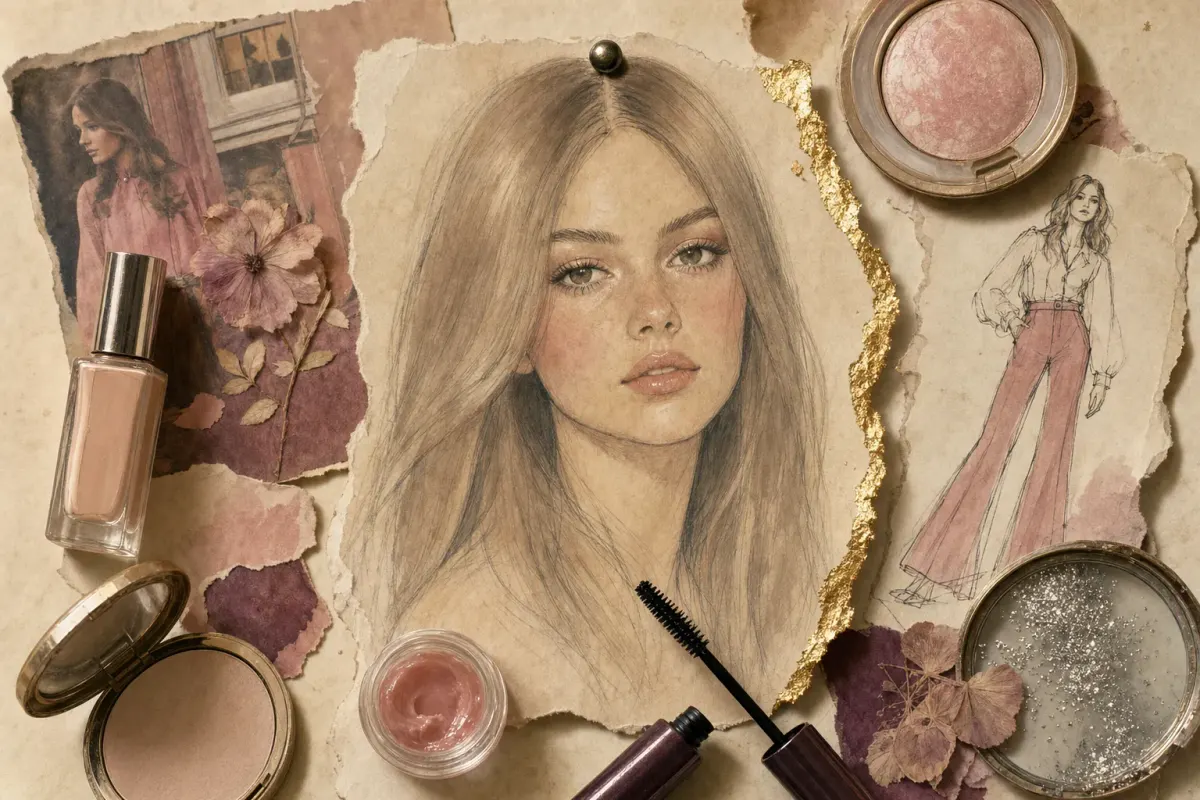
In short
The 1970s sold the natural look as a product line, from Cover Girl’s Super Sheer range and Estée Lauder’s Fresh Air Make-up of 1970; made American cosmetics list their ingredients under a rule published in 1973; saw Fashion Fair take prestige makeup for darker skin to department-store counters; and met glam and punk faces painted to be seen.
- 9min read
- 6chapters
- 18sources
The 1960s had made the eye the centre of the face and sold it false lashes by the million. The 1970s sold something harder to see. Its best-known face was a natural one — sheer, glossy, apparently barely made up — and it was manufactured, packaged and advertised as carefully as any red mouth of the 1950s.
The decade also changed what a cosmetic had to admit about itself, opened prestige counters to women whose skin the mass market had largely ignored, and produced, at its edges, faces painted to be seen across a room. What follows is the story of a natural look that was a product, and of the people who read its label, widened its shades or refused it altogether.
Naturalness, Sold
The look arrived as a product line. In 1970 Noxell launched Cover Girl Super Sheer cosmetics, in the historian James Bennett’s words “better suited to the prevailing ‘natural look’”, with a foundation in shades such as Sheer Bare and a Translucent Powder in Sheer Nude and Sheer Natural.[1] Estée Lauder’s Fresh Air Make-up of the same year offered “a natural, glowing, skim-on blush”, and its Tender Cheek Tint was sold in a range called Little Nothings.[2] Revlon had made the joke first: its Natural Wonder Un-Lipsticks were advertised in 1969 in shades that included Nothing and Nothing Frosted.[3]
The eye was simplified to match. As fashion moved towards a more natural look in the 1970s, Bennett writes, many women gave up false lashes for lash-extending mascaras; Maybelline’s water-based Great Lash appeared in 1971, and its Look Natural comb-on mascara in 1974.[4][5] Advertising supplied a face as well. By the 1970s, according to the Smithsonian’s finding aid for the Cover Girl archive, “a new social emphasis on looking and dressing ‘naturally’” had produced a campaign built on “the wholesome glamour of the ‘girl next door,’ a blue-eyed, blonde all-American image.”[6]
The Label Lists Its Ingredients
A product sold as natural did not have to say what it was made of. The Federal Food, Drug, and Cosmetic Act of 1938 asked a cosmetic’s label to name the product, its maker and the quantity inside, not its ingredients.[7] The decade had already seen a recall: in 1972 the Food and Drug Administration recalled consumer products containing more than 0.75 per cent hexachlorophene, the antiseptic of the previous decade’s medicated makeup.[8]
On 7 February 1973 the FDA published two proposals for ingredient labelling, one of them a petition from Professor Joseph A. Page, Anthony L. Young and the Consumer Federation of America; of 291 comments received, 273 endorsed the idea.[9] The final rule, published on 17 October 1973, required ingredients to be listed in descending order of predominance, let fragrance and flavour be declared in a word and trade secrets be withheld after review, and made the trade association’s Cosmetic Ingredient Dictionary the standard for names.[9] It was to apply to products labelled after 31 March 1975; after stays and court proceedings, the FDA says, it “became fully effective in early 1977.”[9][10]
The presence of a substance to which a consumer is allergic or sensitive, for example, may render the product worthless to that consumer.
Counters for Darker Skin
The natural look had a narrow idea of nature. Cover Girl, whose liquid makeup was the best-selling makeup line in the United States by 1968, had launched in shades its historian judges suitable only for lighter skins, and its advertising, the finding aid records, featured “especially Caucasian women” until the 1980s.[12][13] In NPR’s account there was, in the 1960s and early 1970s, no national makeup brand that catered to women of colour, only regional and smaller ones; Flori Roberts dates its own line to 1965 and claims to have been the first.[14][15]
In 1973 Eunice and John Johnson, the publishers of Ebony and Jet, started Fashion Fair Cosmetics. They hired a chemist to make foundations and lipsticks for darker skin, packaged them in pink — because, in the recollection of the Fair’s announcer Audrey Smaltz, Estée Lauder’s was blue — and asked for space at the prestige counters, beginning with Marshall Field’s in Chicago, A&S in Brooklyn and Bloomingdale’s in Manhattan.[14] The line eventually reached more than 1,500 department stores, and showed other companies a market they had been ignoring.[14]
The Face of the Decade
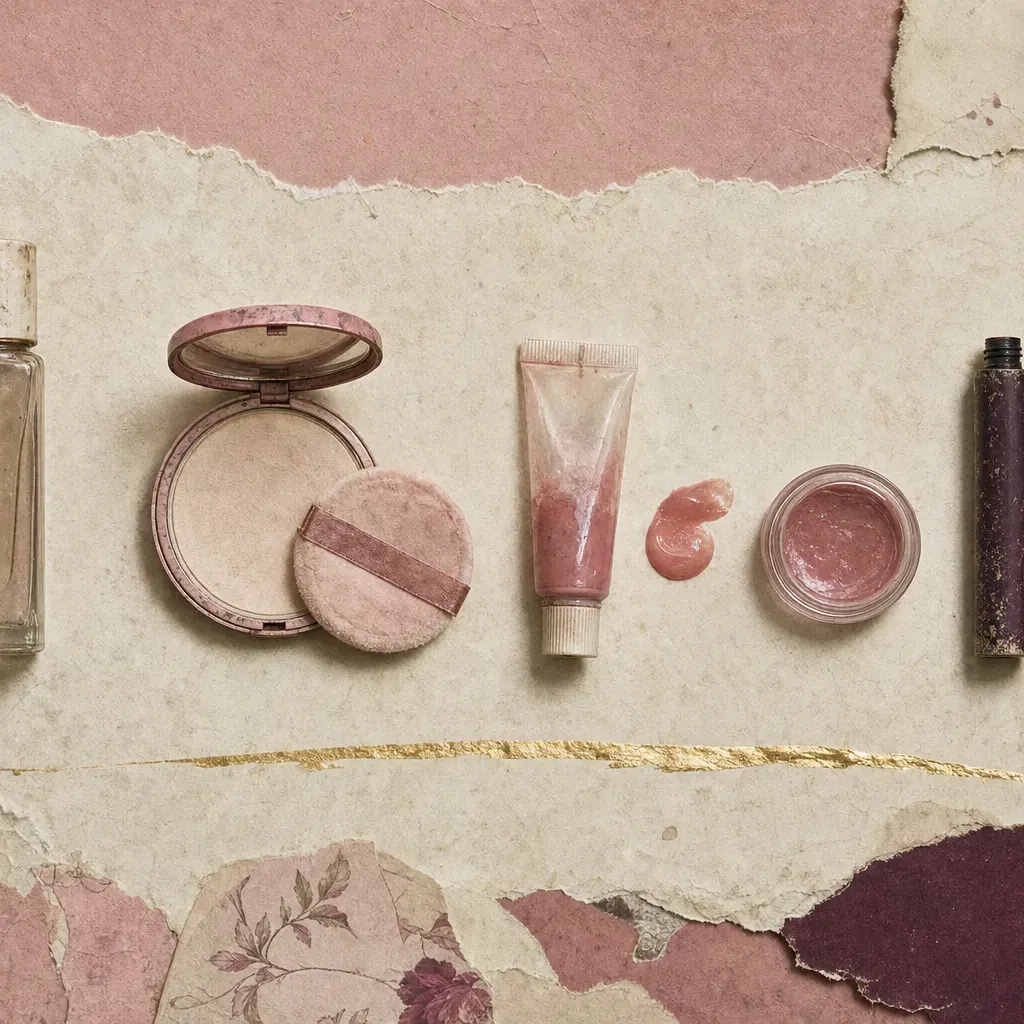
Put together, the decade’s products describe the face its advertising sold: a sheer liquid base set with translucent powder, and brows filled with a pencil from the larger eye ranges of the day — Cover Girl’s eye line of 1971 ran to 47 products;[16] a skim-on tint on the cheeks;[17] colour on the lids from a cream crayon, such as Cover Girl’s PeeperSticks or Revlon’s Natural Wonder Shiny Eyeshadow Crayon of 1973;[16][18] lashes lengthened with mascara rather than false ones;[19] and a glossed mouth, from Cover Girl’s Super Gloss for Lips of 1972 or Bonne Bell’s flavoured Lip Smackers of 1973.[16][20] Shimmer had its moment too: glitter and pearlescent effects in eye shadow reached a highpoint in the 1970s and 1980s, largely through new synthetic pearls.[21]
The plate here is reconstructed from those products rather than from any one woman’s routine, and the steps beside it say what each one takes to do now.
The Refusals
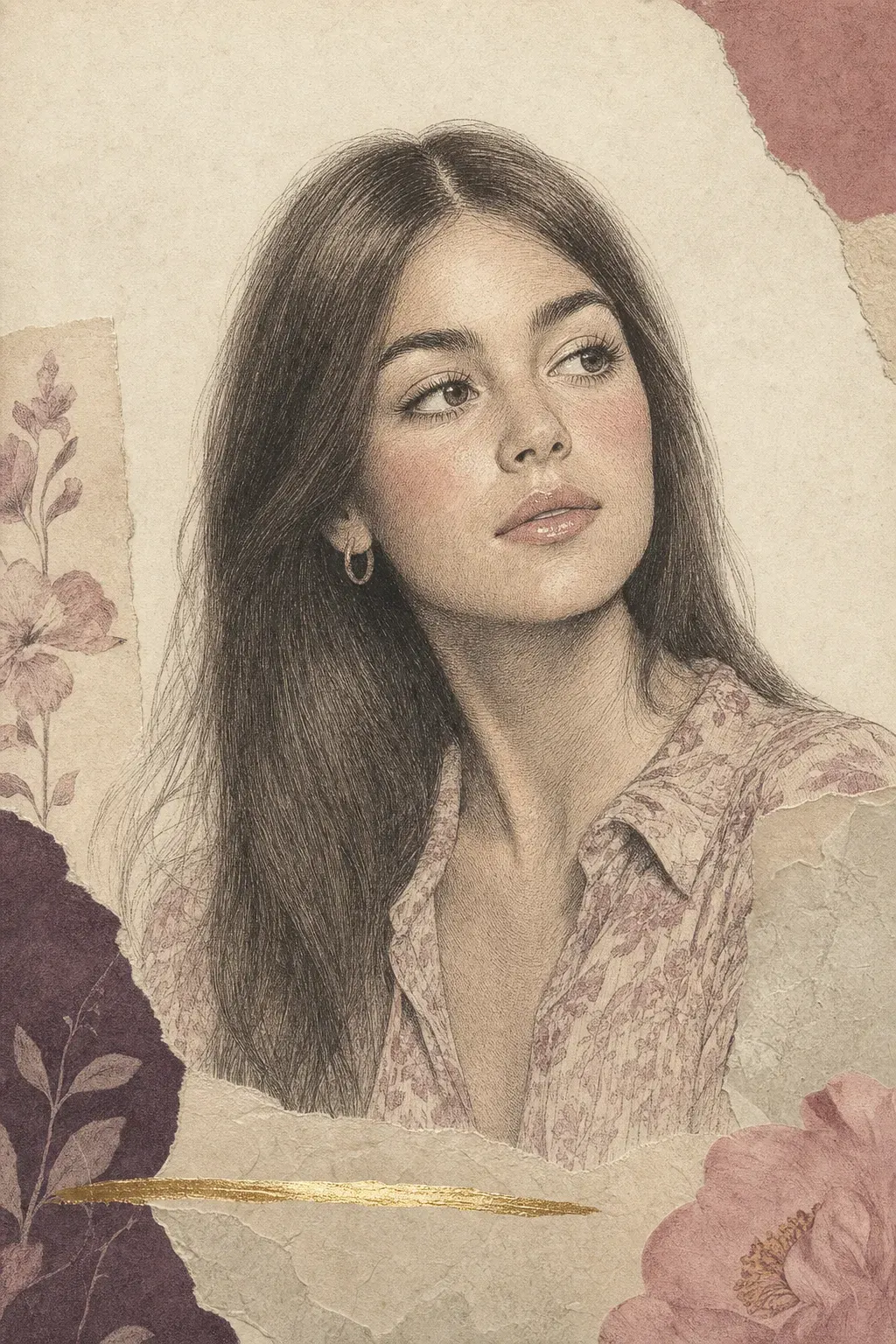
Not everyone wanted to look as if they wore nothing. In Britain glam rock put colour back on the face, and on men’s: as David Bowie built his Ziggy Stardust character in 1972 his band grew their hair long and experimented with eye makeup, and for the sleeve of Aladdin Sane in 1973 the photographer Brian Duffy drew a lightning bolt across Bowie’s face for the makeup artist Pierre Laroche to fill with colour.[22][23] Fans, the V&A records, came to concerts imitating it, with the sleeve as their model.[23]
Punk went further. In Derek Jarman’s Jubilee, photographed in 1977, the model and actress Jordan, who worked at Vivienne Westwood’s SEX boutique on the King’s Road, appeared with her face painted in geometric lines above a twin set and pearls, a mixture of “traditional clichés” with “spiked hair and heavy make-up” that the V&A calls typical of punk.[24] By 1980 a weaver was recording a girl punk she had first seen in a tea shop in Bath, with purple lightning strikes across her cheeks and black and burgundy lipstick.[25] Both were faces made to be noticed, in a decade that sold makeup on the promise that it would not be.
What Is Not Known
The decade’s turns are better documented as products than as practice. The sources here record what was sold as natural, not how many women wore less makeup, or whether they did; Bennett’s suggestion that the hexachlorophene scare of 1972 “may have accelerated” a shift already under way is offered as a possibility, and is reported here as one.[26]
Dates disagree where several events can claim the same change. Ingredient labelling is dated 1973 in one industry timeline, by its publication; the rule set 31 March 1975 for products as labelled; and the FDA dates full effect to early 1977.[27][28][29] Claims to be first disagree too: NPR describes no national brand for women of colour before Fashion Fair, while Flori Roberts calls its 1965 range the first, a claim this archive reports as the company’s own.[30][31]
Some popular stories are absent for want of a source. Revlon’s Charlie, launched as a fragrance in 1973 and extended into a cosmetics line in 1974, is often presented as the emblem of a new, independent woman; the sources used here document the products, not that reading of them.[32] And the account of the Fashion Fair models blending their own foundation rests on one witness, recalling it decades later.[30]
Sources
- [1, 12, 16]Cover Girl Cosmetics and Skin, 2016.View source (opens in a new tab) Accessed 2026-09-26.
- [2, 17]Estée Lauder (post 1960) Cosmetics and Skin, 2023.View source (opens in a new tab) Accessed 2026-09-26.
- [3, 18, 32]Revlon (post 1960) Cosmetics and Skin, 2012.View source (opens in a new tab) Accessed 2026-09-26.
- [4, 19]False Eyelashes Cosmetics and Skin, 2018.View source (opens in a new tab) Accessed 2026-09-26.
- [5]Maybelline Cosmetics and Skin, 2010.View source (opens in a new tab) Accessed 2026-09-25.
- [6, 13]Guide to the Cover Girl Advertising Oral History and Documentation Project, 1959–1990 (NMAH.AC.0374) Smithsonian Online Virtual Archives, 2007.View source (opens in a new tab) Accessed 2026-10-03.
- [7]The FDA, FTC and Cosmetics Cosmetics and Skin (updated 1 October 2023), 2022.View source (opens in a new tab) Accessed 2026-10-03.
- [8, 26]Hexachlorophene Cosmetics and Skin (updated 26 February 2023), 2015.View source (opens in a new tab) Accessed 2026-10-03.
- [9, 11, 28]Cosmetic Ingredient Labeling and Voluntary Filing of Cosmetic Product Experiences (final rules) Federal Register, vol. 38, no. 200, 17 October 1973, pp. 28912–28917, 1973.View source (opens in a new tab) Accessed 2026-10-03.
- [10, 29]Cosmetics Labeling Guide U.S. Food and Drug Administration (content current as of 25 February 2022).View source (opens in a new tab) Accessed 2026-10-03.
- [14, 30]Fashion Fair's makeover NPR, Planet Money (25 March 2022), 2022.View source (opens in a new tab) Accessed 2026-10-03.
- [15, 31]About Us Flori Roberts (company website).View source (opens in a new tab) Accessed 2026-09-22.
- [20, 27]Cosmetics Timeline Cosmetics and Skin (updated 6 August 2026), 2012.View source (opens in a new tab) Accessed 2026-10-03.
- [21]Eye Shadow Cosmetics and Skin.View source (opens in a new tab) Accessed 2026-10-03.
- [22]Bowie and Burretti: the Stardust duo Victoria and Albert Museum (11 September 2025), 2025.View source (opens in a new tab) Accessed 2026-10-03.
- [23]Record sleeve for Aladdin Sane by David Bowie, designed by Duffy/Duffy Design Concepts and Celia Philo, 1973 (E.583-1985) Victoria and Albert Museum, London.View source (opens in a new tab) Accessed 2026-10-03.
- [24]Jordan in Jubilee, photograph, 1977 (S.1315-2010) Victoria and Albert Museum, London.View source (opens in a new tab) Accessed 2026-10-03.
- [25]‘Girl Punk’, tapestry, Candace Bahouth, London, 1980 (T.55-1985) Victoria and Albert Museum, London.View source (opens in a new tab) Accessed 2026-10-03.
Continue in The 1970s Era
Nature & Glitter
Browse all 10 articles