The List on the Label: Cosmetics Declare Their Ingredients
For most of the century an American cosmetic label named the product, its maker and how much was inside. A rule of 1973 made it say what the product was made of, in order of quantity.
In short
The FDA’s cosmetic ingredient labelling rule, published on 17 October 1973 after a petition from Joseph A. Page and the Consumer Federation of America, required ingredients to be listed in descending order of predominance on products labelled after 31 March 1975; it became fully effective in early 1977.
- 7min read
- 6chapters
- 7sources
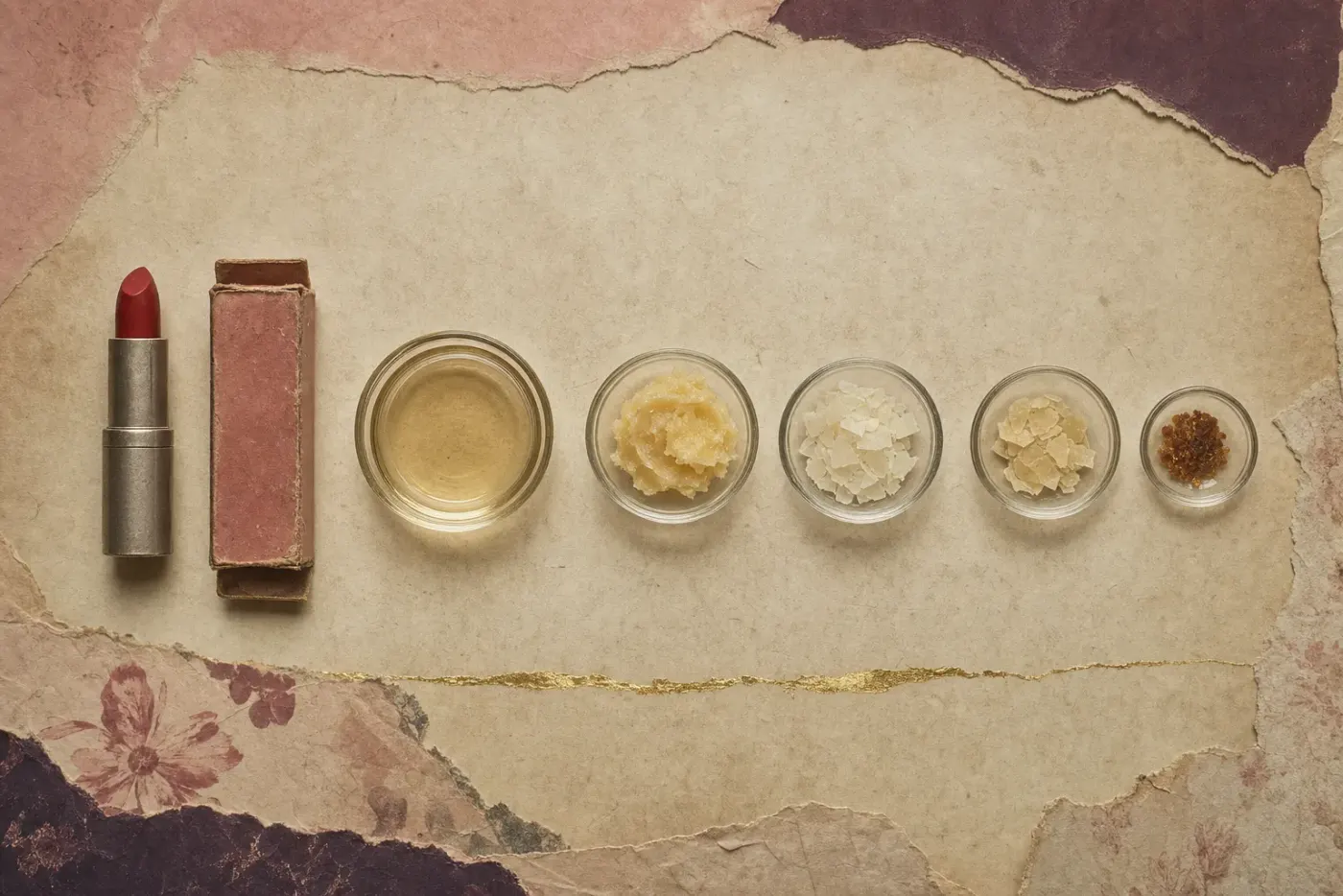
The Food and Drug Administration’s guide to cosmetic labels gives a lipstick as one of its examples. Its ingredients are declared in descending order of predominance — castor oil, lanolin, candelilla wax, carnauba wax and ozokerite first — and the colours follow at the end, in any order.[1]
A list like that is so ordinary now that it is easy to forget how recent it is. In the United States it descends from a regulation published in the Federal Register on 17 October 1973.[2]
What a Label Used to Say
The Federal Food, Drug, and Cosmetic Act of 1938 asked a cosmetic’s label to name the product, its maker and the quantity inside, and to make no false claims.[3] It did not ask what the product was made of. Some firms listed ingredients anyway: Bennett reproduces a Dona Ray Cosmetics label of 1936 as an early example of a company that listed its ingredients.[4]
The FDA’s own summary is brief: “Cosmetic ingredient labeling became an issue in the early 1970s.” Guidelines were published in the middle of 1972, and regulations were proposed early in 1973.[5] The debate ran alongside the recall, in 1972, of consumer products containing more than 0.75 per cent hexachlorophene, the antiseptic of the previous decade’s medicated makeup.[6]
A Petition and a Proposal
The rule began as two proposals, published together in the Federal Register on 7 February 1973. One was a petition from Professor Joseph A. Page, Anthony L. Young and the Consumer Federation of America; the other was the Commissioner of Food and Drugs’ own.[7]
Two hundred and ninety-one comments came in, from consumers, the cosmetics industry, government agencies, and trade and professional bodies. Two hundred and seventy-three endorsed ingredient labelling; ten opposed both proposals.[7] Several questioned its legal basis, arguing that the Fair Packaging and Labeling Act allowed ingredient labelling only commodity by commodity. The Commissioner replied that, for this purpose, all cosmetics could be treated as a single commodity.[7]
Why a List
The Commissioner gave two reasons, both drawn from the packaging law: to prevent consumers being deceived, and to let them compare value. A list would preclude claims “unreasonable in relation to the ingredients present”, and help a buyer judge whether a price was reasonable.[8] The plainest argument was medical: “The presence of a substance to which a consumer is allergic or sensitive, for example, may render the product worthless to that consumer.”[8]
For the same reason the rule refused one firm’s request to list “specialty blends”, such as herbal extracts and emulsifier bases, under their own names. A list made of bases, the Commissioner answered, “would be virtually meaningless to the consumer and would defeat the purpose of the proposed regulation”, since nobody could avoid an ingredient hidden inside one.[8]
The Commissioner recognizes that many consumers may initially be unfamiliar with certain cosmetic ingredients, but concludes that increasing familiarity will be acquired.
Names, Order and Secrets
Much of the wording survives in the regulation in force today. Ingredients are declared “in descending order of predominance, except that fragrance or flavor may be listed as fragrance or flavor”; in 1973 the Commissioner judged that naming every component of a fragrance, which might contain twenty or more, would be impractical.[10][11] An ingredient the FDA accepts as a trade secret need not be named, and the phrase “and other ingredients” may close the list instead.[10] Ingredients present at one per cent or less may follow in any order, and colours may come last, in any order. The list gives the order of quantity, not the quantity: concentrations need not be declared.[12]
Names were the harder problem. Consumers asked for common names, and comments pointed out that the same substance could appear under different names on different labels. The answer was a dictionary: the Cosmetic, Toiletry and Fragrance Association had compiled one, and the rule made it the controlling reference.[11] The regulation in force today still names its second edition, of 1977.[10] The ingredient pages of this archive rest on the same idea: a name on a label is the beginning of an inquiry, not the end of one.
Deadlines and Delays
The industry asked for time; its suggestions ranged from eighteen months to an indefinite period while existing stocks of labels ran out. The Commissioner set two dates: labelling ordered after 31 March 1974, and products labelled after 31 March 1975, had to comply.[13]
Full effect took longer. In the FDA’s summary, two final regulations, stays of those regulations, terminations of the stays and “lengthy court proceedings challenging the legality of the published regulations” followed, and the requirement “became fully effective in early 1977.”[14]
The same issue of the Federal Register set up a quieter system alongside: a voluntary programme, grown from a petition by the industry’s association, for manufacturers to report complaints of injury to the FDA. Some consumers who commented had asked for it to be mandatory.[13]
What Is Not Known
The date depends on which event is meant. A cosmetics timeline compiled by Bennett gives 1973, the year the rule was published;[15] the rule itself set 31 March 1975 for products as labelled;[16] and the FDA dates full effect to early 1977.[17] This archive places the change at 1975, the first date the rule set, and reports the others.
The FDA’s summary mentions court proceedings without naming them; the sources used here do not identify the cases or the parties, and this account does not either. Nor do they say how many products carried a list by 1975, or whether reading one changed what anybody bought.[17]
Sources
- [1, 5, 12, 14, 17]Cosmetics Labeling Guide U.S. Food and Drug Administration (content current as of 25 February 2022).View source (opens in a new tab) Accessed 2026-10-03.
- [2, 7, 8, 9, 11, 13, 16]Cosmetic Ingredient Labeling and Voluntary Filing of Cosmetic Product Experiences (final rules) Federal Register, vol. 38, no. 200, 17 October 1973, pp. 28912–28917, 1973.View source (opens in a new tab) Accessed 2026-10-03.
- [3]The FDA, FTC and Cosmetics Cosmetics and Skin (updated 1 October 2023), 2022.View source (opens in a new tab) Accessed 2026-10-03.
- [4]Ingredients Lists Cosmetics and Skin (updated 23 June 2026), 2009.View source (opens in a new tab) Accessed 2026-10-03.
- [6]Hexachlorophene Cosmetics and Skin (updated 26 February 2023), 2015.View source (opens in a new tab) Accessed 2026-10-03.
- [10]21 CFR 701.3 - Designation of ingredients Code of Federal Regulations, title 21, part 701, subpart A, 2026.View source (opens in a new tab) Accessed 2026-10-03.
- [15]Cosmetics Timeline Cosmetics and Skin (updated 6 August 2026), 2012.View source (opens in a new tab) Accessed 2026-10-03.
Filed under