Glitter and Lightning: The Glam Face
While the counters sold makeup that did not show, British glam rock put colour back on the face, men’s faces included, and its fans copied the look from a record sleeve.
In short
Glam rock put makeup on men: David Bowie’s band experimented with eye makeup as the Ziggy Stardust character took shape in 1972, and for the Aladdin Sane sleeve of 1973 the photographer Brian Duffy drew a lightning bolt across Bowie’s face for the makeup artist Pierre Laroche to colour, which fans copied at concerts.
- 6min read
- 6chapters
- 9sources
In July 1972 David Bowie and his band, the Spiders from Mars, performed on Top of the Pops in matching zip jackets and tight trousers in bright colours and fabrics — for many viewers, the V&A notes, their first sight of the character Bowie called Ziggy Stardust.[1] Bowie wanted the music, in his often-quoted phrase, to ‘look like it sounded’, and as the character took shape the band grew their hair long and experimented with eye makeup.[1]
The counters of the early 1970s were selling makeup that did not show. Glam rock put it back on the face, and on men’s faces as readily as women’s.
Made Together
The look was made collaboratively. The bassist Trevor Bolder described the band’s regular visits to Haddon Hall, where seamstresses led by the designer Freddie Burretti worked on the overall look for the Ziggy Stardust tour.[2] Burretti cut the quilted suits; the peroxide hair of his muse Daniella Parmar, the museum suggests, may have inspired Bowie’s red Ziggy cut.[2]
Makeup took its references from the same places as the clothes. Burretti’s teal suit for the 1973 video of “Life on Mars?” drew on Yves Saint Laurent’s Libération collection of 1971, which paired padded shoulders with heavy makeup evoking the fashions of occupied Paris in the 1940s, and the V&A finds the same reference in the “garish blue eyeshadow” Bowie wore in the video.[2]
The Astral Sphere
A professional hand was at work by 1973. In Masayoshi Sukita’s photograph Starman of that year, lent to the V&A, Bowie wears a quilted black jumpsuit by Kansai Yamamoto and, on his forehead, the “astral sphere makeup designed by Pierre LaRoche”, with “heavily shadowed eyes and metallic lips.”[3]
Metal and shimmer were materials of the moment. The practice of adding glitter and pearlescent effects to eye shadow, which goes back to the 1920s, reached a highpoint in the 1970s and 1980s, Bennett writes, largely through the introduction of new synthetic pearls.[4]
The Lightning Bolt
The image that outlasted the tour was a single photograph. For the sleeve of Aladdin Sane, released in 1973, the photographer Brian Duffy designed a lightning bolt and drew it on Bowie’s face, then asked the makeup artist Pierre Laroche to fill in the flash according to his colour requirements.[5] The V&A also credits Duffy with conceiving the persona itself, from Bowie’s original title, ‘A Lad Insane’.[6]
The flash escaped the sleeve at once. Fan merchandise of 1973 and 1974 carried it, including nylon scarves made not to be worn but to be held up in the audience, and the museum calls the lightning-flash makeup “synonymous with the singer.”[7]
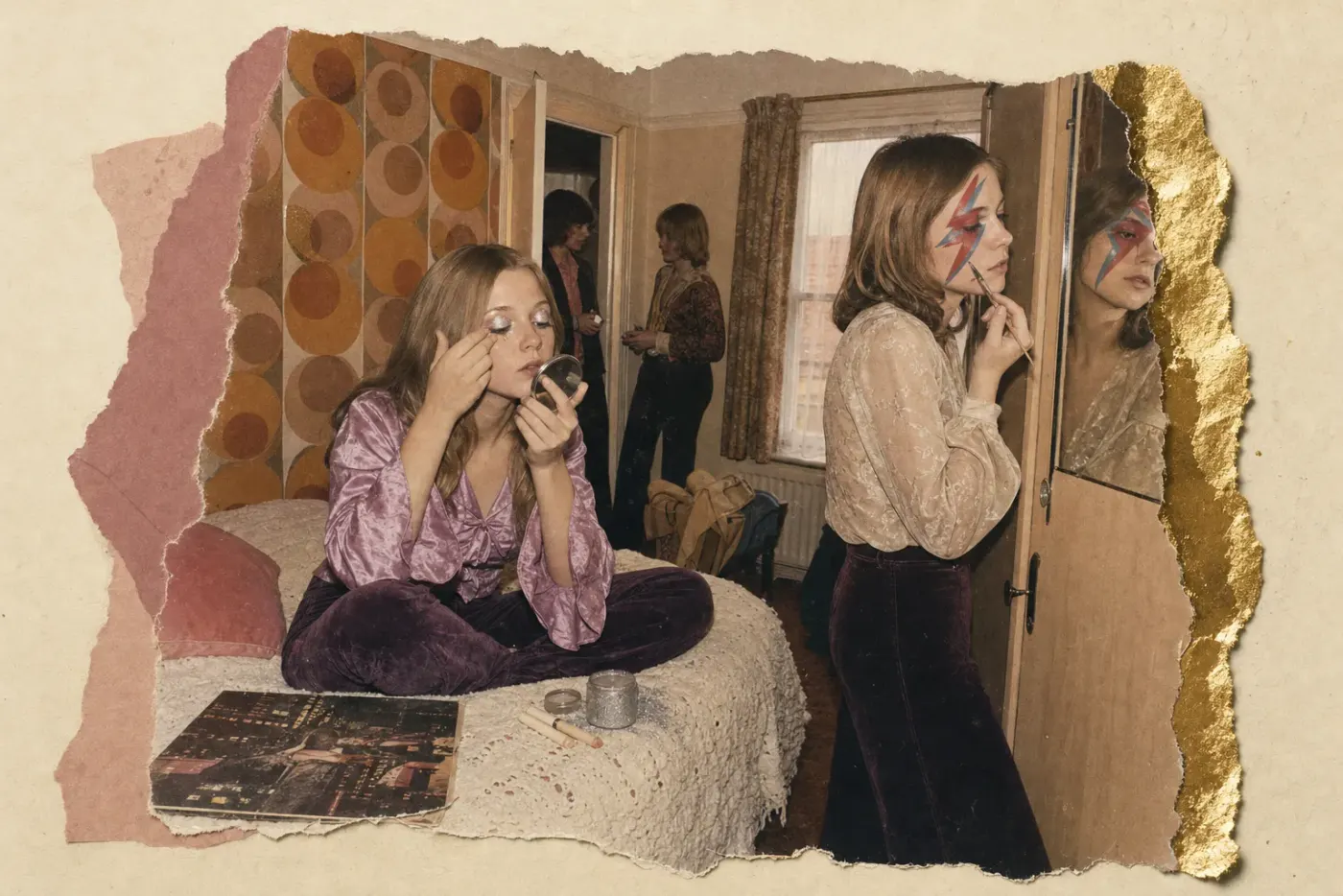
Many fans attended concerts imitating the flash of red and blue facial make up using the sleeve as a model.
A Mirror for the Audience
The audience had its own kit. Among the V&A’s rock merchandise is a small pocket mirror printed with a photograph of Marc Bolan and the words “T-Rex Summer ’73”, designed, the museum says, “to appeal to teenage girls”, and one that would have been useful for applying glitter makeup before a T. Rex concert.[9] The craze it served, which the museum calls T-Rexstacy, gripped Britain from late 1971 to 1973, and in 1972 the band’s records made up six per cent of British record sales.[9]
Makeup, then, was worn in the audience as well as on the stage. The same museum’s record of the Aladdin Sane sleeve describes fans arriving at concerts made up in imitation of it.[10]
Paint on a Man’s Face
What glam put on men was colour. What the cosmetics houses sold men in the same years was skin care and scent. Estée Lauder’s Aramis 900 collection of 1970 offered products for hair, body, face and shave, chosen by answering questions on a punched card, and Clinique added a men’s range in 1976.[11] Revlon, whose habit of following Lauder its founder’s biographer catalogued, answered Aramis with Braggi.[12]
The painted man was far older than any of these. As another article in this archive sets out, for most of the period it covers men simply wore makeup; what glam did was make the eye makeup of a pop star into something his audience could copy from a record sleeve.
What Is Not Known
The sources used here do not name a single cosmetic. None of the museum records says which products made the lightning bolt, the astral sphere or the metallic lips, or what fans bought to copy them, and the pocket mirror’s use for glitter is the museum’s inference from its date and its market, not a record of use.[13]
Credit is divided, too. The V&A’s record of the sleeve gives the design of the bolt to Duffy and its colouring to Laroche; its record of Sukita’s photograph gives Laroche the design of the astral sphere.[14][15] Accounts of the bolt’s making from outside the museum are not used here. And the “Life on Mars?” suit is dated 1972 in one of the V&A’s captions and 1973 in another; the video is dated 1973.[16]
Sources
- [1, 2, 16]Bowie and Burretti: the Stardust duo Victoria and Albert Museum (11 September 2025), 2025.View source (opens in a new tab) Accessed 2026-10-03.
- [3, 15]‘Starman’, photograph of David Bowie by Masayoshi Sukita, 1973 (LOAN:AMERICASFOUNDATION.2898-2024) Victoria and Albert Museum, London (on loan).View source (opens in a new tab) Accessed 2026-10-03.
- [4]Eye Shadow Cosmetics and Skin.View source (opens in a new tab) Accessed 2026-10-03.
- [5, 8, 10, 14]Record sleeve for Aladdin Sane by David Bowie, designed by Duffy/Duffy Design Concepts and Celia Philo, 1973 (E.583-1985) Victoria and Albert Museum, London.View source (opens in a new tab) Accessed 2026-10-03.
- [6]"David Bowie is...watching you", Brian Duffy, 1973 (S.558-2018) Victoria and Albert Museum, London.View source (opens in a new tab) Accessed 2026-10-03.
- [7]David Bowie scarf, sold as fan merchandise, 1973–74 (S.987-2010) Victoria and Albert Museum, London.View source (opens in a new tab) Accessed 2026-10-03.
- [9, 13]T-Rex pocket mirror, 1973 (S.916-2010) Victoria and Albert Museum, London.View source (opens in a new tab) Accessed 2026-10-03.
- [11]Estée Lauder (post 1960) Cosmetics and Skin, 2023.View source (opens in a new tab) Accessed 2026-09-26.
- [12]Revlon (post 1960) Cosmetics and Skin, 2012.View source (opens in a new tab) Accessed 2026-09-26.
Filed under