The Punk Face: Paint as Provocation
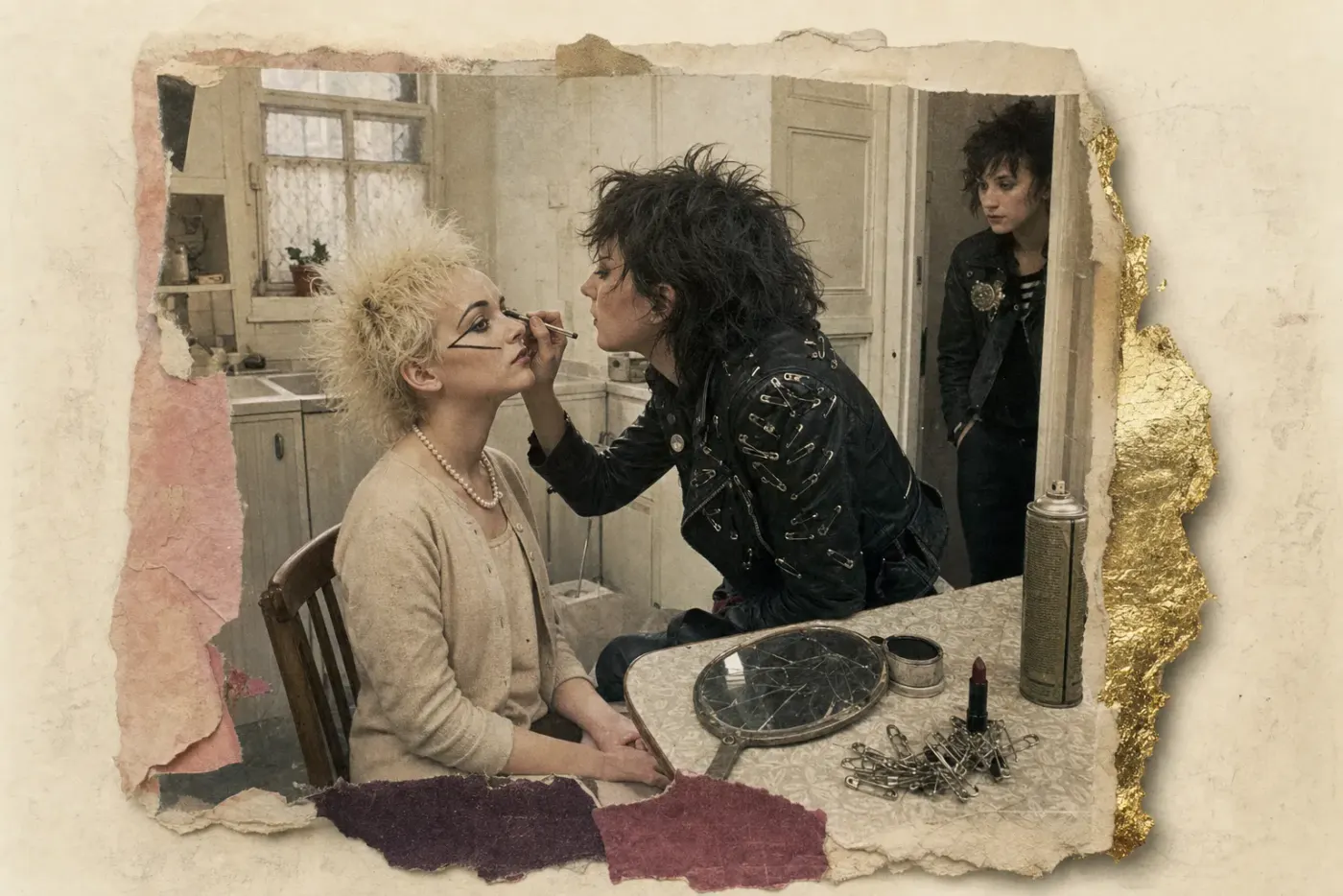
In 1977, the year of the Silver Jubilee, punk painted its faces in geometric lines and heavy black, and wore them with a twin set and pearls: the natural look, turned inside out.
In short
In Derek Jarman’s Jubilee, photographed in 1977, the punk model and actress Jordan, who worked at Vivienne Westwood’s SEX boutique on the King’s Road, wore her face painted in geometric lines with a twin set and pearls, a combination the V&A calls typical of the punk style.
- 6min read
- 6chapters
- 8sources
In a photograph taken in 1977 on the set of Derek Jarman’s film Jubilee, the punk model and actress Jordan sits behind a desk in front of a wall covered in graffiti. She wears a twin set and pearls, her hair sticks up, and her face is painted with geometric lines.[1]
The V&A, which owns the print, calls the combination typical of punk.[1] It was also the exact opposite of the face the cosmetics counters were selling that decade: makeup made to be noticed, worn with the most conventional clothes in the wardrobe.
The Shop on the King’s Road
Jordan’s place in the scene came through a shop. She worked with Vivienne Westwood at SEX, the boutique on the King’s Road in Chelsea, and was a fixture at many of the Sex Pistols’ early performances.[2] The band had grown up around the same shop: its bassist, Glen Matlock, worked there; Malcolm McLaren, who ran it with Westwood, became the band’s manager in 1975 and named it the Sex Pistols to promote the shop; and its members wore Westwood’s clothes.[3]
The chronology is short. The Pistols played their first show in November 1975 and the 100 Club’s Punk Special in May 1976, and released “Anarchy in the UK” that November. “God Save the Queen” came out in May 1977, the year of Elizabeth II’s Silver Jubilee, and the band split in January 1978.[3]
Jubilee
Jarman’s film took the Jubilee as its occasion. In it Elizabeth I is transported to a bleak and decrepit contemporary Britain, to find Elizabeth II dead after a mugging and Buckingham Palace turned by punks into a recording studio; the V&A calls it “a stylised contemporary account of the impact of the punk movement in Britain.”[4] Its cast included Jordan, Adam Ant, Toyah Wilcox and Little Nell, with appearances by Siouxsie Sioux and Steve Severin of Siouxsie and the Banshees.[4]
Jordan played Amyl Nitrate. Her costume for one scene, also in the museum, is a short dress of fluorescent green mesh covered in blue polythene with holes melted into it, with a Union flag cross in red faux leather; in it, with a Roman helmet and a trident, she sings a punk version of “Rule, Britannia!”.[4]
Her appearance as Amyl Nitrate in Derek Jarman’s Jubilee (1977) typifies the punk style: mixing traditional clichés – the twin set and pearls – with spiked hair and heavy make-up.
A Face in Plaster
The makeup survives in a second form. Jean-Marc Prouveur, the film’s stills photographer, made a life mask of Jordan in gypsum plaster and painted it as her makeup in the film had been: geometric lines, pink areas and red lips. It is inscribed ‘PROUVEUR / DEC 77’.[6]
It is the opposite kind of record to a cosmetics advertisement of the same years. The counters described their products by what they would not show — a sheer base, a skim-on tint, a lipstick shade called Nothing — while the punk face was recorded as a set of shapes that could not be mistaken for skin.[7]
A Tea Shop in Bath
By the end of the decade the face had travelled. In 1980 the weaver Candace Bahouth, working in London, made a pair of tapestries, Girl Punk and Boy Punk, of two young people she had first seen in a tea shop in Bath.[8] The girl’s face is made up with purple lightning strikes across the cheeks, eyeshadow in purple, green, blue and red, and lipstick in black and burgundy; a badge on her top reads ‘GIRLS ARE POWERFUL’.[8]
Bahouth, in the museum’s description, concentrates on people who represent their culture or subculture “by the clothes they wear, their hairstyle, make up and jewellery.”[8] Her girl punk is a record of exactly that: a face made up to announce which side its wearer was on.
Against the Natural
Punk’s quarrel was not mainly with makeup. A London Museum record puts it plainly: punk “was a form of rebellion to mainstream music and hippie style fashion in the 1970s.”[9] The natural look belonged to the same mainstream; in the same years Cover Girl’s advertising, by the account of the Smithsonian’s finding aid, focused on “the wholesome glamour of the ‘girl next door’”.[10]
Glam had put makeup on the stage and let its audience copy it. Punk’s faces are recorded off the stage as well as on it: on a film set, cast in plaster, and in a tea shop in Bath.
What Is Not Known
The sources used here record faces, not products. None says what Jordan’s makeup was made with, who designed it, or what punks in general bought or improvised; the claim, often made, that punk makeup was do-it-yourself is not made in them, and is not repeated here as fact.[11][12]
Even the film’s date is given two ways. The V&A’s gallery label and the photograph’s record give Jubilee as 1977; its catalogue entries also say the film was directed in 1978.[11] And a single tapestry is evidence of one artist’s encounter in Bath, not of how many young people outside London wore the face.[13]
Sources
- [1, 2, 5, 11]Jordan in Jubilee, photograph, 1977 (S.1315-2010) Victoria and Albert Museum, London.View source (opens in a new tab) Accessed 2026-10-03.
- [3]Sex Pistols: London’s resident punk rebels London Museum.View source (opens in a new tab) Accessed 2026-10-03.
- [4]Film costume worn by Jordan as Amyl Nitrate in Jubilee, 1977–78 (S.1310-2010) Victoria and Albert Museum, London.View source (opens in a new tab) Accessed 2026-10-03.
- [6, 12]Life mask of Jordan, Jean-Marc Prouveur, 1977 (S.1316-2010) Victoria and Albert Museum, London.View source (opens in a new tab) Accessed 2026-10-03.
- [7]Revlon (post 1960) Cosmetics and Skin, 2012.View source (opens in a new tab) Accessed 2026-09-26.
- [8, 13]‘Girl Punk’, tapestry, Candace Bahouth, London, 1980 (T.55-1985) Victoria and Albert Museum, London.View source (opens in a new tab) Accessed 2026-10-03.
- [9]Punk (collection object 800543) London Museum.View source (opens in a new tab) Accessed 2026-10-03.
- [10]Guide to the Cover Girl Advertising Oral History and Documentation Project, 1959–1990 (NMAH.AC.0374) Smithsonian Online Virtual Archives, 2007.View source (opens in a new tab) Accessed 2026-10-03.
Filed under