Fashion Fair at the Counter: Prestige Makeup for Darker Skin
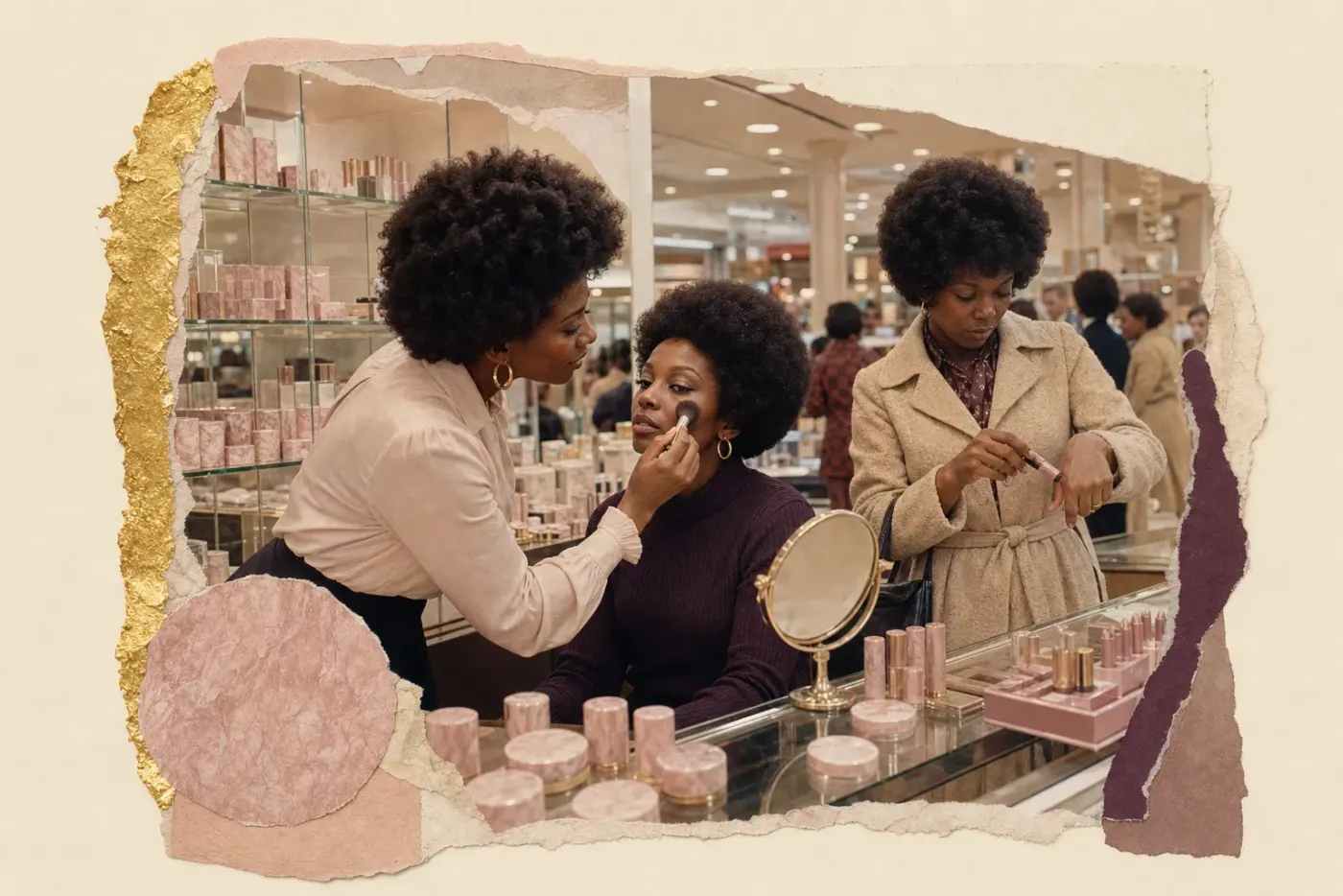
In 1973 the publishers of Ebony started a cosmetics company for darker skin, and took it to the most prestigious counters they could reach.
In short
Fashion Fair Cosmetics was started in 1973 by Eunice and John Johnson, publishers of Ebony and Jet, with foundation and lipstick shades made for darker skin, and was sold at department-store counters, eventually in more than 1,500 stores.
- 6min read
- 6chapters
- 9sources
The story of the Ebony Fashion Fair ends with a problem: its producer had difficulty finding makeup that matched her models.[1] This is the story of what was done about it. In 1973 Eunice and John Johnson, whose company published Ebony and Jet, started a cosmetics company, named it after their show, and set out to sell it where prestige makeup was sold in the 1970s: in department stores.[2]
Backstage
Audrey Smaltz, the Fair’s announcer, described the problem to NPR in 2022. Backstage, the models made their own: “They would blend it themselves. They used whatever they could. You know, they’d go to the five-and-ten and mix it up until they got it the shade that they wanted for themselves.”[3] The programme describes powder foundation made for a lighter complexion with crushed eye makeup mixed into it.[3]
The mass market offered little better. Cover Girl, whose liquid makeup was the top-selling makeup line in the United States by 1968, had launched in three shades and by 1964 had four, which in Bennett’s judgement still left it suitable only for lighter skins.[4] In NPR’s account there was, in the 1960s and early 1970s, no national makeup brand that catered to women of colour, only regional and smaller ones. Flori Roberts, for its part, dates its own range to 1965 and calls it the first developed specifically for women of colour — the company’s claim.[3][5]
The Chicago Office
The Johnsons began, Smaltz recalled, by hiring a chemist to make shades of foundation and lipstick that looked good on darker skin, and tested them on the people who worked in the company’s Chicago office: “We had all shades of colors there, and we tried it on the darkest girl and the lightest girl … [a]nd everything in between.”[6] The lines that came out of it included a Chocolate Raspberry lipstick and foundations called Bronze Blaze and Honey Glow.[6]
The established houses, in NPR’s account, were not interested. When the Johnsons tried to sell the line to companies such as Revlon, no one wanted it, so they went on alone, and chose the packaging themselves.[6]
Eunice came up with pink because Estee at that time was blue. Everything Estee did was blue, so Eunice said, well, I’ll do pink. That’s how we got pink.
The Counters
Selling it meant counter space, and the Johnsons asked for it in person, visiting stores like travelling salespeople. The first they asked were Marshall Field and Company in Chicago, A&S in Brooklyn and Bloomingdale’s in Manhattan. Smaltz telephoned a head of cosmetics she knew, Lester Gribetz, for a meeting the next day, when John Johnson would be in town; the store, she recalled, “wanted the cosmetics immediately.”[8]
The touring show became the line’s advertisement. Smaltz would bring models forward on stage and name the shades they were wearing, and members of the audience went on to the nearest store that sold them.[8] A museum account of the Fair lists A&S, Bloomingdale’s, Marshall Field’s and Harrods among the stores that sold its pink compacts, berry lipsticks and frosty eyeshadows.[9] By NPR’s count it eventually reached more than 1,500 department stores, where, as one of its reporters put it, there was “a Black woman behind a counter that was filled with products made just for them.”[8]
Prestige for Darker Skin
The choice of the department store mattered. In the previous decade Cover Girl’s medicated makeup had been sold in grocery stores and other mass outlets; Fashion Fair went to the counters where prestige makeup was sold, and became, in NBC News’s description, one of the first Black-owned cosmetics lines sold internationally.[10][11] A trade report of its sale in 2019 repeats the claim that it was at one time the largest Black-owned cosmetics company in the world.[12]
For some customers it was close to the only choice. The model Naomi Campbell, as quoted by the FIDM Museum, remembered sneaking into her mother’s makeup bag for “Fashion Fair and Flori Roberts, which were the only brands you could find then for dark skin.”[13]
What Came After
Fashion Fair showed other companies a market they had been ignoring, and many of them, in NPR’s account, expanded their ranges to include deeper colours.[14] NBC News gives that competition, together with an inability to keep up with demand and the closing of the department stores that sold it, as the reasons for the brand’s decline after a commercial peak in 2003.[15]
What Is Not Known
The story of the models blending their own foundation, which this archive’s account of the Fair’s first years could not source, now has a witness: Smaltz, the show’s announcer, describing it to NPR almost fifty years later.[16] It is one person’s recollection, and the programme dates it no more closely than the 1960s and early 1970s.
Who created the company is told differently: the Fair’s exhibition biography counts Eunice Johnson among those involved in creating it, NBC says she created it, and NPR credits both Johnsons.[17][18][16] The sources used here do not name the first store to open a counter, or give the size of the first shade range or its prices. And claims to be first run into each other: NBC called Fashion Fair “the first and one of the largest Black cosmetics lines”, NPR describes no national brand for women of colour before it, and Flori Roberts claims both the first such brand and the first in major department stores, without dating the second.[18][16][19]
Sources
- [1, 18]50 Years of Couture: New Exhibit Celebrates Fashion Empire NBC News, 2017.View source (opens in a new tab) Accessed 2026-10-03.
- [2, 3, 6, 7, 8, 14, 16]Fashion Fair's makeover NPR, Planet Money (25 March 2022), 2022.View source (opens in a new tab) Accessed 2026-10-03.
- [4]Cover Girl Cosmetics and Skin, 2016.View source (opens in a new tab) Accessed 2026-09-26.
- [5, 19]About Us Flori Roberts (company website).View source (opens in a new tab) Accessed 2026-09-22.
- [9, 13]Model Behavior: Black Beauty & Sartorial Ingenuity Through the Lens of the Ebony Fashion Fair – Part Two ASU FIDM Museum.View source (opens in a new tab) Accessed 2026-10-03.
- [10]Guide to the Cover Girl Advertising Oral History and Documentation Project, 1959–1990 (NMAH.AC.0374) Smithsonian Online Virtual Archives, 2007.View source (opens in a new tab) Accessed 2026-10-03.
- [11, 15]New documentary captures legacy of Fashion Fair, one of the first Black-owned makeup lines NBC News, 2022.View source (opens in a new tab) Accessed 2026-09-22.
- [12]Johnson Publishing Company Sells Fashion Fair Cosmetics BeautyMatter, 2019.View source (opens in a new tab) Accessed 2026-09-22.
- [17]Inspiring Beauty: 50 Years of Ebony Fashion Fair — Biographies Exhibition pages, 5 February to 3 May 2015, 2015.View source (opens in a new tab) Accessed 2026-09-25.
Filed under