Flat concealer brush
A small, flat, tongue-shaped brush that puts concealer exactly where it is needed and nowhere else. How to choose and use one, and what painted out a blemish before it.
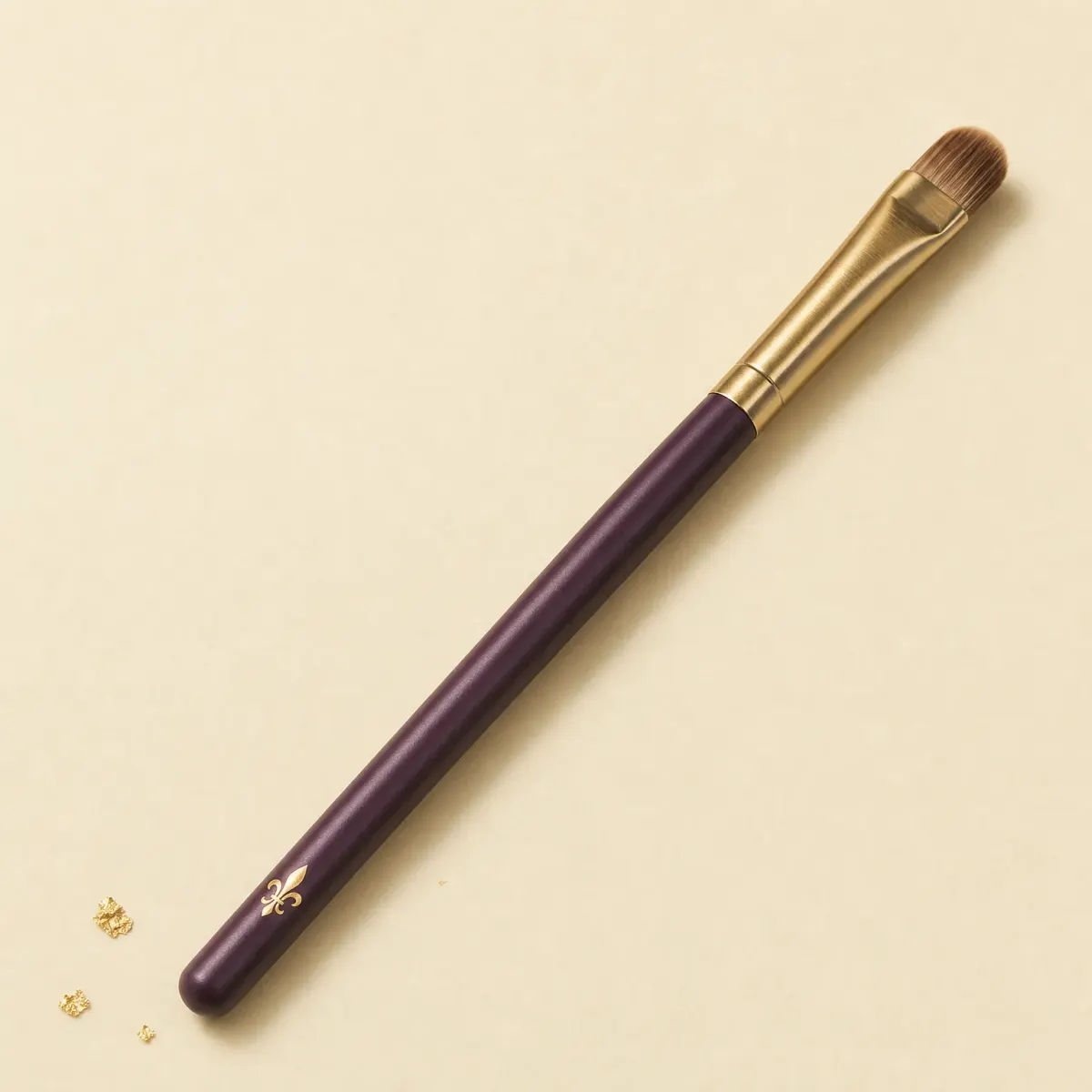
A flat concealer brush is a small, flat synthetic brush with a rounded or tapered tip, used to press concealer precisely onto a blemish, a patch of redness or the inner corner of the eye before its edge is blended away.
Our picks
One flat concealer brush from each house we could verify, across width, tip and firmness, from drugstore to prestige, with a brush from the Kumano maker Hakuhodo and others from a makeup school and professional makeup houses. Each opens where its maker sells it: on Amazon, or at the house’s own shop.
As an Amazon Associate I earn from qualifying purchases. Affiliate links — we may earn a commission at no extra cost to you. How this works
Tip and basePrestige Laura Mercier
Secret Camouflage Brush
Two tools in one head: a fine tip for the tiniest spots and a flatter, wider base for redness and sun spots.
- Fine tip
- Flatter, wider base
- Synthetic
Budget flatDrugstore e.l.f. Cosmetics
Concealer Brush
An inexpensive flat brush for pressing concealer onto blemishes.
- Flat
- Vegan
Full coverageMid-range bareMinerals
Maximum Coverage Concealer Brush
A flat brush of flexible, extra-thin fibres for full coverage around the eyes and nose, sold since at least 2006.
- Flat
- Extra-thin fibres
- Full coverage
Small and firmDrugstore wet n wild
Small Concealer Brush
A small, firm flat head for putting concealer onto one small flaw and nowhere else.
- Flat head
- Firm
- Small areas
Kumano, narrowPrestige Hakuhodo
G538BkSL Concealer Round & Flat
The narrowest of the Kumano maker’s three flat concealer brushes, long enough to reach under the eyes and beside the nose.
- Round and flat
- Synthetic
- Three sizes
Pointed paddleDrugstore Morphe
M134 Pointed Paddle Concealer Brush
A very dense paddle that presses on a lot of concealer at once, with a point for clean lines.
- Pointed paddle
- Very dense
- Creams and liquids
Straight edgeMid-range Make-up Designory
#400 Narrow Flat Concealer Brush
A straight, narrow edge from a makeup school’s own line, made to run along the lower lash line.
- Narrow, flat
- Straight edge
- Under the lash line
Tapered pointDrugstore Ulta Beauty Collection
Precision Concealer Brush 118
Flat, densely packed bristles that come to a point, for pinpoint cover on dark spots.
- Flat, densely packed
- Tapered point
- Under-eye
Flat and pin-pointPrestige Victoria Beckham Beauty
11. Conceal & Detail Brush
A flat end for patting concealer in and a pin-point tip for the smallest marks, on one handle.
- Dual-ended
- Flat end
- Pin-point tip
Mini flatDrugstore Crown Brush
Mini Concealer Brush C421
A small flat synthetic brush from a professional brush maker, for controlled, full coverage in small areas.
- Small, flat
- Synthetic
- Full coverage
Petite flatMid-range Jane Iredale
Camouflage Brush
A petite flat brush for concentrated, targeted cover with creams and liquids.
- Petite, flat
- Creams and liquids
- Targeted
Low-cost flatDrugstore Beauty Creations
Flat Concealer Brush
An inexpensive single flat brush for placing concealer.
- Flat
- Soft bristles
Wide paddleMid-range Graftobian
OMNIA Concealer Brush
A large paddle from a theatrical makeup house, for highlighting and colour correcting larger areas precisely.
- Large paddle
- Cream or liquid
- Larger areas
A flat concealer brush is a flat foundation brush made small: a tongue of smooth, fairly firm synthetic fibre about eight millimetres wide, gathered in a pinched ferrule on a slim handle. Its job is placement. The flat face picks up a little concealer and presses it onto one spot; the thin edge reaches the inner corner of the eye, the crease beside the nostril and the line of a scar, where a fingertip is too broad and a sponge takes too much.
It is the precise half of a pair. A concealer buffing brush, small, dense and domed, blends concealer into the skin; the flat brush puts it down and leaves it there, which is why it suits thicker, fuller-coverage formulas and small, sharply defined marks better than a sheer wash under the eye. Some makers add a second head at the other end of the handle, a pin-point tip for the smallest marks.
Choosing one
Width comes first. A narrow brush, a few millimetres across, is for single spots, broken veins and the edge of the lip; a wider one covers a patch of redness or the shadow under the eye in a few presses. Hakuhodo sells its flat concealer brush in three sizes, and Laura Mercier’s Secret Camouflage Brush puts a fine tip for the smallest spots and a wider, flatter base for larger areas on one head.
Then the tip and the firmness. A rounded tip leaves a soft edge; a tapered or pointed one reaches into corners and draws a precise line; a straight edge, like Make-up Designory’s narrow brush, runs along the lower lash line. A firm, dense brush pushes a thick cream or a stick concealer into place and gives the most coverage; a softer, springier one lays liquid down more thinly. Choose synthetic fibre, which does not soak up concealer, so that what you pick up is what you put down.
How to use it
Warm a little concealer on the back of your hand and pick it up on the tip of the brush, not the whole head. Press it onto the centre of the blemish, patting rather than sweeping, so that the product stays where it is put; a sweep moves it off the spot it was meant to cover. Leave the centre alone and soften only the edge, with the side of the brush, a clean fingertip or a buffing brush, until no line shows.
Work in thin layers: a second small press over a spot that still shows covers better than one thick one, which cracks and slides by the afternoon. Set it with a little powder pressed on with a puff or a small brush, not swept across. Under the eyes, use the flat brush to place concealer only in the darkest part, usually the inner corner, and blend outward with something softer.
The same brush has other uses. Painted across the lid with concealer up to the socket line, it carves the sharp edge of a cut crease; run along the outside of the lip line, or under the tail of a winged liner, it cleans up an edge that has gone astray.
Spots, veins and correctors
On a raised spot, cover the spot itself and not the whole red area around it, and use a concealer that matches the skin rather than a lighter one, which catches the light and shows the bump. Trace broken veins with the tip, in short strokes along their length. A colour corrector, a green sold to counter redness or a peach sold for bluish shadows, goes on first, in the thinnest layer the brush will lay, and only where that colour is. Concealer is thick, and a flat brush packs it into the ferrule: wash the brush after every use and dry it flat, so that the tip keeps its edge.
Where it came from
Painting out a mark on the face is older than the brush made for it. In 1909 the actor Cavendish Morton, in a manual of stage make-up, put in wrinkles and shadows with a small wax-modelling tool, one end curved and brought to a knife-like edge, which he found “not only valuable for applying colours” but useful for shaping nose paste too. No brush appears in his list of make-up materials.[1]
The camouflage make-up that Lydia O’Leary developed for serious blemishes did go on with a brush. Her Covermark began as a lotion, developed by 1928 and sold from 1931, and was applied with a brush until a cream that covered better replaced it; a British trade advertisement of 1937 told chemists to have it used “like paint”.[2] Small brushes were meanwhile being carried for the lips. A patent filed in 1946 observed that many women preferred to put on lip rouge with a brush rather than a crayon, and that accessories for the handbag holding rouge and a brush had already been devised.[3]
The flat concealer brush joins those two habits, the paint-like cover and the small brush carried for precise colour, and its own beginnings are thinly recorded: nothing read for this page names a first. One kit gives it a date. When the mineral-makeup company Bare Escentuals filed to go public in 2006, its introductory kit held two shades of foundation, an application brush, a full-coverage brush and a maximum coverage concealer brush,[4] the flat brush bareMinerals still sells under that name.
The techniques
- Press
- Press product onto the skin without dragging, so it stays where it is put.
- Pat
- Tap lightly with a fingertip or damp sponge so product melts in rather than moves.
- Cut crease
- Carve a sharp line along the crease with concealer, then fill the lid beneath it.
Sources
- [1]The Art of Theatrical Make-up Adam and Charles Black, London; Project Gutenberg eBook #56617, 1909.View source (opens in a new tab) Accessed 2026-09-26.
- [2]Covermark Cosmetics and Skin, 2012.View source (opens in a new tab) Accessed 2026-09-25.
- [3]US Patent 2,575,997 - Cosmetic accessory comprising a rouge cup and a brush United States Patent Office, 1951.View source (opens in a new tab) Accessed 2026-09-26.
- [4]Form S-1/A registration statement (amendment), filed 13 September 2006 U.S. Securities and Exchange Commission (EDGAR), 2006.View source (opens in a new tab) Accessed 2026-09-26.
What it is used with
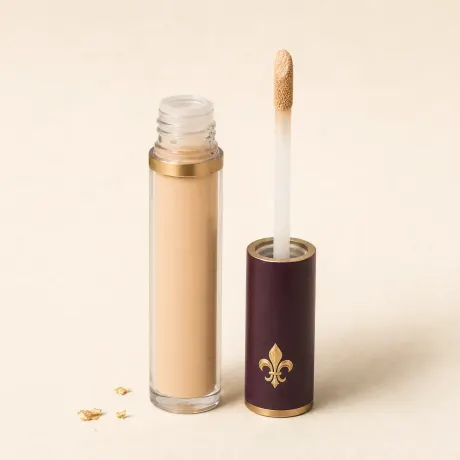
Liquid concealer
A fluid concealer in a wand tube, the most versatile form for the under-eye.
Read the guide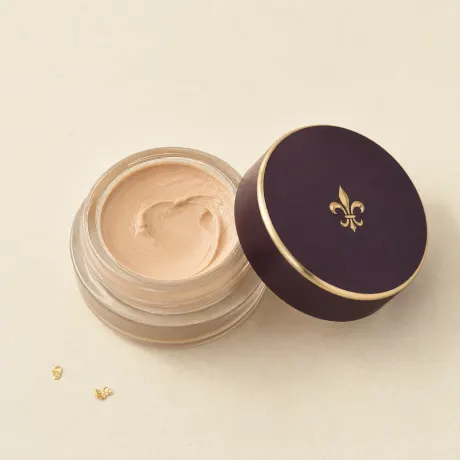
Cream concealer
A thick, high-coverage concealer in a small pot, for blemishes and deep shadow.
Read the guide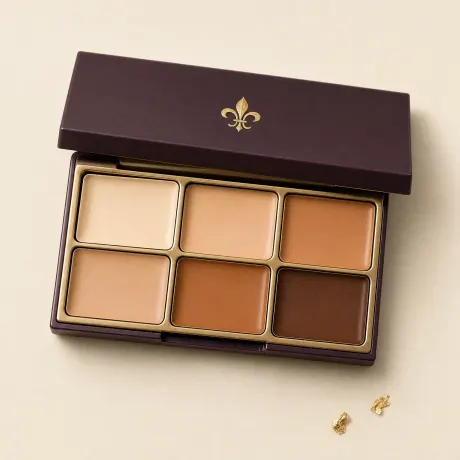
Concealer palette
Several cream concealers in one palette, to mix a match or correct and conceal together.
Read the guide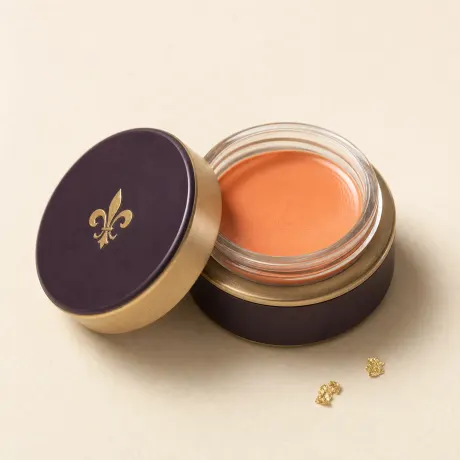
Colour corrector
A cream in the colour opposite what it hides: peach or orange over blue shadows, green over redness, lavender over sallowness.
Read the guide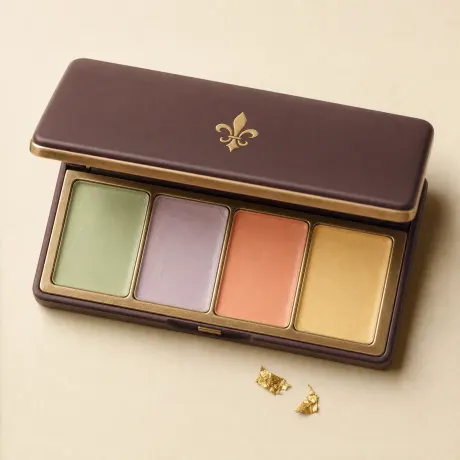
Colour-correcting palette
Correctors in the full wheel of opposing shades, side by side.
Read the guide
Other kinds of face brushes
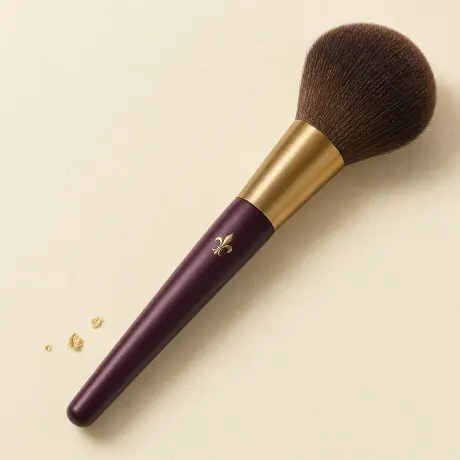
Powder brush
A large, loosely packed, fluffy brush that lays down a veil of powder rather than pushing it in.
Read the guide
Kabuki brush
A squat, palm-sized brush with a very dense dome of short bristles on a stubby handle, for buffing powders and creams into the skin.
Read the guide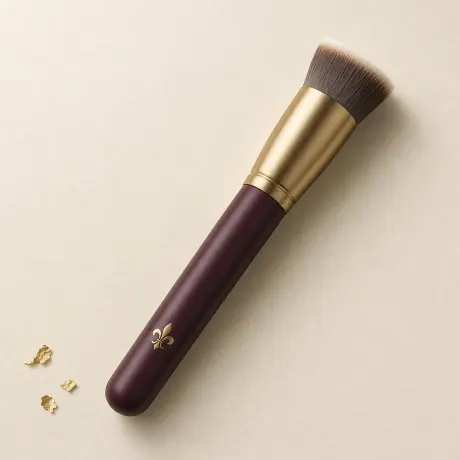
Flat-top buffing brush
A dense brush cut straight across, which buffs liquid and cream into skin with no streaks.
Read the guide
Flat foundation brush
A flat synthetic brush with a rounded edge, for painting foundation on like a primer coat.
Read the guide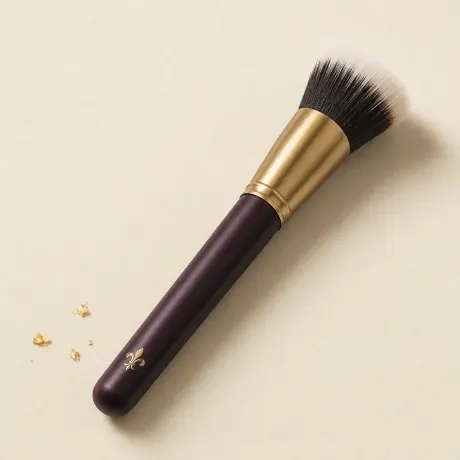
Stippling brush
Two layers of fibre — long and sparse over short and dense — that dot product on for an airbrushed finish.
Read the guide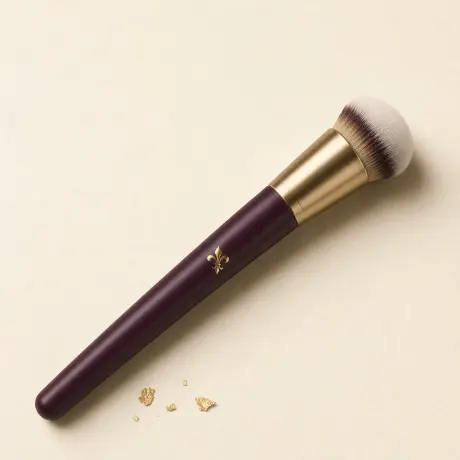
Domed buffing brush
A dense, rounded brush on a full-length handle, for buffing cream and liquid with more control than a kabuki.
Read the guide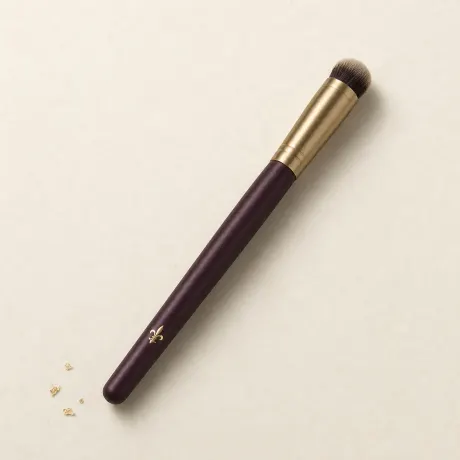
Concealer buffing brush
A small, dense, domed brush — about the size of a fingertip — that buffs concealer into skin.
Read the guide