Cream concealer
The thickest, most opaque form of concealer, warmed on the back of the hand and pressed on with a brush. What it covers best, how to keep it from looking heavy — and how it grew out of camouflage makeup for birthmarks and scars.
Cream concealer is a thick, highly pigmented concealer, usually sold in a small pot, that is warmed and pressed onto blemishes, pigmentation and deep shadows to cover them more completely than a liquid can.

Our picks
Chosen across finish and coverage, from a dense matte cream to a sheer mineral one, and across budgets. Pot concealers are a smaller category than liquids, and only listings sold by the maker, by Amazon itself or by Sephora are linked. Each opens where it is sold, and you choose your shade on that page.
As an Amazon Associate I earn from qualifying purchases. Affiliate links — we may earn a commission at no extra cost to you. How this works
Full-coverage mattePrestige NARS
Soft Matte Complete Concealer
A small pot of full-coverage, oil-free matte cream for blemishes, redness and deep shadow.
- Soft matte
- Full
- Oil-free
High coverageDrugstore the SAEM
Cover Perfection Pot Concealer
A Korean pot concealer with a dense balm texture that covers a spot at a touch.
- Intensive coverage
- Balm texture
Dewy finishMid-range Glossier
Stretch Balm Concealer
A soft, flexible balm with a dewy finish, gentler than most creams on the under-eye.
- Dewy
- Medium, buildable
- 32 shades
Multi-use creamPrestige Kevyn Aucoin
The Sensual Skin Enhancer
A makeup artist’s pot: dense enough to hide a mark at a touch, sheer enough to thin into a base.
- Full coverage
- Concealer and foundation
Dark circlesDrugstore SKINFOOD
Salmon Dark Circle Concealer Cream
A soft, inexpensive Korean cream made specifically for dark circles.
- Full coverage
- Under-eye
Sheer to mediumMid-range RMS Beauty
UnCoverup Concealer
A mineral-pigmented cream that sheers out to a tint or builds to medium coverage.
- Natural finish
- Light, buildable
- Glass jar
Cream concealer is concealer at its most concentrated: pigment in a waxy, emollient base, firm enough to hold its shape in a small pot and soft enough to melt at skin temperature. It carries more pigment and less fluid than a liquid, so a smaller amount covers more. A dot pressed onto a red mark can hide it completely where a liquid would need two or three layers.
That density is both its advantage and its difficulty. A cream sits on the skin rather than in it, and on thin, mobile skin it can look heavy or gather in lines. Its neighbours show the trade-off: a liquid concealer is lighter and more forgiving under the eyes; a stick is firmer and made for pressing onto a single spot; a concealer palette holds several creams to mix. The cream in a pot sits between them — the choice for blemishes, pigmentation and the darkest circles.
What it covers best
Use a cream where the problem is colour rather than texture: a red mark from a spot that has flattened, a patch of pigmentation, broken capillaries round the nose, a birthmark, a tattoo, or under-eye darkness deep enough that a liquid only greys it. It is less good on anything raised or flaking. Cream clings to a dry patch and outlines it, and on an active spot it hides the colour but not the shape, so press on one thin layer and stop.
Finish varies more than the format suggests. Matte creams stay longest on the face and on oily skin; balmier satin or dewy ones are kinder under the eyes and on dry skin, but move more through the day. Coverage runs from sheer mineral creams that spread into a tint to camouflage creams dense enough to hide a birthmark.
Matching the shade
Because it covers so completely, a cream shows a wrong shade more plainly than any other concealer. On a blemish or mark it should match the skin around it, or the foundation over that skin, exactly. Under the eyes, choose one with a slightly peach or golden cast, no lighter than your foundation: it cancels blue shadow without turning grey. Match to the skin beside the mark, never to the mark itself, and carry the cream a little beyond its edge so that it fades into skin rather than stopping in a line.
Warm it, press it, set it
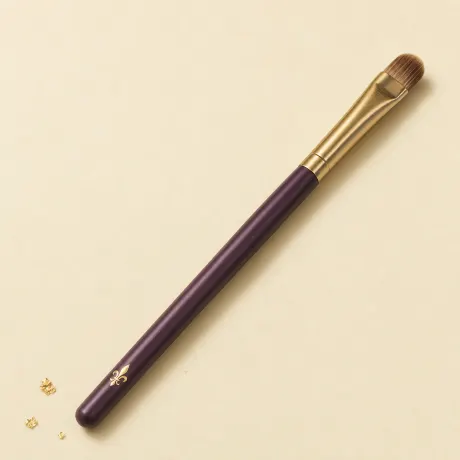
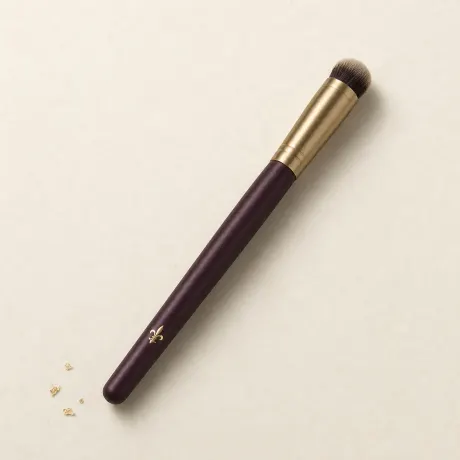
A cream straight from the pot is too stiff to blend. Take a little on a small flat brush, warm it on the back of the hand until it softens, and then press it onto the spot rather than stroking it: stroking drags it off the place it is meant to cover. Blend only the edges, with a fingertip or a buffing brush, so the middle keeps its full coverage.
Apply it over foundation, and set it. A cream never quite dries, so a light press of powder is what stops it moving and transferring onto glasses or collars. Under the eyes, use a softer cream and a far smaller amount, and pat rather than press. A fingertip dipped straight into the pot leaves behind whatever was on it; a clean brush or spatula keeps the cream longer.
Through the day
A cream concealer never quite dries, so it moves when the skin makes oil and when anything rubs against it. To retouch, blot first: press a tissue over the spot to lift the oil, then press a little more cream onto the mark itself rather than a fresh layer over everything, and finish with a light press of powder. Cream laid on top of oily cream is what turns a covered spot into a visible patch by the afternoon.
Carry a small flat brush with the pot rather than retouching with a fingertip, which lifts as much as it lays down. A cream that has stiffened in its pot usually softens again when warmed on the back of the hand; one that has separated or smells different has gone off, and should be thrown away.
Where it came from
Cream concealer comes out of camouflage makeup, a trade built for people with birthmarks and scars rather than for everyday faces. Lydia O’Leary, who had a port-wine stain across half of one side of her face, sold her first Covermark as a lotion from 1931. By 1936 the lotion had gone, replaced by a cream that covered better, and her salon on Fifth Avenue sold it alongside a waterproof version, recommended for the hands as well, and a Complexion Cream whose job was to put back the natural shadows that a covering layer erased.[1] A British trade advertisement of 1937 set out the method for chemists: match the cream to the skin surrounding the blemish, use it “like paint”, take it an inch beyond the edges, and pat powder over it, then pat on more powder every two or three hours as the skin began to shine.[1]
Other firms followed — Clark-Milner’s Hide-It Cream appeared in 1936 — but camouflage makeup sold too little to interest the large companies, and it took more skill to apply than a department-store demonstrator could teach.[2] The wider market came when the idea was sold for ordinary faces: Helena Rubinstein introduced Conceal in 1942, a cream in two shades, light and dark, to be worn under regular makeup.[2] Concealers of the 1950s were in effect foundations made more opaque with extra titanium dioxide; a cream could be built on petrolatum, mineral oil and paraffin, where a stick needed harder waxes.[2] Covermark itself survives, its trade mark now divided among several companies.[1]
The techniques
- Press
- Press product onto the skin without dragging, so it stays where it is put.
- Pat
- Tap lightly with a fingertip or damp sponge so product melts in rather than moves.
Sources
- [1]Covermark Cosmetics and Skin, 2012.View source (opens in a new tab) Accessed 2026-09-25.
- [2]Corrective Make-up (Concealers) Cosmetics and Skin, 2016.View source (opens in a new tab) Accessed 2026-09-25.
What to apply it with
Other kinds of concealer
Liquid concealer
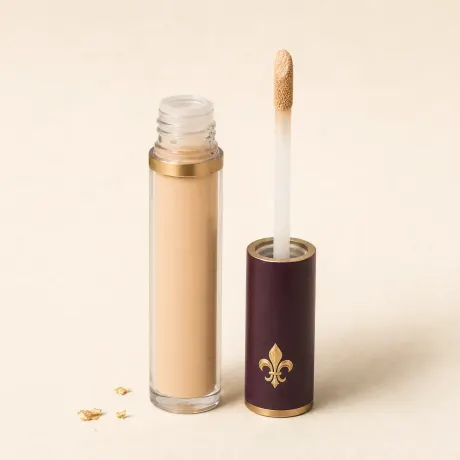
A fluid concealer in a wand tube, the most versatile form for the under-eye.
Read the guide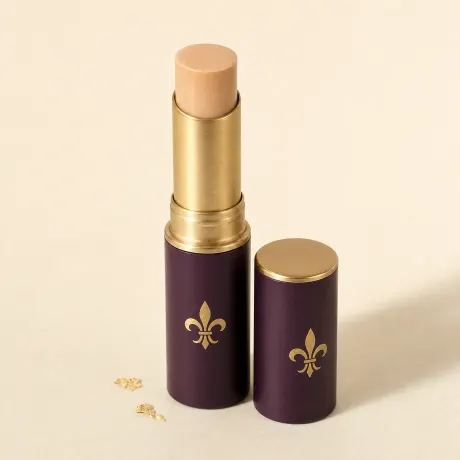
Stick concealer
A firm concealer in a slim twist-up case, for spot coverage.
Read the guide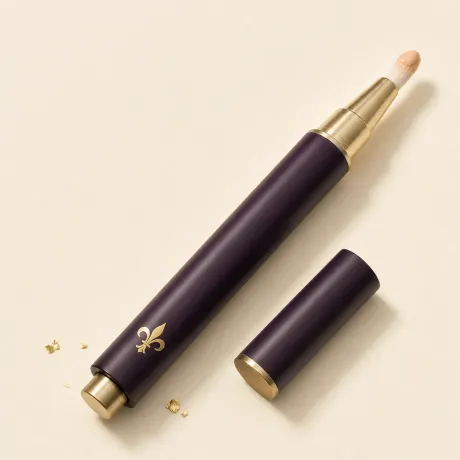
Brightening pen
A light-reflecting concealer in a click pen with a brush tip, for lifting shadows rather than covering them.
Read the guide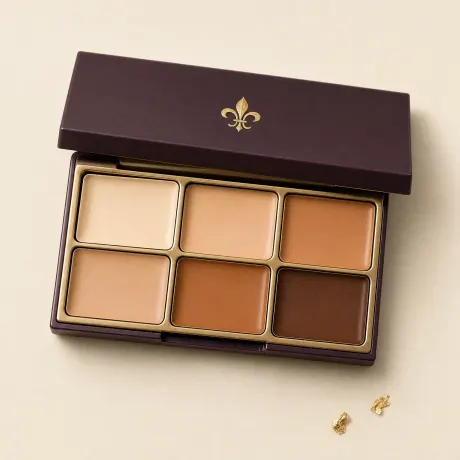
Concealer palette
Several cream concealers in one palette, to mix a match or correct and conceal together.
Read the guide