Colour corrector
A little cream in the colour opposite the one you want to hide: peach or orange over blue shadow, green over redness. Which colour does what, how to use one without it showing — and where the idea came from.
A colour corrector is a pigmented cream, liquid or stick in the colour opposite a discolouration — peach or orange for blue-grey shadows, green for redness, lavender for sallowness — pressed thinly onto that area alone, under concealer or foundation, to cancel the colour rather than cover it.

Our picks
Chosen to cover the forms correctors are sold in — pots, liquids, sticks and a stain — and the range of shades, from green for redness to peach, orange and red for shadows on light to deep skin, across budgets. It is a smaller category than concealer, and these are the correctors we could confirm on sale from their makers in the US. Each opens where its maker sells it — on Amazon, at the house’s own shop, or at Sephora — and you choose your shade on that page.
As an Amazon Associate I earn from qualifying purchases. Affiliate links — we may earn a commission at no extra cost to you. How this works
Buttery creamPrestige Charlotte Tilbury
Magic Vanish Color Corrector
A creamy corrector for the under-eye, soft enough to press on with a fingertip and sold to lift shadow as well as cancel it.
- Cream
- Dark circles
- With mica
Budget liquidDrugstore e.l.f. Cosmetics
Camo Color Corrector
An inexpensive liquid corrector in several colours, for trying the method before spending more.
- Liquid wand
- Hydrating
- Hyaluronic acid
Peach to orangeMid-range Huda Beauty
#FauxFilter Under Eye Color Corrector
A liquid under-eye corrector whose shade range runs from pale pink to deep orange, so it reaches deeper skin.
- Liquid
- Brightening
- Pink to orange shades
Classic potPrestige Bobbi Brown
Under Eye Color Corrector
The makeup artist’s standard: a firm cream in a small pot, in families of peach and bisque shades.
- Cream pot
- Peach and bisque
Green for rednessDrugstore Physicians Formula
Butter Glow Corrector
An inexpensive liquid that covers the cool side of the wheel — green, yellow and lavender — for redness and sallowness.
- Green, yellow, lavender
- Illuminating
Cream stickMid-range Live Tinted
Huestick All-over Color Corrector
A creamy stick drawn straight onto dark circles or dark spots, and sold for use all over the face.
- Cream stick
- All-over
- Vitamin C
Skin-caringPrestige Givenchy Beauty
Prisme Libre Skin-Caring Corrector
A French house’s liquid corrector, sold as caring for the skin as well as correcting it.
- Multi-purpose
- 24h hydration
Wide rangeMid-range Tarte
Shape Tape Corrector
A blendable liquid from Tarte’s Shape Tape line, sold for blemishes and dark spots as well as under-eye circles.
- Liquid wand
- Hyaluronic acid
- Squalane
Eight-hour wearDrugstore Sephora Collection
Best Skin Ever 8HR Color Corrector
A retailer’s own-label liquid corrector in shades from green to red, sold as lasting through a working day.
- Liquid
- 8-hour wear
Under-eye liquidPrestige Kosas
Revealer Extra Bright
A liquid-cream corrector made for dark circles, with caffeine and peptides in the formula.
- Liquid cream
- Caffeine and peptides
- Under-eye
Waterproof stainMid-range ONE/SIZE
Ultimate Color Corrector Stain
A stain rather than a cream: it sets, so the concealer laid over it does not drag it about.
- Stain
- 12-hour waterproof
- Niacinamide
Under foundationDrugstore wet n wild
Photo Focus Care Color Corrector
A plain green corrector for redness, made to sit under foundation, at a drugstore budget.
- Green for redness
- Skincare ingredients
Green liquidMid-range Beauty Pie
Superluminous Redness Green Color Corrector
A light green liquid for redness from a British brand, for anyone who finds cream correctors too heavy.
- Green
- For redness
- Lightweight
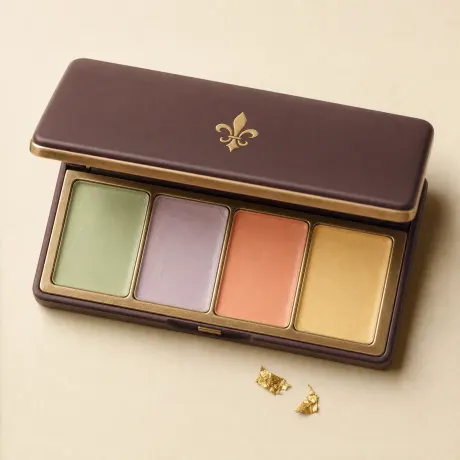
A colour corrector is a concealer that has stopped trying to match the skin. It is made in the colour that cancels another: peach, apricot, orange or red over the blue-grey of under-eye shadow and dark marks; green over redness; lavender over a sallow, yellowish cast; yellow over faint purple. The principle is the colour wheel’s. Opposite colours laid over one another dull each other towards a neutral grey-brown, so a thin layer of the right opposite takes the strength out of a discolouration before anything covers it. Most correctors are dense creams in small pots; many now are liquids with a wand, and some are twist-up sticks.
That makes it a different tool from its neighbours. A concealer matches the skin and covers; a corrector changes a colour and is almost always covered in turn, by concealer or foundation. A colour-correcting primer is a sheer tint spread over the whole face, and a CC cream does a gentler version of the same job everywhere. A colour-correcting palette holds several correctors side by side. A single corrector does one job, strongly, in one place.
Which colour for what
Choose by the colour you are cancelling and by the depth of your skin. For blue or purple under-eye shadow, the usual choice is peach or salmon on light skin, apricot or orange on medium and olive skin, and a deeper orange or red on deep skin, where a pale peach turns grey. The same warm shades take the blue out of visible veins and the grey out of some dark marks. Green is for redness: a blemish, broken capillaries, the flush around the nostrils. Yellow is the gentler choice for mild redness or light purple, and lavender or violet lifts sallowness, sparingly, since it brightens as well as corrects.
A corrector that suits you makes the area look neutral, not coloured. If a peach leaves a grey patch, it is too light for your skin; if the green shows through your concealer, there is too much of it. Judge it in daylight, from an ordinary distance.
Pot, liquid, stick or stain
The form changes how a corrector behaves. A cream in a pot is the densest and gives the most correction for the least product, which suits deep shadow and strong redness; warm it on the hand first, or it drags. A liquid with a wand is thinner and easier to sheer out, and suits a wider area under the eye, though it takes a steadier hand to keep it off skin that does not need it. A stick is the quickest, drawn straight onto a spot, and a stain sets as it dries, so the concealer laid over it does not move it about. For fine lines or dry skin under the eyes, a liquid or a creamy formula with some slip creases less than a firm cream.
How to use it
Put it on after skincare and any primer, and before concealer. Use very little. Warm a dot on the back of the hand, then press it only onto the discolouration — the darkest crescent under the eye, often near the inner corner, or the red spot itself rather than the skin around it — with a fingertip or a small, flat brush, and pat the edges out. Give it a minute to settle.
Then cover it. Pat concealer or foundation over the top rather than wiping, which drags the corrector away or smears it into the skin beside it. A light press of powder sets the layers if they tend to crease. Most mistakes are of quantity: a thick layer of green shows as grey through anything, and peach spread across the whole under-eye leaves a warm band where there was no shadow to cancel. Where the discolouration is mild, leave the corrector out: a well-matched concealer, or one a shade warmer, does the job in a single layer.
Where it came from
Cancelling one colour with another is older than the product. A British beauty manual of 1936 advised any woman whose face was apt to flush and become very red to “try using a green powder. It will not look so startling as it may sound”, recommending it for hiding a red nose or the tiny red veins that sometimes show under the skin.[1]
The corrector as a cream came later, as the neutralising concealer: in the historian James Bennett’s summary, a concealer in the complementary colour of the blemish, green to neutralise redness and yellow for purple blotches. The make-up artist Marvin G. Westmore, son of the make-up artist Monte Westmore, traced the idea back to the 1920s, but he did not recommend it for everyday use. Mixing opposite colours, he wrote in 2001, creates only “a third color”, which “must then be concealed with a color that matches the skin, which adds an extra step and additional thickness to the makeup”.[2]
His objection is still the fairest test of a corrector. It earns its place when it lets a thinner layer of concealer do the work; when it needs more concealer to hide it than the shadow did, it is the wrong shade, or too much of it. When correctors moved from make-up artists’ kits onto ordinary shop shelves is a question the sources read here do not answer.
The techniques
- Press
- Press product onto the skin without dragging, so it stays where it is put.
- Pat
- Tap lightly with a fingertip or damp sponge so product melts in rather than moves.
Sources
- [1]Loose Face Powders Cosmetics and Skin, 2009.View source (opens in a new tab) Accessed 2026-09-26.
- [2]Corrective Make-up (Concealers) Cosmetics and Skin, 2016.View source (opens in a new tab) Accessed 2026-09-25.