The Face as a Statement
A club where makeup decided who got in, a model paid to be the face of a cosmetics house, a line built for makeup artists — and, at either end of the decade, an argument about the rabbits.
HOM · Era1980 – 1989Colour & Conscience
All of The 1980s Era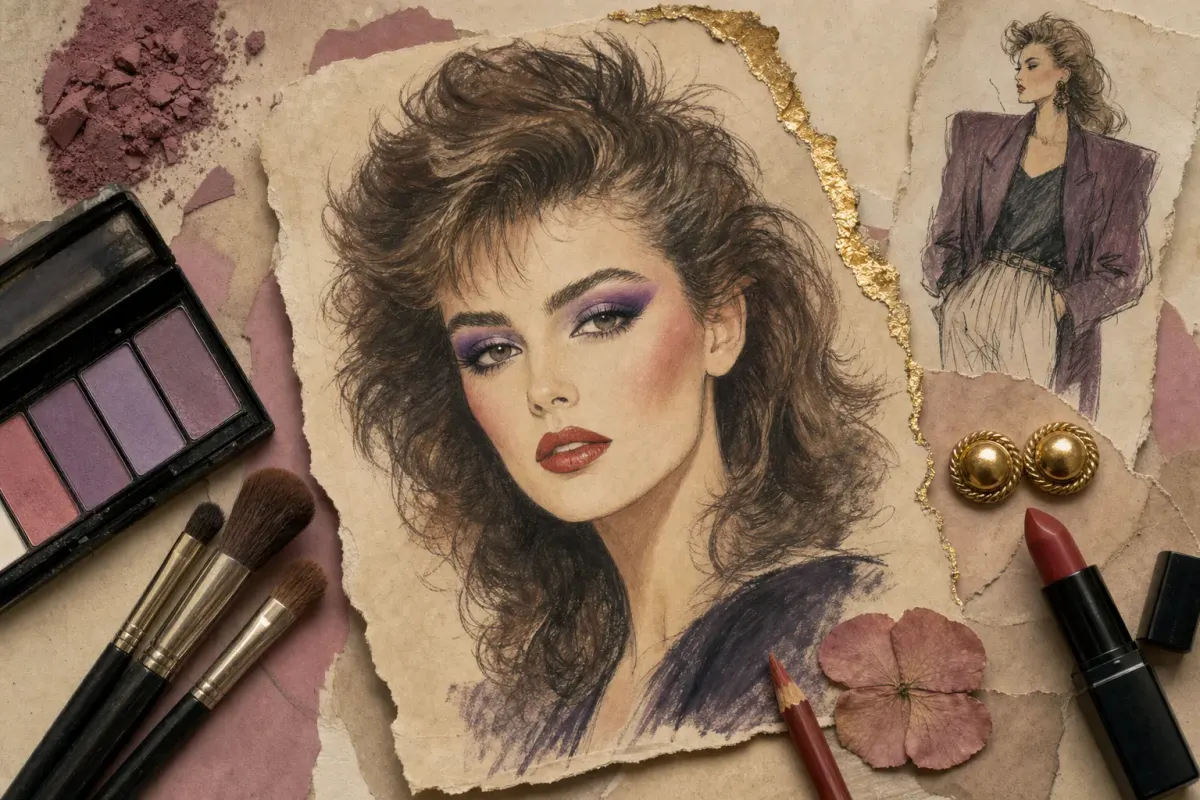
In short
The 1980s opened with a London club whose door was decided by makeup and an advertisement asking how many rabbits Revlon blinded, made one model the face of a cosmetics house and a makeup artist’s kit into a brand, and closed with Avon ending its animal tests in 1989.
- 8min read
- 6chapters
- 21sources
Vivien
Your guide through time
Listen to this essay
10 min listenVivien reads our essays aloud, word for word — every date and every name in its place — so you can listen the way you would be walked through a gallery.
An AI voice, designed for History of Makeup
The 1950s finished the face, and the 1960s sold it to the young. The 1980s wore it as a statement. In ten years the made-up face became a door policy at a London club, a model’s contract with a cosmetics house, a professional’s kit sold to anyone who wanted it, and the subject of a campaign about the animals on which its products were tested.
What follows is less the story of one look than of what a face was taken to say: who you were, whom you stood for, and what had been done to make it.
Dressed for the Door
The decade’s most extravagant faces began in a wine bar. Steve Strange, who kept the door of the Blitz club in Covent Garden, admitted, in the London Museum’s account, only “creative-minded pioneers… who looked like a walking piece of art”, and would hold up a mirror to the queue and ask, “Would you let yourself in?”[1] He and Rusty Egan had opened their Tuesday night there in February 1979.[2] Its regulars, the Blitz Kids, travelled to it by Tube and bus “dressed in theatrical makeup, extravagant hats and flowing gowns”, in clothes that challenged traditional ideas about gender.[2][1]
The look did not stay in the club. In 1980 David Bowie cast four Blitz Kids in his video for “Ashes to Ashes”, and within a few years the high street had taken the style up: the Design Museum’s account of the scene shows a Boy George Fashion & Make-up Book of 1984 and a campaign for 17 Cosmetics in Smash Hits in 1985.[2] Colour ran through the decade beyond the clubs as well. A report on the Color Association of the United States, which forecast colour for clothes and interiors, gave purple, peach and pink as the decade’s “color constants”.[3]
The Face of a House
At the other end of the market, the face was a contract. Isabella Rossellini signed with Lancôme in 1982, at thirty, by one account — a contract that made her the world’s highest-paid model — or in 1983 by another, and she was the face of the house for fourteen years.[4][5] She had started modelling only at twenty-eight. “The next best thing to winning the lottery is having a beauty contract,” she joked in 1996.[6]
What such a face stood for was larger than a product. On tour for the house, she found that what she represented “goes way beyond selling mascara—it’s the whole capitalist world of free market.”[6] The contract ended when she was in her forties, and she was told why: “They told me they needed somebody younger.”[4] A new company in Toronto had drawn the opposite conclusion from the start. “When we started MAC,” its co-founder Frank Toskan recalled, “we didn’t want to put a face to our product.”[7]
The Artist’s Brand
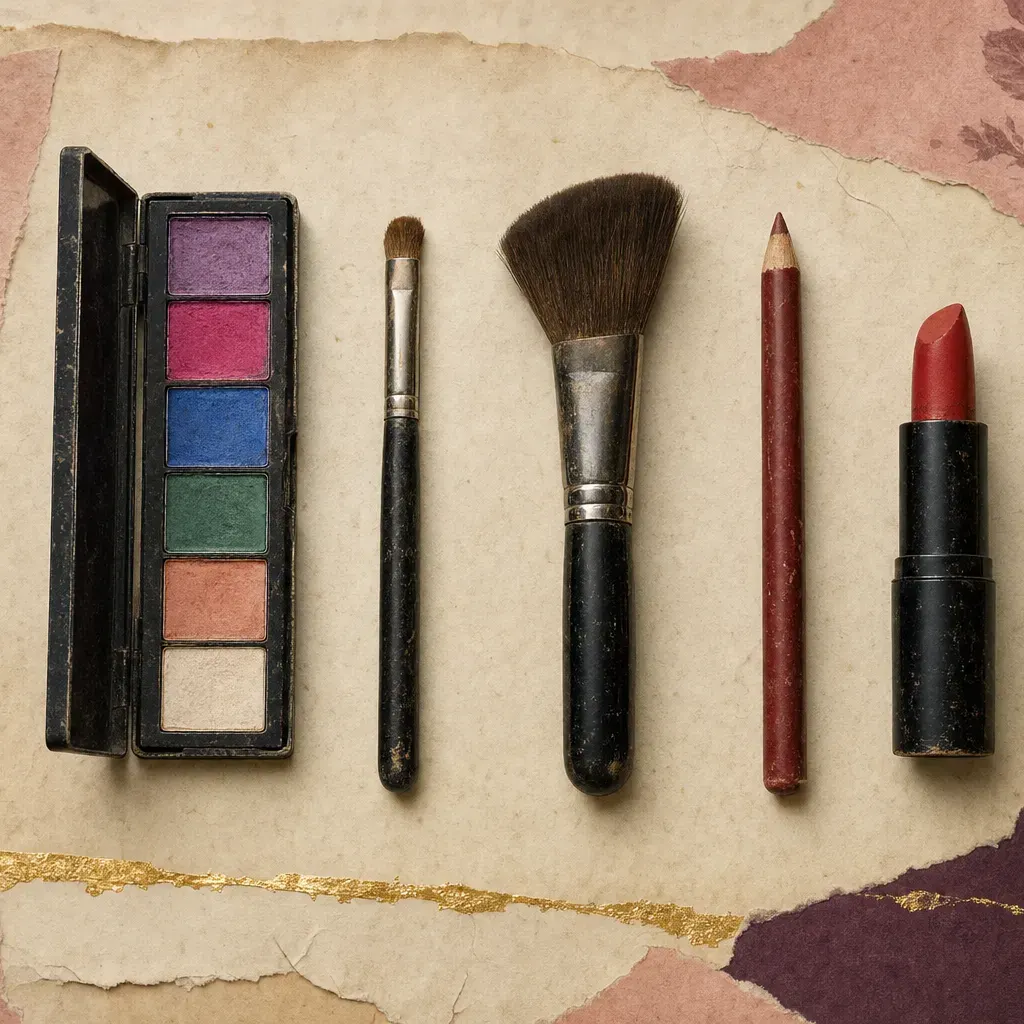
M·A·C — Make-Up Art Cosmetics — was founded in Toronto in 1984 by Frank Toskan and Frank Angelo.[8][9] Toskan, a photographer, had begun in the late 1970s to make products for makeup artists and drag queens who needed makeup that would withstand harsh photographic lights, and wanted it to work on a wide variety of skin tones; Angelo, who had built a chain of thirty-seven hair salons, led on the business side.[10] The firm did not advertise, listed all its ingredients on the label, never tested on animals, and paid its counter staff high base salaries rather than commission[10] — the usual way of paying the department-store staff who represented a single brand.[11]
The professional’s judgement was becoming a product in its own right. Bobbi Brown arrived in New York in 1980 with a degree in theatrical makeup and worked freelance on magazine shoots.[12] By 1989 Barbara Daly, who had made up the Princess of Wales for her wedding, was running Colourings, a makeup line sold through The Body Shop in shops where customers could help themselves and try what was on display.[13] The larger houses bought in later: the Estée Lauder Companies took 51 per cent of M·A·C in 1994 and the rest in 1998.[9]
I don’t like the whole feeling of making someone feel insecure if they’re not wearing the color of the moment.
How Many Rabbits
The decade’s ethical argument was about how makeup was made safe. Since the 1940s the standard test for anything that might get into a human eye had been the Draize test, in which the substance was put into one eye of a conscious rabbit held in stocks and the damage graded over the following days.[15] In 1980 the activist Henry Spira, leading a coalition that would eventually include four hundred groups, took the question to Revlon in full-page advertisements; one, in the New York Times on 15 April, asked: “How many rabbits does Revlon blind for beauty’s sake?”[15][16][17]
Revlon agreed to give $750,000 over three years to the search for alternatives, money that set up a research programme at Rockefeller University, and other houses followed.[15][18] By 1986, by the industry association’s count, cosmetics firms had given $2 million to the Center for Alternatives to Animal Testing at Johns Hopkins University, which Spira had persuaded them to finance, and Spira could say that alternatives had moved “away from a humane, flaky idea towards entering the mainstream.”[18][16] The animals had never been a legal requirement: American law does not specifically require cosmetics to be tested on them, though a product whose safety had not been substantiated had to carry a warning saying so.[19][18]
The decade ended where it began. In 1989, after a campaign by People for the Ethical Treatment of Animals that hung three million “Avon Killing” door-hangers on American homes, Avon announced that it would end product safety testing on animals, the first large cosmetics company to stop altogether; Revlon, Faberge, Noxell and Mary Kay cut back, suspended or ended their own.[20] M·A·C, founded in the middle of the argument, had never tested on animals at all.[21]
The Face of the Decade
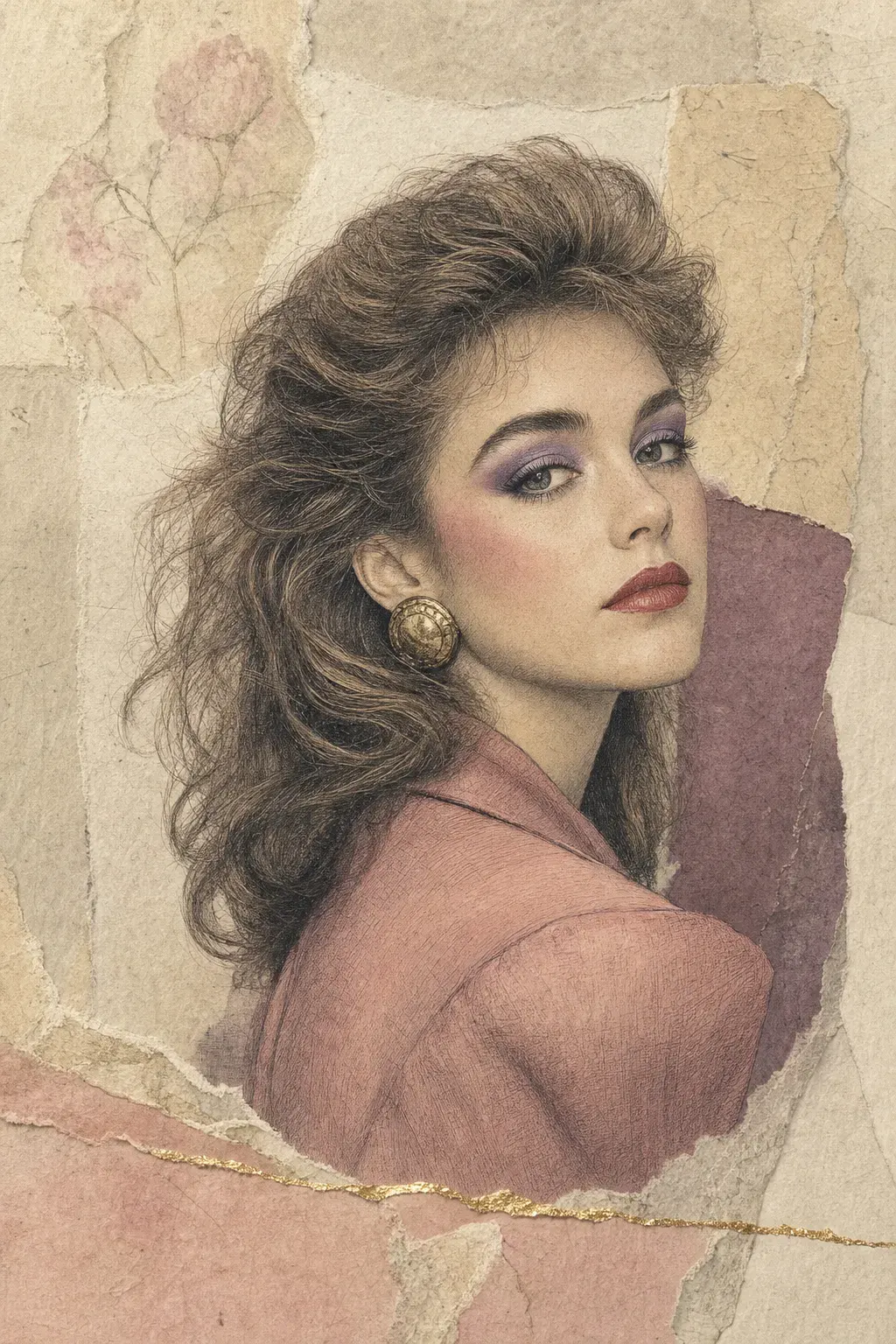
The fashionable face of the decade is easier to remember than to document. Bobbi Brown later recalled its makeup as extreme — white skin, red lips and contouring — and as the look she set herself against.[22] Barbara Daly, at the decade’s end, listed what a full face had come to include, in order to argue that few women needed it every day: “three shades of eyeshadow, concealer, lip liner, two shades of lipstick, brow makeup”.[23] And the professional lines sold colour in quantity: M·A·C, in the words of a review of its history, “burst on the scene in the 1980s with vibrant colour palettes”.[24]
The plate here is reconstructed from those accounts rather than from any one woman’s routine — a pale, even base, contoured cheekbones, three shades on the lid, filled brows and a lined red mouth — and the steps beside it say what each one takes to do now.
What Is Not Known
The popular shorthand for the decade’s face — the strong brow, the bold blusher, the “power” look worn with shoulder pads — circulates widely, but this archive has not found a source it can cite for it as a dated fashion, which is why the plate above is built from what makeup artists described rather than from that shorthand.
Dates disagree, as they often do. The Blitz ran from 1979 to 1981 in one museum’s account; in another’s, Strange and Egan held their last night there in October 1980.[25][26] Rossellini’s contract began in 1982 or in 1983, depending on the account, and a third places it in the late 1980s, which cannot be reconciled with fourteen years that her interviewer described as just finished in February 1996.[27][28][29][30]
The numbers are softer still. Counts of the animals used in testing were estimates that differed by millions between government offices and campaigners, and Avon’s own figures for its reductions differ between reports.[31][32][33] Nor do the sources here settle how far the campaigns, rather than the companies’ own plans, decided the end of testing: Avon said the boycott had nothing to do with its decision.[33][32]
Sources
- [1, 25]Blitz: A revolutionary 1980s club night London Museum (London Stories).View source (opens in a new tab) Accessed 2026-10-03.
- [2, 26]BLITZ: the club that shaped the 80s — Large Print Guide Design Museum, London (exhibition guide, PDF).View source (opens in a new tab) Accessed 2026-10-03.
- [3]They catch colors from the air and make trends The Christian Science Monitor, 16 December 1988, 1988.View source (opens in a new tab) Accessed 2026-10-03.
- [4, 27]At 65-Years-Old, Isabella Rossellini Has Nabbed a New Beauty Campaign W Magazine, 23 February 2018, 2018.View source (opens in a new tab) Accessed 2026-10-03.
- [5, 28]Isabella Rossellini returns to Lancôme FashionNetwork Canada, 7 March 2016, 2016.View source (opens in a new tab) Accessed 2026-10-03.
- [6, 30]Isabella Rossellini, interviewed (republished as "New Again: Isabella Rossellini") Interview, February 1996; republished online 7 December 2011, 1996.View source (opens in a new tab) Accessed 2026-10-03.
- [7]MAC co-founder Frank Toskan on why blue hair is good for business The Globe and Mail, 2 November 2014, 2014.View source (opens in a new tab) Accessed 2026-10-03.
- [8]How MAC is reclaiming the cosmetic line’s indie spirit that began in Toronto The Globe and Mail, 30 January 2026, 2026.View source (opens in a new tab) Accessed 2026-10-03.
- [9]Estee Lauder Buys Remaining MAC Equity Los Angeles Times, 28 February 1998, 1998.View source (opens in a new tab) Accessed 2026-10-03.
- [10, 21, 24]Review of Andrea Benoit, Viva M·A·C: AIDS, Fashion, and the Philanthropic Practices of M·A·C Cosmetics (McGill-Queen’s University Press, 2019) Canadian Business History Association, book reviews.View source (opens in a new tab) Accessed 2026-10-03.
- [11]Sephora Holdings S.A. International Directory of Company Histories, via referenceforbusiness.com.View source (opens in a new tab) Accessed 2026-09-22.
- [12, 22]How I Did It: Bobbi Brown, Founder and CEO, Bobbi Brown Cosmetics Inc., 1 November 2007, 2007.View source (opens in a new tab) Accessed 2026-09-26.
- [13, 14, 23]Colourings: No hype, just good faces United Press International, 21 August 1989, 1989.View source (opens in a new tab) Accessed 2026-10-03.
- [15]Henry Spira’s Search for Common Ground on Animal Testing Cambridge Quarterly of Healthcare Ethics 8(1), 9–22, 1999.View source (opens in a new tab) Accessed 2026-10-03.
- [16]Henry Spira, 71, Animal Rights Crusader The New York Times, 15 September 1998, section B, p. 9, 1998.View source (opens in a new tab) Accessed 2026-10-03.
- [17]Caso coelhos-cosméticos Bioética, Universidade Federal do Rio Grande do Sul, 1997.View source (opens in a new tab) Accessed 2026-10-03.
- [18, 31]Household products and laboratory animal testing The Christian Science Monitor, 20 March 1986, 1986.View source (opens in a new tab) Accessed 2026-10-03.
- [19]Animal Testing & Cosmetics United States Food and Drug Administration (posted 31 May 1999; updated 5 April 2006).View source (opens in a new tab) Accessed 2026-10-03.
- [20, 32]PETA pressures Avon to stop animal testing, United States, 1989 Global Nonviolent Action Database, Swarthmore College (entry of 3 December 2016), 2016.View source (opens in a new tab) Accessed 2026-10-03.
- [29]Isabella Rossellini’s doomed feminist makeup line was ahead of its time i-D, 1 March 2016, 2016.View source (opens in a new tab) Accessed 2026-10-03.
- [33]On the Cutting Edge of Animal Rights Activism Los Angeles Times, 28 April 1989, 1989.View source (opens in a new tab) Accessed 2026-10-03.
Continue in The 1980s Era
Colour & Conscience
Browse all 11 articles