How Many Rabbits: Henry Spira and the Draize Test
In 1980 a former merchant seaman and schoolteacher asked, in a full-page newspaper advertisement, how many rabbits a cosmetics company blinded for beauty’s sake. The industry answered with money for alternatives.
In short
In 1980 Henry Spira’s coalition ran full-page advertisements against Revlon’s use of the Draize rabbit eye test — one asked “How many rabbits does Revlon blind for beauty’s sake?” — and Revlon agreed to give $750,000 over three years to the search for alternatives.
- 6min read
- 6chapters
- 5sources
On 15 April 1980 a full-page advertisement in the New York Times put a question to one of America’s best-known cosmetics companies: “How many rabbits does Revlon blind for beauty’s sake?”[1]
It was the work of a coalition led by Henry Spira, a former merchant seaman and schoolteacher who had come to animal rights at forty-five. The New York Times would later call him the architect of the American animal rights movement’s first successful campaigns against the use of animals in testing.[2]
The Test
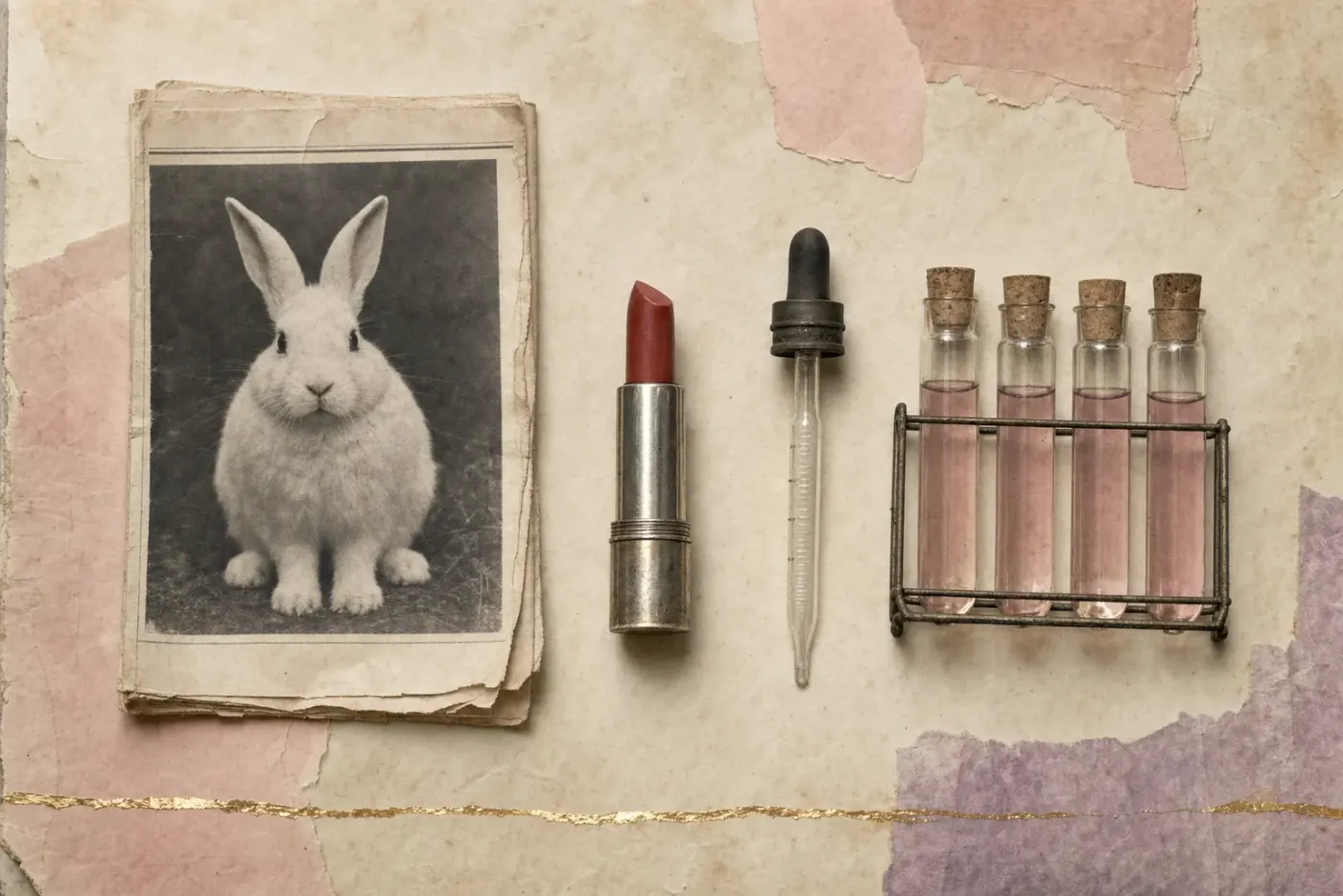
Since the 1940s the Draize test had been the standard for any substance that might get into a human eye. A conscious rabbit was held in stocks so that it could not scratch, the substance was applied to one eye, and the eye was examined at intervals — at 24, 48 and 72 hours, for example — and graded for damage such as blistering or blindness.[3]
Cosmetics were tested that way alongside detergents and other everyday products.[4] A second standard procedure, the LD50, dosed animals to find the quantity that killed half of them — up to two hundred mice or rats in a single test.[5][4]
The Organiser
Spira was born in Antwerp in 1927 and reached the United States by way of Germany, England and Panama. He had been a merchant seaman, a General Motors assembly-line worker and an activist in the labour and civil rights movements, and he taught English at a Manhattan high school from 1966. His interest in animals began when a friend left him with a cat, around the time he first read Peter Singer’s Animal Liberation.[6]
His first campaign, against experiments on cats at the American Museum of Natural History, ended in 1977 when the research was halted. Two years later he organised the coalition — eventually some four hundred groups — that pressed first Revlon and then the rest of the cosmetics industry to phase out the Draize test.[6] His method, as his obituary describes it, was the coalition itself: the money and reach of larger organisations joined to scientists, advertising professionals and anyone else who could help.[6]
Revlon Pays
Revlon was chosen first. It agreed to give $750,000 over three years to the search for alternatives to the Draize test — money that set up the Alternative Research Program at Rockefeller University’s Laboratory Animal Research Center — and other leading cosmetics companies soon followed.[7][8]
By July 1982 Revlon reported that a panel now made sure no unnecessary Draize tests were run, and that the rabbits it used in them each year had fallen from 2,210 in 1979 to 1,431 in 1981. Avon had adopted a policy of using local anaesthetics wherever it expected an animal to suffer discomfort, and Bristol-Myers said that it used fewer animals than the classical test required.[7]
Money for Alternatives
Spira also negotiated with the industry to provide the first money for the Center for Alternatives to Animal Testing at Johns Hopkins University in Baltimore.[9] By 1986, according to the industry’s trade association, cosmetics firms had given it $2 million, and about $5 million to alternative testing in all, including programmes at eight other schools.[10]
The money bought cautious progress. The director of the Rockefeller programme said its cell-culture work had shown that some chemicals could be tested without animals, but a proven replacement for the Draize test was, as the Christian Science Monitor reported, still some way off, and Revlon had renewed its funding at $200,000 for the year.[10] Alex Pacheco of People for the Ethical Treatment of Animals called the industry’s investment “a token”; Andrew Rowan of Tufts University, himself a critic of animal testing, said that the cosmetics industry had “done more to change the way we do things than other . . . industries”.[10]
People are looking at what they’ve done in the past, and they’re revising their procedures.
What the Law Required
The animals had never been a legal requirement. The Federal Food, Drug, and Cosmetic Act does not specifically require cosmetics to be tested on animals, nor does it subject them to approval before sale; the Food and Drug Administration has advised manufacturers to use whatever testing is appropriate to substantiate safety.[12]
What the rules did require was that a product whose safety had not been shown carry a warning saying so — and in practice, as the Monitor put it in 1986, “testing” had meant “animal testing”.[13] Fear of product-liability suits kept it that way: a Humane Society official said cosmetics executives had told him they would like to stop but were afraid of jeopardising their insurance.[13]
What Is Not Known
The headline is quoted here from a university bioethics page that dates the advertisement to 15 April 1980 and draws on Peter Singer’s account; this archive has not seen the advertisement itself.[14] The accounts differ on timing in small ways: one dates the coalition to 1979, another the campaign’s launch to 1980, and a report of March 1986 places Revlon’s grant “five years ago”.[15][16][17]
Nor do they settle what the campaign achieved in numbers. Revlon’s count of rabbits fell, but how many animals the cosmetics industry used, before or after, rests on estimates that differed by millions, and the companies the Monitor asked would not say what they had spent on alternatives.[17]
Sources
- [1, 14]Caso coelhos-cosméticos Bioética, Universidade Federal do Rio Grande do Sul, 1997.View source (opens in a new tab) Accessed 2026-10-03.
- [2, 5, 6, 9, 15]Henry Spira, 71, Animal Rights Crusader The New York Times, 15 September 1998, section B, p. 9, 1998.View source (opens in a new tab) Accessed 2026-10-03.
- [3, 7, 16]Henry Spira’s Search for Common Ground on Animal Testing Cambridge Quarterly of Healthcare Ethics 8(1), 9–22, 1999.View source (opens in a new tab) Accessed 2026-10-03.
- [4, 8, 10, 11, 13, 17]Household products and laboratory animal testing The Christian Science Monitor, 20 March 1986, 1986.View source (opens in a new tab) Accessed 2026-10-03.
- [12]Animal Testing & Cosmetics United States Food and Drug Administration (posted 31 May 1999; updated 5 April 2006).View source (opens in a new tab) Accessed 2026-10-03.
Filed under