A Different Palette: Ten Lipsticks and a Longer History
A range built on skin rather than on the season is usually dated to 1991. It is older than that, and the older version is the better story.
In short
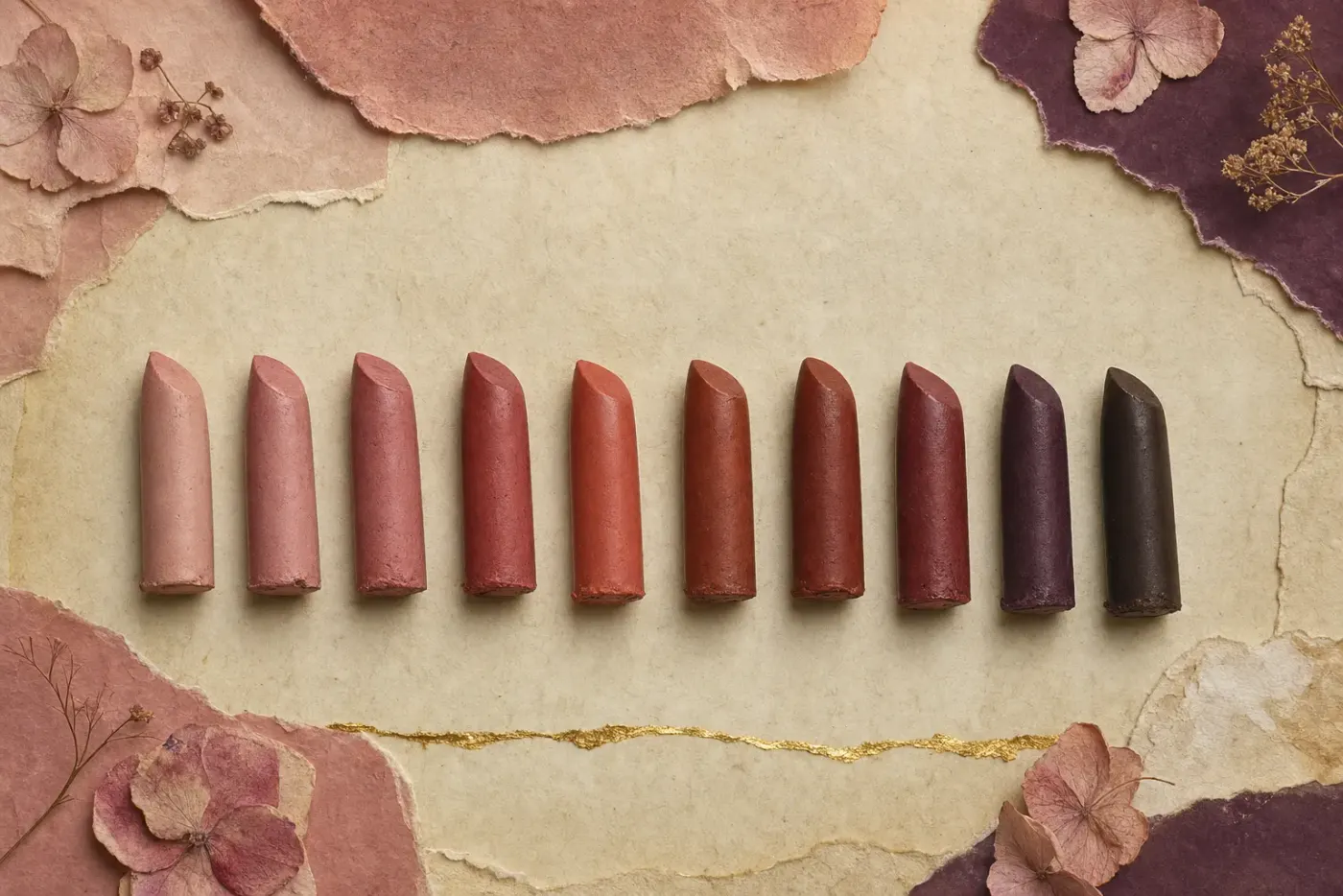
Bobbi Brown’s brand dates its launch to 1991 with a range of ten lipsticks; ranges built for skin the mass market ignored already existed, Flori Roberts from the 1960s and Fashion Fair from 1973.
- 13min read
- 6chapters
- 5sources
Vivien
Your guide through time
Listen to this essay
5 min listenVivien reads our essays aloud, word for word — every date and every name in its place — so you can listen the way you would be walked through a gallery.
An AI voice, designed for History of Makeup
There are two ways to organise a colour range. You can index it to the season, which is what the industry had done since the 1950s, or you can index it to the person wearing it, which is a different business entirely.[1]
The second is usually dated to 1991 and a range of ten lipsticks.[2] It is considerably older than that, and the reason the earlier version is less famous is the actual subject of this piece.
What a Skin-Indexed Range Changes
A seasonal range asks what is current; a skin-indexed range asks who is buying. The first can be planned in advance of any customer, and the second cannot, because it requires knowing which skins exist in the market and in what proportion.
It also breaks the obsolescence model. A shade chosen because it suits a face does not stop suiting that face in September, so the manufacturer gives up the repeat purchase that the fashion calendar was invented to produce.[3]
What replaces it is loyalty. A customer whose shade is permanently stocked has no reason to look elsewhere, and a customer who has been told twice a year that her colour is finished has every reason to — so the skin-indexed range trades a faster cycle for a longer relationship, which is a defensible business and a slower one.[3]
It Had Already Been Done
Flori Roberts, Inc. was founded in the 1960s by Flori Roberts and her husband Craig Roberts, a doctor who had studied the science of Black skin. Metropolitan New York department stores turned the line down; it launched at Bamberger’s and went on to Burdine’s in Miami and Foley’s in Houston.[4]
Eunice W. Johnson launched Fashion Fair Cosmetics in 1973, designed specifically for women of darker skin who were frequently unable to find products that matched them, and it became one of the first Black-owned international cosmetic lines.[5]
The principle was not discovered in 1991. It was noticed in 1991.
What the Company Account Establishes
The brand’s own account dates its launch to 1991 with a range of ten lipsticks. A company is well placed to state its own founding date and product count and has no obvious motive to misstate either, so those two facts are usable.[6]
Everything else a brand page carries — that the approach was unprecedented, that it performed a particular way commercially, what the founder intended — is what such a page exists to shape, and none of it is asserted here. The distinction is not pedantry: it is the difference between a date and a legend.[6]
Why the Earlier Version Is Less Famous
Because a line sold to a market the industry treated as a niche is recorded as a niche achievement, while the same idea at a general-market counter is recorded as an innovation. The sequence — rejection by the major stores, then a regional department-store rollout — is in the record.[7]
Fashion Fair’s later decline was attributed in part to competition from brands that began carrying shades for Black women, which is a grim way for an achievement to be absorbed: the problem it solved got solved elsewhere, and the solving put it out of business.[8]
How Far It Actually Got
Far enough to be measurable and not far enough to be solved. A 2018 analysis converted published foundation shade values to a perceptual colour model and plotted them by lightness: 31 of one range’s 40 shades fell in the 60 to 90 lightness band, serving light and tanned skin, and very few American brands supported the darkest 10 to 20 band at all.[9]
The same study found narrow ranges outside the United States too — nothing darker than the 50 to 60 band in its Japanese set, and in its Indian set only one product, a L’Oréal foundation, below that band. Its authors are explicit that they measured published shade values rather than sales or populations, and called the result a rough proxy.[9]
What Is Not Known
Whether the 1991 range influenced the industry or merely coincided with a shift already underway is not established by anything cited here, and a brand page is the wrong place to settle it.[10]
The obituary that supplies the Flori Roberts sequence gives the 1960s rather than a specific year, and it is trade journalism rather than scholarship. It is used here for the named facts and the order they happened in, and for nothing about who was first.[11]
Sources
- [1, 3]Fire and Ice: The Story of Charles Revson William Morrow, 1976.
- [2, 6, 10]About Us Bobbi Brown Cosmetics.View source (opens in a new tab) Accessed 2026-09-24.
- [4, 7, 11]Flori Roberts Dies Happi (Household and Personal Products Industry), 2020.View source (opens in a new tab) Accessed 2026-09-22.
- [5, 8]New documentary captures legacy of Fashion Fair, one of the first Black-owned makeup lines NBC News, 2022.View source (opens in a new tab) Accessed 2026-09-22.
- [9]The Diversity of Makeup Shades The Pudding, 2018.View source (opens in a new tab) Accessed 2026-09-22.
Filed under