The Artist’s Counter: M·A·C and Makeup for Professionals
A photographer who made makeup for the camera and a hairdresser who built salons founded a line for professionals in Toronto. It did not advertise, did not test on animals and did not pay its staff by commission.
In short
M·A·C was founded in Toronto in 1984 by the photographer Frank Toskan and the salon owner Frank Angelo as makeup that would hold up under photographic lights; it did not advertise or test on animals, and the Estée Lauder Companies bought half of it in 1994 and the rest in 1998.
- 6min read
- 6chapters
- 6sources
Most makeup is made for the person who buys it. M·A·C was made first for the people who put makeup on other people, under the glare of photographic lights.[1] It was founded in 1984 by Frank Toskan and Frank Angelo, then partners in business and in life, and it began, as a later profile put it, as “a modest models’ makeup brand”.[2]
It grew into what one historian calls an outstanding Canadian success story, and it did so without advertising.[1]
The Two Franks
The founders came out of the city’s hair and photography trades. Angelo, born to an Italian immigrant family in Montreal, had by the age of twenty-one built Toronto’s first chain of unisex hair salons, The Haircutting Place, with thirty-seven locations. Toskan, who had come to Canada as a child, worked as a photographer until the Eaton’s catalogue folded in 1976; he then ran a laundromat that washed towels for salons such as Angelo’s, and at night used the space to photograph and make up strippers and drag queens.[3]
They had met at the Manatee, a gay bar in Toronto.[4] In the business that followed, Angelo led on the commercial side and Toskan on the creative.[3]
Made for the Lights
Toskan began making products in the late 1970s — first a shampoo for The Haircutting Place, then makeup. It was meant for makeup artists and drag queens who needed products that would withstand the glare of harsh photographic lights, and from the beginning he wanted it to work on a wide variety of skin tones.[5]
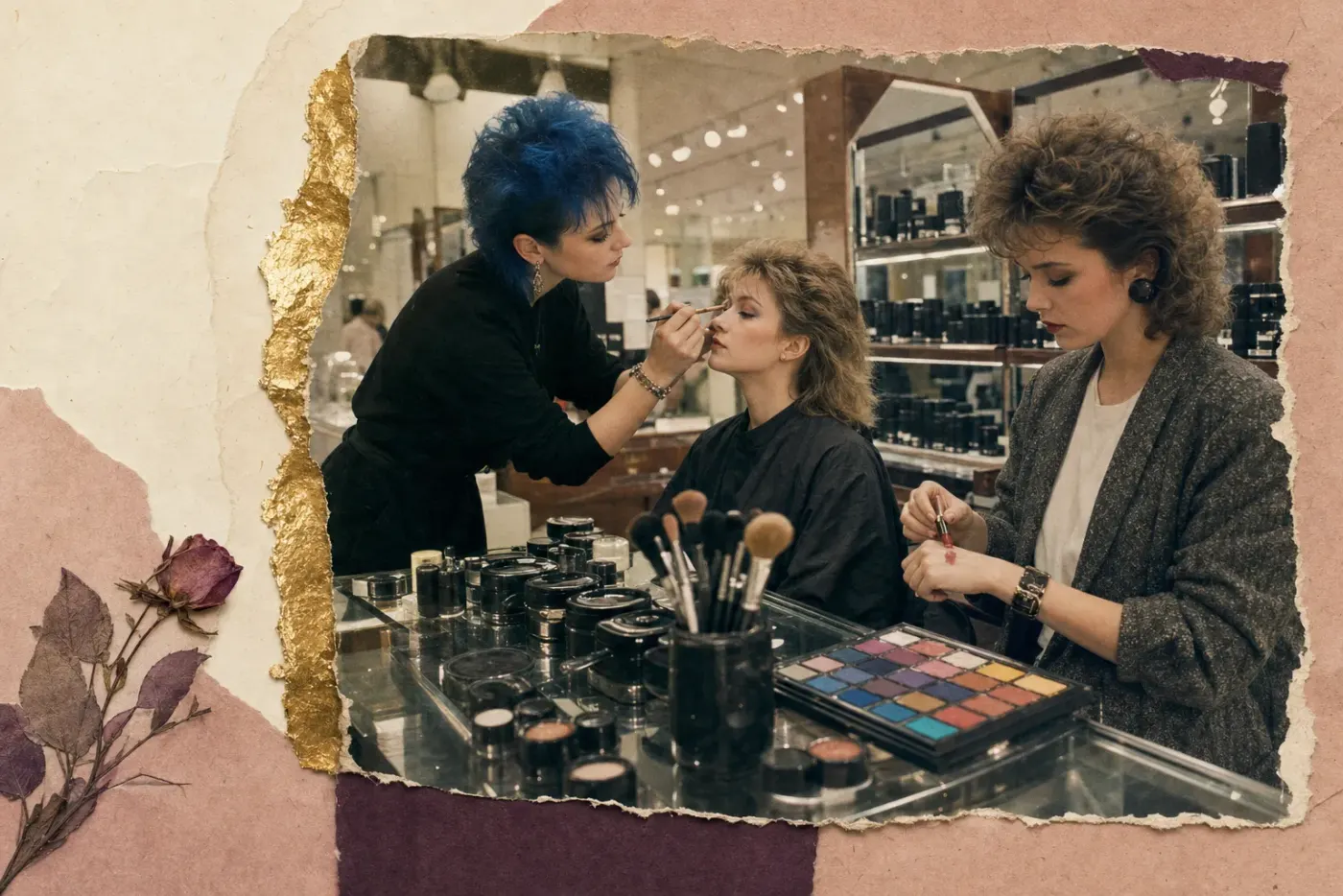
Its name said who it was for: Make-Up Art Cosmetics.[6] The line reached the public through department stores, and depended on them, at a time when those stores were themselves under pressure from the new downtown shopping malls.[5] Its counters looked like nothing else on the floor.
Selling the Artist
M·A·C did not advertise; Toskan regarded advertising as a tax on customers.[7] It put its money behind the counter instead. It hired men, including drag queens, which was highly unusual at makeup counters at the time; it let its staff keep creative hairstyles, tattoos and piercings; and it paid them high base salaries rather than commission.[7] Commission was the custom it was leaving: the department-store model had staff representing a single brand and generally paid on what they sold.[8]
“When we started MAC, most cosmetic companies were doing the hard sell, pushing their products,” Toskan recalled. “We did something different by encouraging employees to sell their talent rather than selling makeup.”[9]
When we started MAC, we didn’t want to put a face to our product. People kept saying – you have to have a face.
Behind the Counter
The staff policy met resistance on the shop floor. Toskan remembered department-store floor managers who sent M·A·C’s staff home “because they had blue hair or because it was a boy wearing makeup.” When a transgender employee was fired, the company said it would pull its products unless the employee was taken back.[11] The history of the firm, as its reviewer summarises it, records a similar stand at Nordstrom in the American South, over a gender-fluid member of staff.[12]
Its other policies set it apart in the same way. M·A·C listed all its ingredients on its labels, unlike most makeup of the time, ran an early recycling programme for its containers, and never tested on animals — in the decade of the campaign against the rabbit eye test.[12]
Bought, Not Changed
The larger houses noticed. The Estée Lauder Companies bought 51 per cent of M·A·C in 1994, raised its stake to 70 per cent in March 1997 and acquired the rest in February 1998; analysts expected few changes, because Lauder was known for keeping each of its brands distinct.[13] Frank Angelo died at forty-nine, not long after he and Toskan had separated as a couple, and long before the firm’s history came to be written.[14]
By then the professional’s name had become a selling point across the trade. In 1989 the makeup artist Barbara Daly, who had made up the Princess of Wales for her wedding, was running Colourings, a line sold through The Body Shop.[15] M·A·C’s own best-known cause, the Viva Glam lipstick launched in 1994 to raise money for HIV and AIDS charities, belongs to the next decade.[16]
What Is Not Known
Much of the early history comes from Toskan himself, in interviews given decades later, or from a history written with his help. Its reviewer notes that Frank Angelo is “strangely absent” from that book, that it says much more about the creative side of the firm than about how the business grew so fast, and that it “reads as a homily to M·A·C”.[17]
The sources used here do not give the month of the launch, the store that first sold the line or its first products, and this account names none. Brand histories supply those details; they are the company’s own account, and they are not repeated here as fact.
Sources
- [1, 3, 5, 7, 12, 14, 17]Review of Andrea Benoit, Viva M·A·C: AIDS, Fashion, and the Philanthropic Practices of M·A·C Cosmetics (McGill-Queen’s University Press, 2019) Canadian Business History Association, book reviews.View source (opens in a new tab) Accessed 2026-10-03.
- [2, 9, 10, 11]MAC co-founder Frank Toskan on why blue hair is good for business The Globe and Mail, 2 November 2014, 2014.View source (opens in a new tab) Accessed 2026-10-03.
- [4, 16]How MAC is reclaiming the cosmetic line’s indie spirit that began in Toronto The Globe and Mail, 30 January 2026, 2026.View source (opens in a new tab) Accessed 2026-10-03.
- [6, 13]Estee Lauder Buys Remaining MAC Equity Los Angeles Times, 28 February 1998, 1998.View source (opens in a new tab) Accessed 2026-10-03.
- [8]Sephora Holdings S.A. International Directory of Company Histories, via referenceforbusiness.com.View source (opens in a new tab) Accessed 2026-09-22.
- [15]Colourings: No hype, just good faces United Press International, 21 August 1989, 1989.View source (opens in a new tab) Accessed 2026-10-03.
Filed under