The Blitz Kids: Makeup at the Door
For a short time at the turn of the 1980s, a Tuesday night in a Covent Garden wine bar admitted people by how they looked — and the look went from the night bus to the high street.
In short
From February 1979 Steve Strange and Rusty Egan ran a Tuesday club night at the Blitz wine bar in Covent Garden, where entry depended on looking like “a walking piece of art”; its regulars wore theatrical makeup to the club, on the Tube and, in 1980, in Bowie’s “Ashes to Ashes” video.
- 6min read
- 6chapters
- 2sources
On Tuesday nights at the turn of the 1980s, the queue outside a wine bar in Covent Garden was judged by its faces. Steve Strange, who kept the door, would hold up a mirror to the people waiting and ask them: “Would you let yourself in?”[1]
The club was the Blitz, and the people who got in were soon called the Blitz Kids, or the New Romantics.[2] For a short time their makeup was the price of admission.
A Wine Bar on Great Queen Street
The Blitz was a wine bar at 4 Great Queen Street, themed on the Second World War and named after the German bombing campaign of forty years before. Its walls carried wartime posters and memorabilia, and its tables had candles pushed into empty wine bottles.[3] Strange and Rusty Egan, who had met by chance on the King’s Road in 1977 and run a Bowie night at Billy’s Disco in Soho from February 1978, opened their Tuesday night there in February 1979.[4]
The timing mattered to the people who came. Margaret Thatcher became Prime Minister that May, the economy was in a downturn, and many of the regulars were working class and disillusioned with punk; free university tuition had brought many of them to the art schools a short walk away.[4][3] The club, in the London Museum’s phrase, was “a glamorous and colourful escape from everyday life”.[3]
The Door Policy
Entry was exclusive by design. If your makeup or your clothes did not fit, you did not get in: Strange limited the door to “creative-minded pioneers… who looked like a walking piece of art.”[5] Regulars spent the week preparing, buying fabric and customising what they already owned, and for the fashion students among them, many from St Martin’s School of Art nearby, the dance floor was a catwalk.[5]
The looks were made collectively. The Blitz Kids, as the Design Museum puts it, created garments and styled looks for one another: the hairdresser Ollie O’Donnell styled his fellow club-goers for performances and photographs, and the makeup artist Lesley Chilkes wore a robe and chemise made for her by her friend David Holah, then a student, who went on to found the label BodyMap.[6]
Theatrical Makeup on the Night Bus
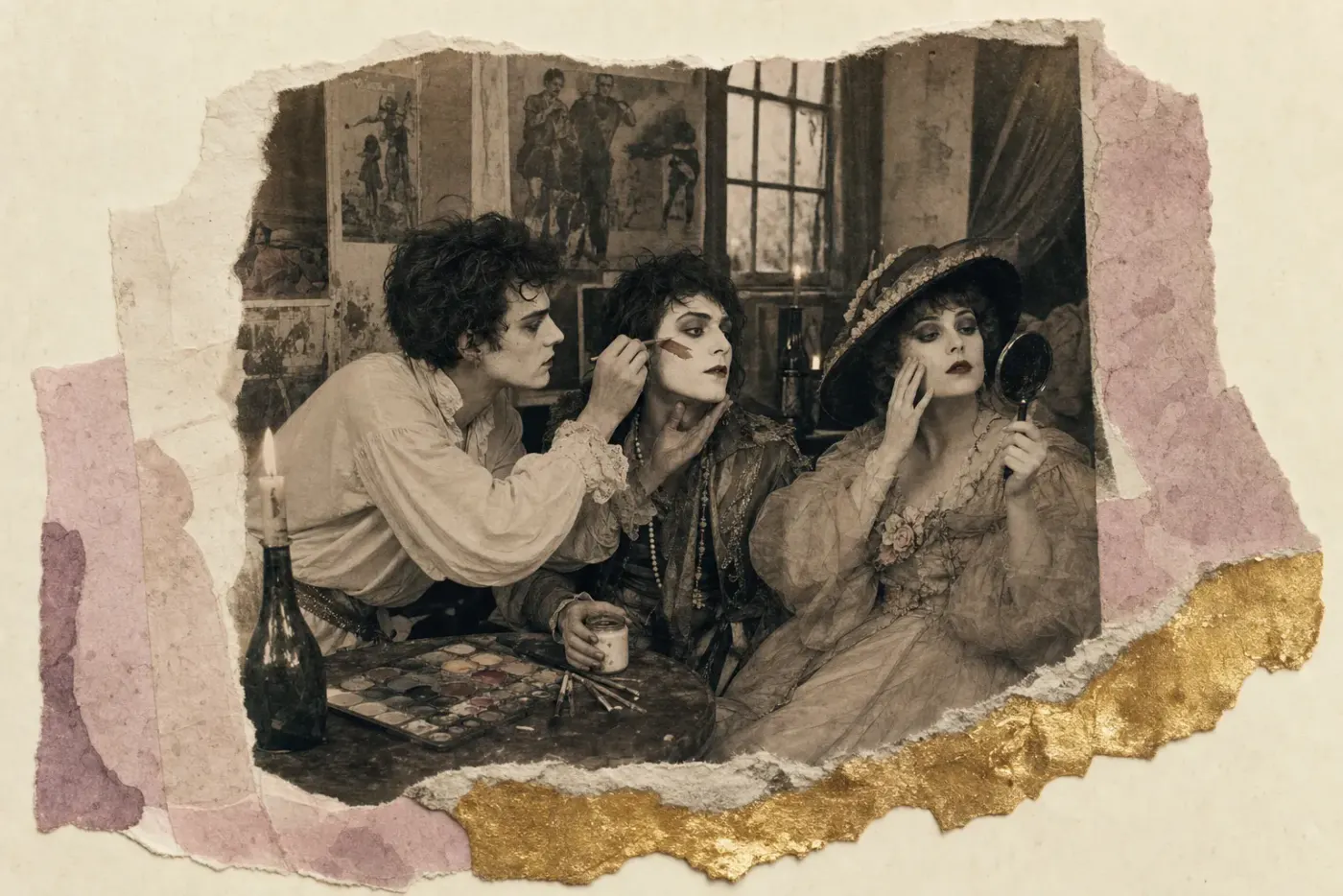
The public met the Blitz Kids before the club did. They travelled on Tube trains and buses “dressed in theatrical makeup, extravagant hats and flowing gowns”, and when the club shut at three in the morning the night bus came, at best, once an hour, leaving them open to harassment in the dark streets of Covent Garden.[7] Many of the women wore voluminous, full-coverage garments, which were a style statement and also a defence against unwanted sexual attention.[7]
The look drew on the stage and the screen. The London Museum describes theatrical hair and makeup and outfits that borrowed from pirates, early-nineteenth-century Romantic dress and the glam rock of the 1970s.[8] The Design Museum adds the late-night films at the Scala cinema — Cabaret, The Night Porter, Salon Kitty, with their stylised Weimar and Nazi-era decadence — which many regulars took as sources for costume and makeup.[7]
Blurring the Lines
Makeup on men was part of the point. The Blitz Kids wore clothes that, in the London Museum’s words, “challenged traditional ideas about gender”, and the Design Museum describes the club as a place to experiment without attracting homophobic abuse, though it was not specifically a gay club.[9][10]
The ground had been laid in the decade before. Glam rock and The Rocky Horror Show had made camp popular; homosexuality had been decriminalised in 1967; and many future Blitz Kids attended the 1978 Alternative Miss World, the satirical pageant the artist Andrew Logan had founded in 1972, judged that year by the American drag queen Divine.[10]
From the Club to the High Street
The scene lasted a short time and travelled a long way. In July 1980 David Bowie cast four Blitz Kids — Steve Strange, Judith Frankland, Darla-Jane Gilroy and Elise Brazier — in the video for “Ashes to Ashes”, which on its release that November was the most expensive music video yet produced.[11] The video for Visage’s “Fade to Grey”, the same year, was built around Strange’s face, transformed by the makeup of Richard Sharrah; Boy George, who had started in the club’s cloakroom, became a household name.[11][12]
The magazines that would record the look began alongside it: The Face in May 1980 and i-D that September.[11] Within a few years the high street had caught up. Among the products and advertisements that major brands designed “to capitalise on the pop culture sensation created by the scene”, the Design Museum shows a Boy George Fashion & Make-up Book of 1984 and a 1985 campaign for 17 Cosmetics in Smash Hits, lent by the Boots archive.[11]
What Is Not Known
Even the club’s dates are uncertain. The London Museum says the Blitz ran from 1979 to 1981; the Design Museum’s timeline has Strange and Egan running their last night there in October 1980, and opening a far larger one at the Camden Palace in April 1982.[13][14]
The sources describe the makeup in general terms — theatrical, bold, transforming — but they do not record what the Blitz Kids used, where they bought it, or how a face was built step by step. No product of the period is tied to the club in anything cited here, and this account does not supply one.
Nor can its reach be measured. That the look influenced the high street is the Design Museum’s judgement, a fair one on the evidence it shows; how many people outside a few London clubs wore makeup in the Blitz manner is not recorded.[14]
Sources
- [1, 3, 5, 8, 9, 12, 13]Blitz: A revolutionary 1980s club night London Museum (London Stories).View source (opens in a new tab) Accessed 2026-10-03.
- [2, 4, 6, 7, 10, 11, 14]BLITZ: the club that shaped the 80s — Large Print Guide Design Museum, London (exhibition guide, PDF).View source (opens in a new tab) Accessed 2026-10-03.
Filed under