Colour as a Season: Selling a Shade That Expires
A lipstick lasts months and a wardrobe changes twice a year. One industry solved that by borrowing the other’s calendar.
In short
Revlon’s seasonal colour promotion, of which the 1952 Fire and Ice campaign is the best-known instance, attached cosmetics to the fashion calendar and made a shade something that could go out of season.
- 12min read
- 6chapters
- 3sources

Vivien
Your guide through time
Listen to this essay
5 min listenVivien reads our essays aloud, word for word — every date and every name in its place — so you can listen the way you would be walked through a gallery.
An AI voice, designed for History of Makeup
A lipstick is a difficult thing to build a growth business on. It costs little, it lasts for months, and a woman who has found a red she likes has no reason to buy another one. The product’s durability is the manufacturer’s problem.[1]
Revlon’s answer was to stop selling the object and start selling the moment. If a shade belongs to a season, then last season’s shade is not used up but out of date, and the purchase can repeat without the product failing.[1]
Borrowing the Fashion Calendar
Clothing already ran on a cycle: collections, seasons, colours that arrived and were superseded. Cosmetics had no equivalent, and attaching one to the other gave the industry a rhythm it had never possessed.[2]
The mechanics are the coordinated launch. A named shade, released at a fixed moment, advertised as the colour of the season, and supported across press and counter simultaneously — so the product arrives as an event rather than as stock.[2]
The counter gains as much from this as the manufacturer does. A seasonal release is a reason to rebuild a display, retrain the staff on a single story and clear the previous stock at a moment everyone has agreed on in advance — which turns a shelf that was being restocked into a shelf that is being relaunched, twice a year, forever.[3]
What the Name Does
Naming is doing more work here than it appears to. A number describes a pigment; a name describes an idea, and an idea can be advertised, discussed and desired in a way a number cannot.[4]
It also makes the shade discussable between customers, which is free distribution. A woman can tell a friend what she is wearing, and the friend can ask for it by name at a counter — a transaction that a numbered range makes awkward and a named one makes easy.[5]
And a name can be retired. A number implies a catalogue position that ought to persist, while a name implies an occasion that can end, so naming quietly builds the expiry date into the product before anyone has to announce it.[4]
Last season’s shade is not used up. It is out of date.
The Matching Set
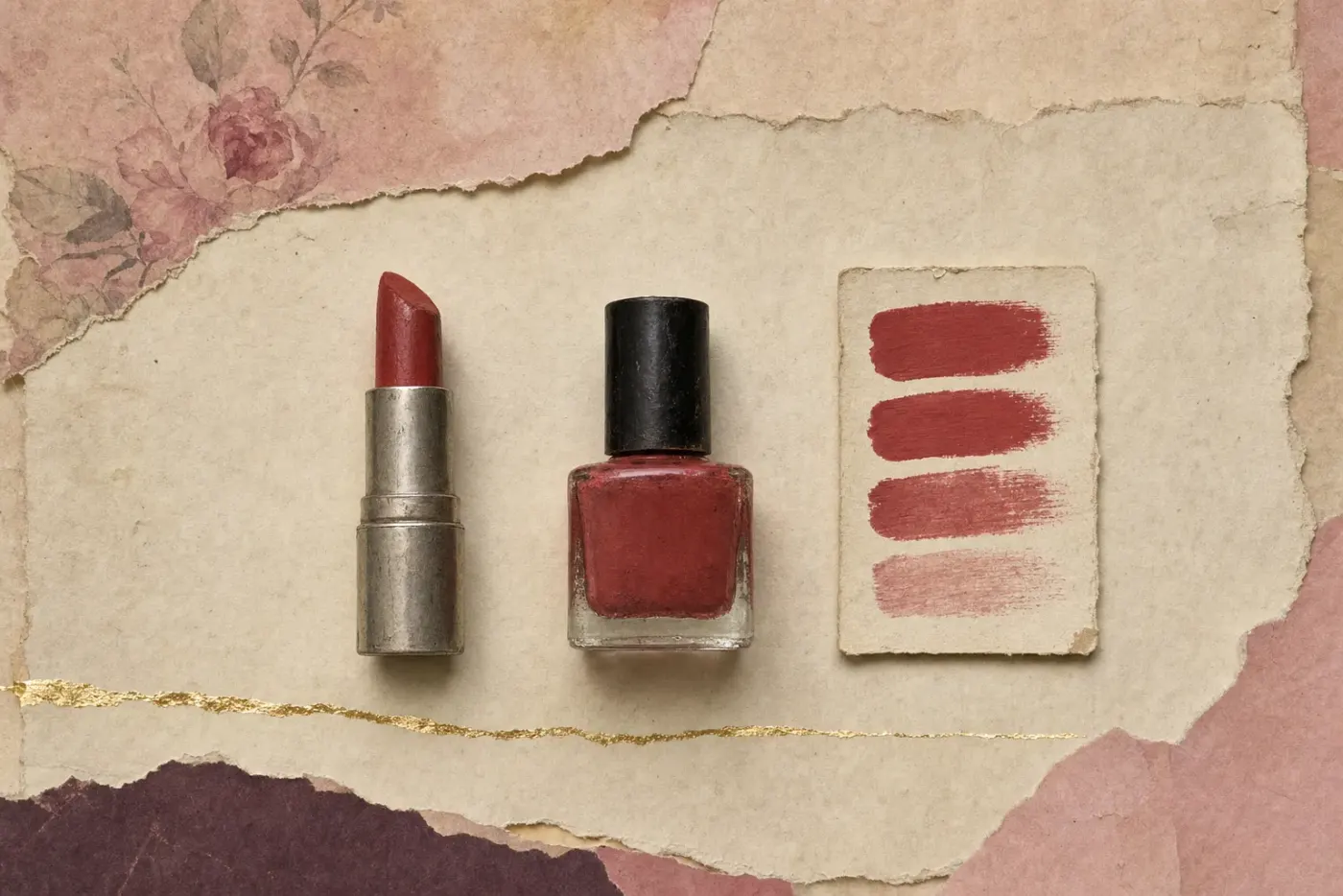
The seasonal shade was rarely one product. Lip and nail colour released together as a coordinated pair doubles the purchase from a single decision, and makes the shade visible on two parts of the body at once.[6]
That is the 1920s idea of the coordinated face, extended and monetised. Where the earlier decade taught that the elements of a face should agree, this one taught that agreeing required buying them together and replacing them together.[7]
Pairing also solves an evidence problem for the manufacturer. A lipstick worn alone is one woman’s choice, while the same colour on her hands as well reads as a decision made deliberately — so the matching set makes the seasonal shade visible as a system rather than as a preference, and a system is what other people copy.[6]
Why It Worked
Because the cost of participating is very low. A dress in this season’s colour is a serious purchase; a lipstick in it is not, which makes the cosmetic the cheapest available way to be current.[8]
That is a genuinely attractive proposition rather than a trick, and it is worth saying so. The seasonal cycle offered real access to a fashion system that clothing priced most people out of — and it did so by making a small purchase feel like participation.[9]
What It Cost
The obvious cost is consumption: a manufactured obsolescence in a product that does not wear out, and a drawer of shades abandoned for being last year’s rather than for being finished.[10]
The subtler cost is the transfer of authority. A seasonal system requires somebody to declare what the season is, and that somebody is the manufacturer — so the industry acquired the right to tell its customers when what they already owned had stopped being right.[11]
What Is Not Known
How much of the campaign’s reputation is retrospective is hard to establish. Fire and Ice is remembered as a landmark partly because it worked and partly because it has been cited as a landmark for seventy years, and those two reinforce each other.[12]
Sales attribution is also unreliable at this distance. A campaign that coincides with a growing market is difficult to separate from the market, and the figures that survive come substantially from interested parties.[13]
Sources
- [1, 2, 4, 6, 8, 11, 12]Fire and Ice: The Story of Charles Revson William Morrow, 1976.
- [3, 5, 9, 10, 13]Beauty Imagined: A History of the Global Beauty Industry Oxford University Press, 2010.
- [7]Hope in a Jar: The Making of America’s Beauty Culture Metropolitan Books, 1998.
Filed under