Allergy Tested: Clinique and the Dermatologist at the Counter
In 1968 Estée Lauder opened counters staffed in white coats, selling makeup and skin care built on a dermatologist’s routine and the words “allergy tested”. It was not the first line of its kind, whatever its makers said.
In short
Clinique was launched by Estée Lauder in 1968 with the Vogue editor Carol Phillips and the dermatologist Norman Orentreich, sold as allergy-tested and fragrance-free by counter staff in white coats; smaller hypo-allergenic lines such as Almay (1931) and Ar-Ex (1935) had come before it.
- 6min read
- 5chapters
- 5sources
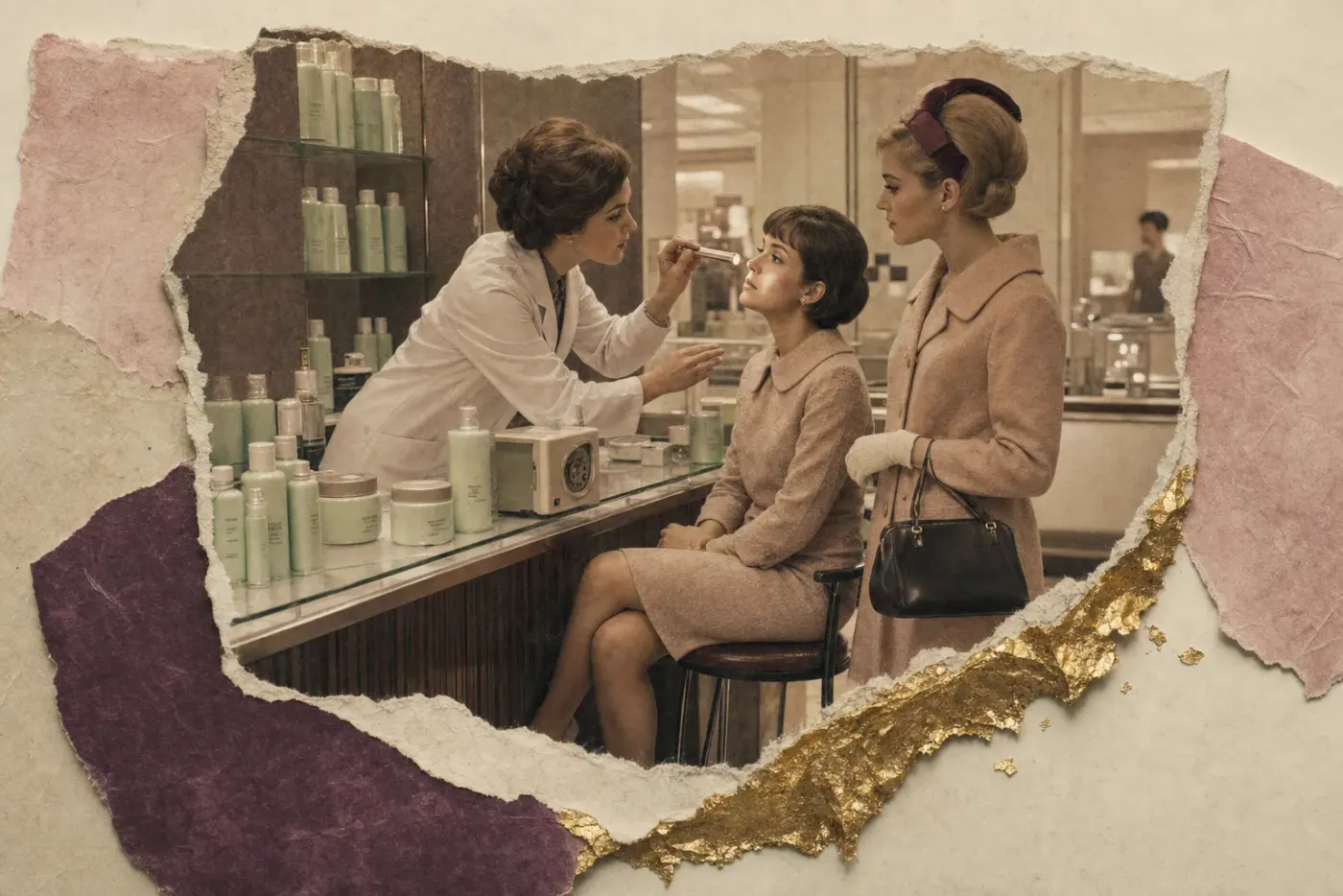
In 1968 Estée Lauder opened a counter that did not look like a cosmetics counter. Its staff wore white laboratory coats, its packages looked antiseptic, and its products carried clinical phrases such as “allergy-tested”.[1] The line was Clinique, and its appeal to the customer was not glamour but care: a dermatologist’s routine, and the assurance that every product had been tested for reactions before it went on sale.[2]
It was the end point of a decade that had sold makeup as good for the skin, and it put that promise behind a prestige counter.
A Line for the Next Generation
Estée Lauder’s customers had mostly been older women, and Clinique was made to reach younger ones.[3] James Bennett, the historian of the company whose work this account relies on, gives Leonard Lauder’s reasons: slowing growth in the Estée Lauder line, the baby boom, and the move of shoppers from department stores to suburban malls, which threatened the high-status outlets the company depended on.[3]
The answer was a second brand that could not dilute the first. Clinique had counters of its own and no reference to its parent; its name was chosen to sound scientific. A small range for younger women in the 1950s had failed, so this one launched large, with 117 products across skin care, body care, hair care and makeup. It reached Britain, at Harrods, in 1969.[3]
The Editor and the Dermatologist
Two people from outside the family are tied to its making. In 1967 Vogue ran an article headlined “Can Great Skin Be Created?”, written by its editor Carol Phillips and built around the New York dermatologist Norman Orentreich; Leonard Lauder then recruited both of them to help create the line.[4]
Orentreich supplied its method. In Leonard Lauder’s account he had pioneered a three-step routine for his own patients — cleanse, exfoliate, moisturise — developed Clinique’s formulas, and led the allergy testing of each one, going back to reformulate if there was even one reaction.[5] The line’s best-selling product, Dramatically Different Moisturizing Lotion, was based on one of his formulas, and he helped devise the “Clinique Computer”, a counter device for working out a customer’s skin type.[4]
We go “scurfing,” you might say, taking away the scaly scurf that everybody has and nobody needs.
Not the First
Leonard Lauder did not undersell it. Speaking of beauty products that apply the ideas of dermatology, he told the New York Times in 2019: “We were the first, we were the inventor of it — and anyone else is a wannabe.”[7] Cosmetics for customers prone to reactions, sometimes described as hypo-allergenic, were already being made by smaller firms: Almay from 1931 and Ar-Ex from 1935.[8]
What Clinique brought to the idea was a prestige counter, a laboratory manner and a parent able to wait for it; like the company’s men’s line, Aramis, it lost money at first, and a private company did not have to explain that to shareholders.[9] Revlon, which had largely ignored the sensitive-skin market, answered in 1969 with Etherea, described as “beginning where hypo-allergenics end”, and it never gained much ground.[8]
Makeup as Treatment
Clinique arrived at the end of a decade that had sold makeup as medicine. Cover Girl, launched in 1961, was medicated with antiseptics and advertised as better for the skin than no makeup at all, and Revlon’s Natural Wonder followed it in 1962.[10][11] Clinique’s version was more refined — allergy testing in place of antiseptics, fragrance left out, and petrolatum and mineral oil in many products because they were less likely to cause a reaction — but it rested on the same proposition.[12]
It also changed what happened at the counter. Staff carried penlights to examine a customer’s skin, a machine helped decide her skin type, and she left with a routine of three steps and the products to match: a consultation more than a demonstration.[12][13]
What Is Not Known
The origin story is told two ways. The trade-press notice of Carol Phillips’s death in 2006, which quoted Leonard and Ronald Lauder, said her Vogue article “inspired the Lauders” to invite her to help create the line;[14] Leonard Lauder’s memoir of 2020, as quoted by Bennett, says he had never read it, and that he and Phillips came to the idea at the same moment.[15] Her title at Vogue is also given differently: beauty editor and then managing editor in the notice, beauty and special projects editor in Bennett.[14][15]
Nor do the sources used here describe how the allergy testing was done, on how many people, or what counted as a reaction. “Allergy-tested” is a claim about a procedure the company ran on its own products, and no independent account of that procedure has been found for this archive.[16]
Sources
- [1, 4, 7, 13, 16]Norman Orentreich, 96, Force Behind Hair Transplants, Dies The New York Times, 2019.View source (opens in a new tab) Accessed 2026-10-03.
- [2, 3, 5, 6, 9, 12, 15]Estée Lauder (post 1960) Cosmetics and Skin, 2023.View source (opens in a new tab) Accessed 2026-09-26.
- [8, 11]Revlon (post 1960) Cosmetics and Skin, 2012.View source (opens in a new tab) Accessed 2026-09-26.
- [10]Cover Girl Cosmetics and Skin, 2016.View source (opens in a new tab) Accessed 2026-09-26.
- [14]In Memoriam: Clinique mourns death of founder and former Chairman The Moodie Davitt Report, 2006.View source (opens in a new tab) Accessed 2026-10-03.
Filed under