The Face in the Feed
A camera in every pocket and a feed to fill, a palette of twelve neutrals, a contour kit sold out in minutes, brands with no counter — and, in Europe, a law that closed the market to cosmetics tested on animals.
HOM · Era2010 – 2019Feeds & Founders
All of The 2010s Era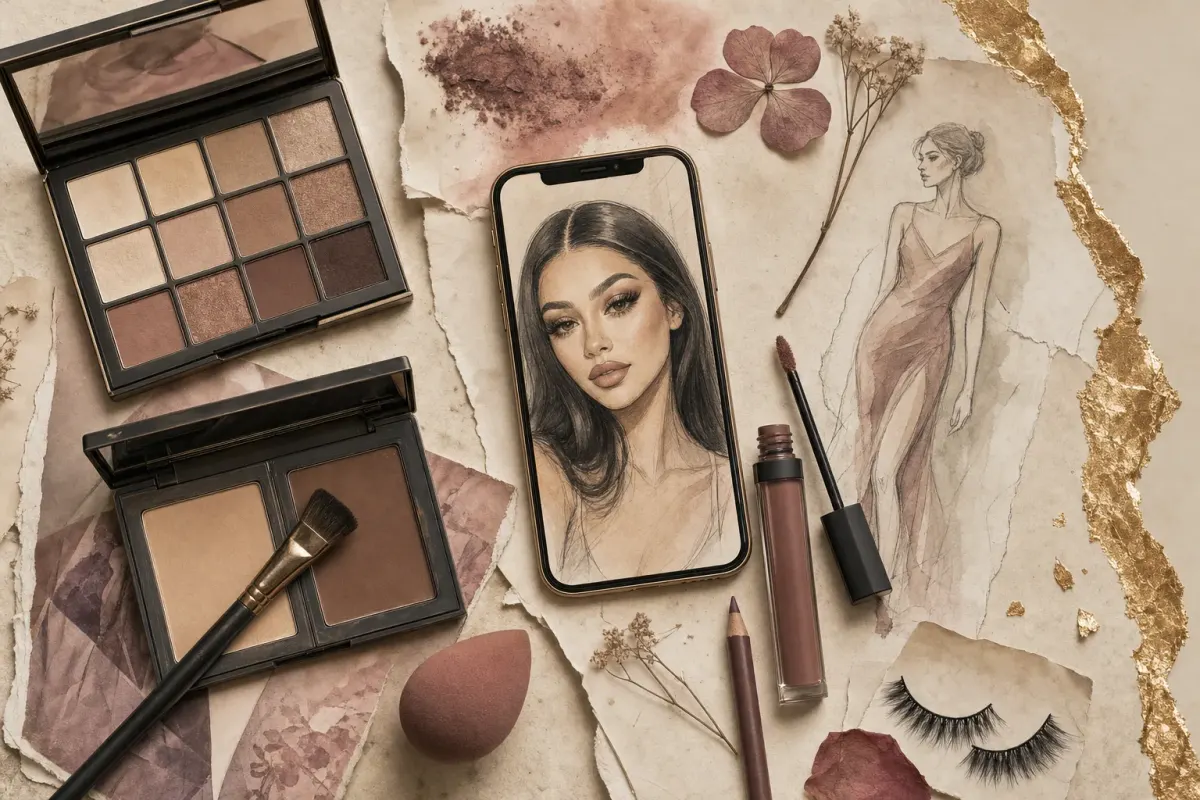
In short
The 2010s opened with Instagram and Urban Decay’s twelve-shade Naked palette, sold contour kits and matte lip kits straight from their founders’ feeds, closed the European market to cosmetics tested on animals in 2013, and turned a forty-shade foundation launch into the decade’s argument about range.
- 9min read
- 7chapters
- 22sources
The 1960s turned the industry towards the young. The 2010s handed the young a camera. In ten years the front-facing phone and the photo-sharing feed became the place where faces were made, shown and judged; the eyeshadow palette and the contour kit became bestsellers; brands were built from a following before they had a shop; Europe closed its market to cosmetics tested on animals; and the industry was made to count, shade by shade, whom its foundations were for.
Much of the decade’s evidence is commercial — launch figures, valuations, filings — and where those figures came from the companies themselves, or were later disputed, the text says so.
The Camera in the Pocket
Instagram launched in October 2010, as the decade was beginning, and its look was set by the screen it was seen on: on Instagram, one critic wrote, “the ideal image is always the one that instantly pops on a phone screen.”[1] In April 2012 Facebook agreed to buy it, for approximately $1 billion in cash and shares.[2] Snapchat, launched in 2011, kept its users in large part with photo filters, and the editing app FaceTune, released in 2013, offered finer control still: the retouching that magazines had long applied to celebrities could now be done to a selfie in a few taps.[1]
Instruction moved to the same screen. By the count of the video-advertising firm Pixability, reported by CNN, views of beauty-related content on YouTube rose from 4 billion in 2010 to 104 billion in 2017.[3] Huda Kattan, who left a job in finance to become a makeup artist, launched a website of tutorials in 2010 and later called Instagram “the catalyst that changed everything”.[3] The counter and the magazine now competed with a stranger’s face on a phone, performing every step in order.
The Palette and the Contour
The decade’s best-known product was a case of eyeshadows. Urban Decay’s Naked palette, twelve shades on a nude theme, went on sale in 2010; when the company withdrew it in 2018 it said that more than thirty million had been sold, one every six seconds at its height, earning the brand more than $1 billion.[4][5] The trade press called it a catalyst for the eyeshadow market that followed.[5] In 2017, by the market-research firm NPD’s account, foundation and eye shadow drove the growth of American prestige makeup, together with bronzers, highlighters and glow products.[6]
Those last were the tools of contouring: a deeper shade to set back the hollows of a face and a lighter one to bring forward its high points. The method was old. Gala of London sold a pair of light and dark creams for accentuating the contours of the face in 1967,[7] and Kevyn Aucoin had put sculpting and contouring before general readers, with the shades named, by 2000.[8] What the decade added was demand on a new scale. When Kim Kardashian West started a makeup line in June 2017, its first product was a contour and highlighting kit, and industry sources expected all 300,000 of them, at $48 each, to sell out in less than five minutes.[9]
It’s a young face, of course, with poreless skin and plump, high cheekbones. It has catlike eyes and long, cartoonish lashes; it has a small, neat nose and full, lush lips.
The Brand Without a Counter
The feed also made brands. Emily Weiss started the blog Into the Gloss in 2010 and launched Glossier from it four years later;[11] its first products, in October 2014, included a sheer Perfecting Skin Tint, sold under the line “Skin first, makeup second, smile always.”[12] In 2018, according to the company, its revenue more than doubled and passed $100 million, and in March 2019 a funding round valued it at $1.2 billion.[11]
Kylie Jenner’s first Lip Kits — a lip liner and a matching lipstick, at $29 — went on sale online in November 2015 and were gone in less than a minute.[13] By early 2019 her company had twelve employees, seven of them full-time; its manufacturing was outsourced, its online sales were run on Shopify, and its marketing was mostly her own social media.[14] In November 2019 Coty agreed to buy 51 per cent of it for $600 million, and the figures behind that deal led Forbes to conclude that the business had been much smaller than the family had led it to believe; her representatives denied that she had lied.[13]
Settled in Law
On 11 March 2013 the last deadline of a European phase-out passed, and from that day, in the European Commission’s words, “cosmetics tested on animals cannot be marketed any more in the EU.”[15] Testing itself had been banned in the Union since 2004 for finished products and since 2009 for ingredients; the 2013 deadline ended the exception that had let companies rely on the most complex tests carried out elsewhere.[15][16] In 2016 the Court of Justice held that the rule could reach tests done outside the EU to sell in other countries, wherever their results were used to show that a product was safe for the European market.[17]
China, where testing had been mandatory, moved more slowly. From 30 June 2014 animal testing became optional for ordinary cosmetics made in China, makeup among them; imported cosmetics still had to be tested.[18] Two years earlier Urban Decay had announced that it was pulling out of the Chinese market because of the country’s animal-testing policies.[19]
The Face of the Decade
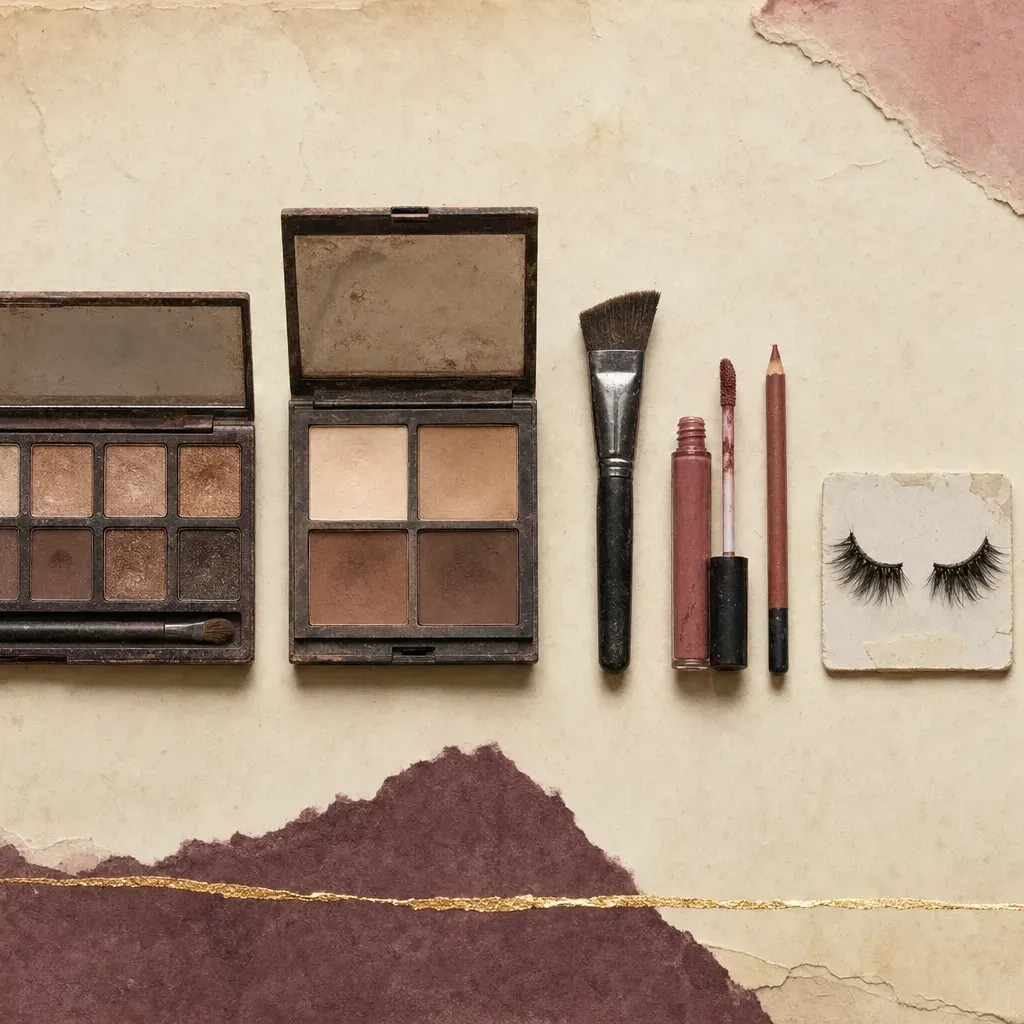
Put together, the decade’s bestsellers describe the face its feeds rewarded: cheekbones set up with a contour shade beneath and a highlighter above;[20] lids shaded in neutral browns from a single palette;[21] long, full lashes, with false ones among the first products of the decade’s new founders;[22] and a matte mouth drawn with a liner and filled with a liquid lipstick.[23] A writer looking back from the decade’s last weeks found it on one much-copied face — “poreless skin and plump, high cheekbones”, “catlike eyes and long, cartoonish lashes” — and argued that social media, editing apps and cosmetic procedures had made it between them.[24]
The plate here is reconstructed from those products rather than from any one woman’s routine, and the steps beside it say what each one takes to do now.

Forty Shades
The decade’s reckoning came in the bottle. Fenty Beauty, a fifty-fifty venture between Rihanna and LVMH,[25] launched in 2017 with forty shades of foundation.[26] A measurement published the following year was more exact than the headlines: Make Up For Ever had, by its own account, sold forty shades since 2015, but thirty-one of them sat in one band of light and tanned skin, while Fenty’s were spread far more evenly — though very few brands, Fenty not among them, reached the darkest band at all.[26] The pigments to make every one of those shades had long existed. What changed was whom a range was built for, which is the subject of this archive’s history of the shade range.
The decade had its refusals too: from 2018 a movement in South Korea, organised largely on social media, rejected what its participants called the appearance-corset.[27] And at its close a retail analyst told Fortune: “Today’s consumer goes to YouTube and TikTok for beauty videos and tutorials.”[28] What TikTok, a pandemic and a new American cosmetics law made of that belongs to the 2020s.
What Is Not Known
Much of the decade’s evidence comes from the companies it describes. The Naked palette’s thirty million and its billion dollars are Urban Decay’s figures, repeated by the trade press;[29] Glossier’s revenue is the company’s own;[30] and the sales of Kylie Cosmetics were reported at one size, repeated across the trade and financial press, and then revised sharply downward by Forbes on the strength of Coty’s filings — a revision the Jenners’ representatives disputed.[31]
The face is harder to pin down than its products. No source this archive can cite dates the filled, sharply shaped brow popularly associated with the decade, so the plate leaves it out; nor does any source here measure how many people wore the full contoured face. “Instagram Face” was a phrase in circulation by 2019, when a New Yorker writer took it for her title, and the essay’s most striking figures on editing apps and procedures are one makeup artist’s estimates, not counts.[32]
And the ban did not end animal testing. The Commission said in 2013 that full replacement of animal tests was not yet possible in all cases, and that most cosmetic ingredients are also used in medicines, detergents, food and paints, and may be tested under the laws for those.[33]
Sources
- [1, 10, 24, 32]The Age of Instagram Face The New Yorker, 2019.View source (opens in a new tab) Accessed 2026-10-03.
- [2]Facebook to Acquire Instagram Meta Newsroom, 2012.View source (opens in a new tab) Accessed 2026-10-03.
- [3, 22]Huda Kattan: The face that launched a billion-dollar beauty empire CNN, 2018.View source (opens in a new tab) Accessed 2026-10-03.
- [4, 21]Urban Decay’s ‘Naked Palette’ has passed away Free Malaysia Today (AFP Relaxnews wire), 2018.View source (opens in a new tab) Accessed 2026-10-03.
- [5, 29]Urban Decay mourns iconic Naked palette in humorous funeral-style video Cosmetics Business, 2018.View source (opens in a new tab) Accessed 2026-10-03.
- [6]U.S. Prestige Beauty Industry Sales Rise 6 Percent in 2017, Reports The NPD Group PRWeb, 31 January 2018, 2018.View source (opens in a new tab) Accessed 2026-09-26.
- [7]Gala of London Cosmetics and Skin, 2024.View source (opens in a new tab) Accessed 2026-09-25.
- [8]Face Forward Little, Brown and Company, 2000.
- [9, 20]The Sales Projections for Kim Kardashian’s New Makeup Line Are Crazy Fortune, 2017.View source (opens in a new tab) Accessed 2026-10-03.
- [11, 30]Glossier started as a beauty blog and is now valued at $1 billion CNN Business, 2019.View source (opens in a new tab) Accessed 2026-10-03.
- [12]How Glossier Made Effortlessness a Billion-Dollar Brand The New Yorker, 2023.View source (opens in a new tab) Accessed 2026-09-25.
- [13, 31]Inside Kylie Jenner’s Web Of Lies—And Why She’s No Longer A Billionaire Forbes, 2020.View source (opens in a new tab) Accessed 2026-10-03.
- [14, 23]At 21, Kylie Jenner Becomes The Youngest Self-Made Billionaire Ever Forbes, 2019.View source (opens in a new tab) Accessed 2026-10-03.
- [15]Full EU ban on animal testing for cosmetics enters into force (press release IP/13/210) European Commission, 2013.View source (opens in a new tab) Accessed 2026-10-03.
- [16, 33]Questions and Answers: Animal testing and cosmetics (MEMO/13/188) European Commission, 2013.View source (opens in a new tab) Accessed 2026-10-03.
- [17]Press release No 105/16: Judgment in Case C-592/14, European Federation for Cosmetic Ingredients v Secretary of State for Business, Innovation and Skills and Others Court of Justice of the European Union, 2016.View source (opens in a new tab) Accessed 2026-10-03.
- [18]China Ends Mandatory Animal Testing for Domestic Non-special Use Cosmetics from 30 Jun 2014 ChemLinked (REACH24H Consulting Group), 2014.View source (opens in a new tab) Accessed 2026-10-03.
- [19]L’Oréal to acquire Urban Decay make-up brand Premium Beauty News, 2012.View source (opens in a new tab) Accessed 2026-10-03.
- [25]Rihanna set to light up Super Bowl LVII. Here's how much she's worth. CBS News MoneyWatch, 12 February 2023, 2023.View source (opens in a new tab) Accessed 2026-09-25.
- [26]The Diversity of Makeup Shades The Pudding, 2018.View source (opens in a new tab) Accessed 2026-09-22.
- [27]'Escape The Corset' Movement in South Korea: An Exploratory Study Focusing on Social Media Data Analysis Journal of Fashion Business 28(6), 63-76, 2024.View source (opens in a new tab)
- [28]The Decade Beauty Retail Stepped Out From Behind the Counter Fortune, 2019.View source (opens in a new tab) Accessed 2026-10-03.
Continue in The 2010s Era
Feeds & Founders
Browse all 9 articles