The Young Face and Its Critics
Medicated makeup sold beside the groceries to the young, false eyelashes by the million, a dermatologist at the counter — and, at the end of the decade, a trash can on the Atlantic City boardwalk.
HOM · Era1960 – 1969Youth & Dissent
All of The 1960s Era
In short
The 1960s opened with Noxzema’s medicated Cover Girl sold in drug and grocery stores to the young, moved the face’s emphasis from a paling mouth to the eye and its false lashes, and closed with Clinique’s allergy-tested counter and a protest that threw false eyelashes into a Freedom Trash Can.
- 8min read
- 6chapters
- 15sources
The 1950s finished the face and built the machine that sold it. The 1960s turned the machine towards the young. In ten years the industry put medicated makeup on grocery shelves, completed the move of the face’s emphasis from the mouth to the eye, sold false eyelashes by the million and opened counters staffed in laboratory coats.
It also met an organised argument against itself, made in public. By the end of the decade some women were throwing its products into a bin on a boardwalk, and others were asking whose face it had been selling all along. What follows is the story of a market that grew younger, and of the people who refused its terms.
Sold to the Young
The decade’s first great launch came from a company that had never sold makeup. In January 1961 the Noxzema Chemical Company of Baltimore put Cover Girl on national sale: a liquid makeup and a compressed powder, medicated with the antiseptics of its skin cream, advertised to teenagers and young women and sold in drug and grocery stores rather than at department-store counters.[1][2] By 1968 Cover Girl Liquid Make-up was the best-selling makeup line in the United States.[1]
Its rivals chased the same buyer. Revlon answered in 1962 with Natural Wonder, an economy line medicated in the same way, and with brush-on powders that its historian counts as part of the company’s response to the natural look.[3] Estée Lauder, whose customers had mostly been older women, built Clinique in 1968 to reach a younger generation.[4] In London, Mary Quant’s cosmetics launched in 1966 with the claim that the products worked together, so that women spent less time applying them and carried fewer of them around.[5]
The Eye Carries the Face
The shift the 1950s had begun was completed. In the late 1950s and early 1960s lipsticks went pale, while mascara, eyeliner and eye shadow came into colourful use.[6] The shade names tell it: Revlon sold its Colors on the Naked Side — Barely Pink, Barely Peach, Barely Tan among them — in 1963 and frosted shades in 1965 and 1966, and Cover Girl added frosted lipsticks in 1966.[7][8]
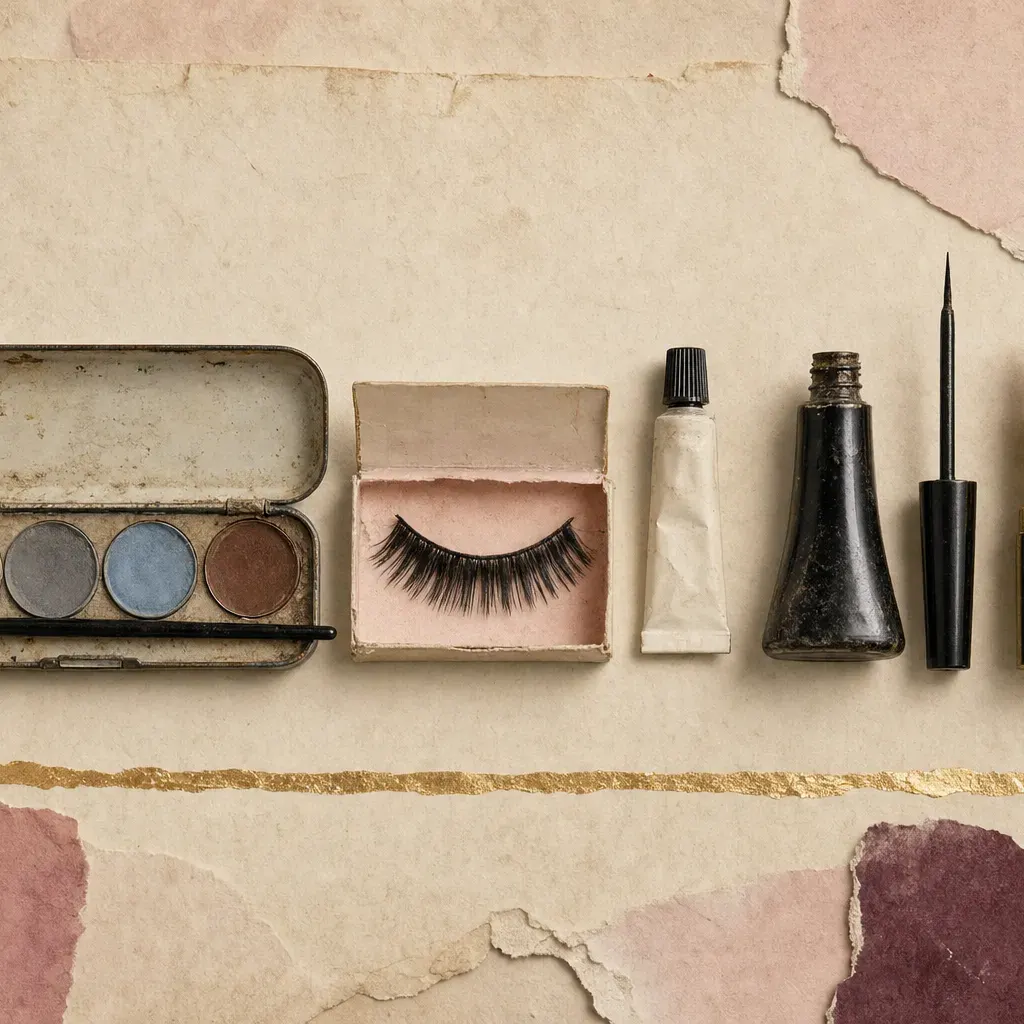
The eye, meanwhile, acquired a kit. Gala of London sold eye palettes in 1967 packaged like a child’s paintbox, with instructions to colour the lid from the lashes to the brow, add a darker tone of the same shade as a contour line, and a darker one again for the eye line.[9] False eyelashes, made mostly by the British firm Eylure for other houses’ labels, sold more than twenty million pairs a year in the United States by 1968.[10] How the eye displaced the mouth is told in full elsewhere in this archive; this was the decade it happened.
Good for the Skin
Much of the decade’s makeup was sold as treatment. Cover Girl contained hexachlorophene and two other bactericides, which let its maker call it “really good for the skin”; Revlon’s Natural Wonder and Max Factor’s Pure Magic carried the same antiseptic.[11][12] In 1972, after infants in France died from a talcum powder made with too much of it, the Food and Drug Administration recalled consumer products containing more than 0.75 per cent.[12]
The colours themselves came under new rules as the decade opened. The Color Additive Amendments of 1960 allowed only colour additives listed as “suitable and safe” for a given use into foods, drugs and cosmetics, and the two hundred or so then in commercial use were listed provisionally until each was either listed permanently or dropped.[13]
Clinique, at the decade’s end, offered the reassurance in a more refined form: products allergy-tested before sale, made without fragrance, and a dermatologist’s routine of three steps.[14] Lines for sensitive skin were not new — Almay had made them since 1931 — but Clinique gave the idea a prestige counter and a laboratory manner.[15]
The Face of the Decade
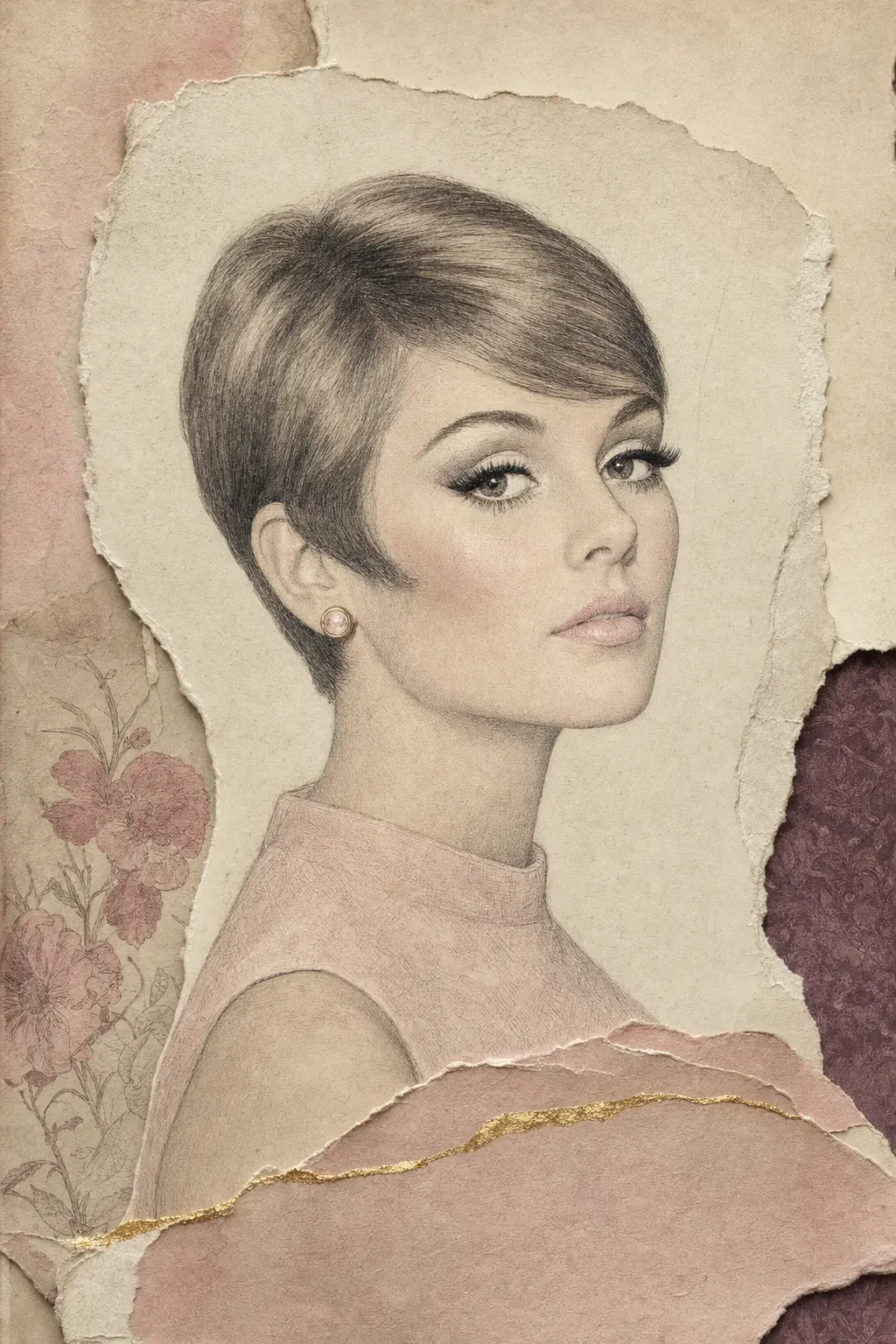
Put together, the decade’s products describe the face its advertising sold: a pale, even, matte base, often foundation and powder in one; brows filled with a brush-on colour sold as softer than a pencil; a lid coloured up to the brow, with a darker contour line in a deeper tone of the same shade; lashes thickened with false ones; cheekbones shaped with light and dark, “high cheek bones then being in favour”; and a pale, frosted mouth.[16][17][18] The historian of false lashes calls it “the European look of big eyes in a pale face”, and names Jean Shrimpton and Twiggy as its models.[19]
The plate here is reconstructed from those products rather than from any one woman’s routine, and the steps beside it say what each one takes to do now.
The Argument
The decade’s critics came from more than one direction. In Harlem in 1962 a fashion show called Naturally ’62 put the Grandassa Models on the runway in their Afros under the tagline “Black Is Beautiful”,[20] the phrase of a movement that, in the words of the National Museum of African American History and Culture, affirmed “the variety of skin colors, hair textures, and physical characteristics found in the African American community.”[21] The mass-market makeup that would outsell all others by 1968 had launched in three shades, which its historian judges suitable only for lighter skins.[22]
On 7 September 1968 women’s liberation activists protested outside the Miss America pageant in Atlantic City. They invited women to throw “bras, girdles, curlers, false eyelashes, wigs” and women’s magazines into a Freedom Trash Can, and one of their placards asked: “Can make-up hide the wounds of our oppression?”[23] At midnight, a few blocks away, the first Miss Black America pageant made a different case: that Miss America would not accommodate Black women, so they would hold a pageant of their own.[23]
The industry, meanwhile, was widening its market rather than defending it. Estée Lauder’s Aramis range for men, launched in 1963, included Mark-Out, a matte cream to “disguise blemishes” that, its advertising said, “heals what it hides.”[24] And by the end of the decade the houses were learning to answer their critics in their own language.
The last thing she needs is anybody’s blueprint – even ours. We just make the make-up – you make the face.
What Is Not Known
Several of the decade’s best-known stories are larger than their evidence. No bras were burned in Atlantic City; the burning was a myth that grew out of the coverage.[26] Claims of “firsts” are made freely and disagree. Leonard Lauder told the New York Times in 2019 that Clinique was “the first”,[27] though lines for sensitive skin had been sold since the 1930s;[28] Cover Girl is sometimes credited with starting the trend that produced the supermodel, which its historian calls overstated.[29]
The look is easier to document as products than as practice. The sources here name Jean Shrimpton and Twiggy as wearers of strong eye makeup and false lashes, but they do not record how many women wore the full face, or how many gave makeup up. Nor do they show that the critique changed what people bought: American sales of false eyelashes had passed twenty million pairs a year by 1968, the year of the protest.[30]
And they do not settle where “Black is beautiful” began. One records it as the tagline of a Harlem show in 1962; another credits that show with carrying the phrase into a national movement, which is not the same as having coined it.[31][32]
Sources
- [1, 8, 11, 18, 22, 29]Cover Girl Cosmetics and Skin, 2016.View source (opens in a new tab) Accessed 2026-09-26.
- [2]Guide to the Cover Girl Advertising Oral History and Documentation Project, 1959–1990 (NMAH.AC.0374) Smithsonian Online Virtual Archives, 2007.View source (opens in a new tab) Accessed 2026-10-03.
- [3, 7, 15, 17, 28]Revlon (post 1960) Cosmetics and Skin, 2012.View source (opens in a new tab) Accessed 2026-09-26.
- [4, 14, 24]Estée Lauder (post 1960) Cosmetics and Skin, 2023.View source (opens in a new tab) Accessed 2026-09-26.
- [5]The story of Mary Quant make-upView source (opens in a new tab) Accessed 2026-09-22.
- [6]Eye Shadow Cosmetics and Skin.View source (opens in a new tab) Accessed 2026-10-03.
- [9, 16, 25]Gala of London Cosmetics and Skin, 2024.View source (opens in a new tab) Accessed 2026-09-25.
- [10, 19, 30]False Eyelashes Cosmetics and Skin, 2018.View source (opens in a new tab) Accessed 2026-09-26.
- [12]Hexachlorophene Cosmetics and Skin (updated 26 February 2023), 2015.View source (opens in a new tab) Accessed 2026-10-03.
- [13]Color Additives History U.S. Food and Drug Administration (reprinted from Food Safety Magazine, October/November 2003), 2003.View source (opens in a new tab) Accessed 2026-09-26.
- [20, 31]Kwame Brathwaite The Studio Museum in Harlem.View source (opens in a new tab) Accessed 2026-10-03.
- [21]Black is Beautiful: The Emergence of Black Culture and Identity in the 60s and 70s Smithsonian Institution.View source (opens in a new tab) Accessed 2026-10-03.
- [23, 26]Fifty Years Ago, Protesters Took on the Miss America Pageant and Electrified the Feminist Movement Smithsonian Magazine, 2018.View source (opens in a new tab) Accessed 2026-09-22.
- [27]Norman Orentreich, 96, Force Behind Hair Transplants, Dies The New York Times, 2019.View source (opens in a new tab) Accessed 2026-10-03.
- [32]Kwame Brathwaite, “Black Is Beautiful” Photographer, Dies at 85 Hyperallergic, 2023.View source (opens in a new tab) Accessed 2026-10-03.
Continue in The 1960s Era
Youth & Dissent
Browse all 10 articles