The Eye Takes Over: When the Face Changed Its Centre
For most of recorded history the mouth was the loudest thing on a made-up face. Then it wasn’t.
In short
Through the 1960s the eye displaced the mouth as the emphasised feature, a change that multiplied the products and tools a made-up face required; Mary Quant’s cosmetics range launched on 28 March 1966.
- 13min read
- 6chapters
- 6sources

Vivien
Your guide through time
Listen to this essay
5 min listenVivien reads our essays aloud, word for word — every date and every name in its place — so you can listen the way you would be walked through a gallery.
An AI voice, designed for History of Makeup
A made-up face has a centre — one feature the others are arranged around. For the Victorians it was the complexion; for the 1920s it was the mouth. In the 1960s it moved to the eye and has never entirely moved back.
This is a larger change than it sounds, because the eye is a more expensive feature to emphasise than the mouth. It takes more products, more tools, more skill and more time, and the industry that supplied all four grew accordingly.[1]
Why the Eye Costs More Than the Mouth
A mouth takes one product. An emphasised eye takes shadow, liner and mascara at minimum, frequently more than one shadow, and each of them is a separate purchase with a separate replacement cycle.
Shadow was sold as single shades rather than as sets — Kurlash introduced its Shadette compact in 1930 in four colours, added two more in 1936 to reach twelve, and issued iridescent versions in 1938 — so a wearer who wanted a blended eye bought several compacts, from possibly several firms, and worked out the combination herself.[2]
The Tools Arrive With It
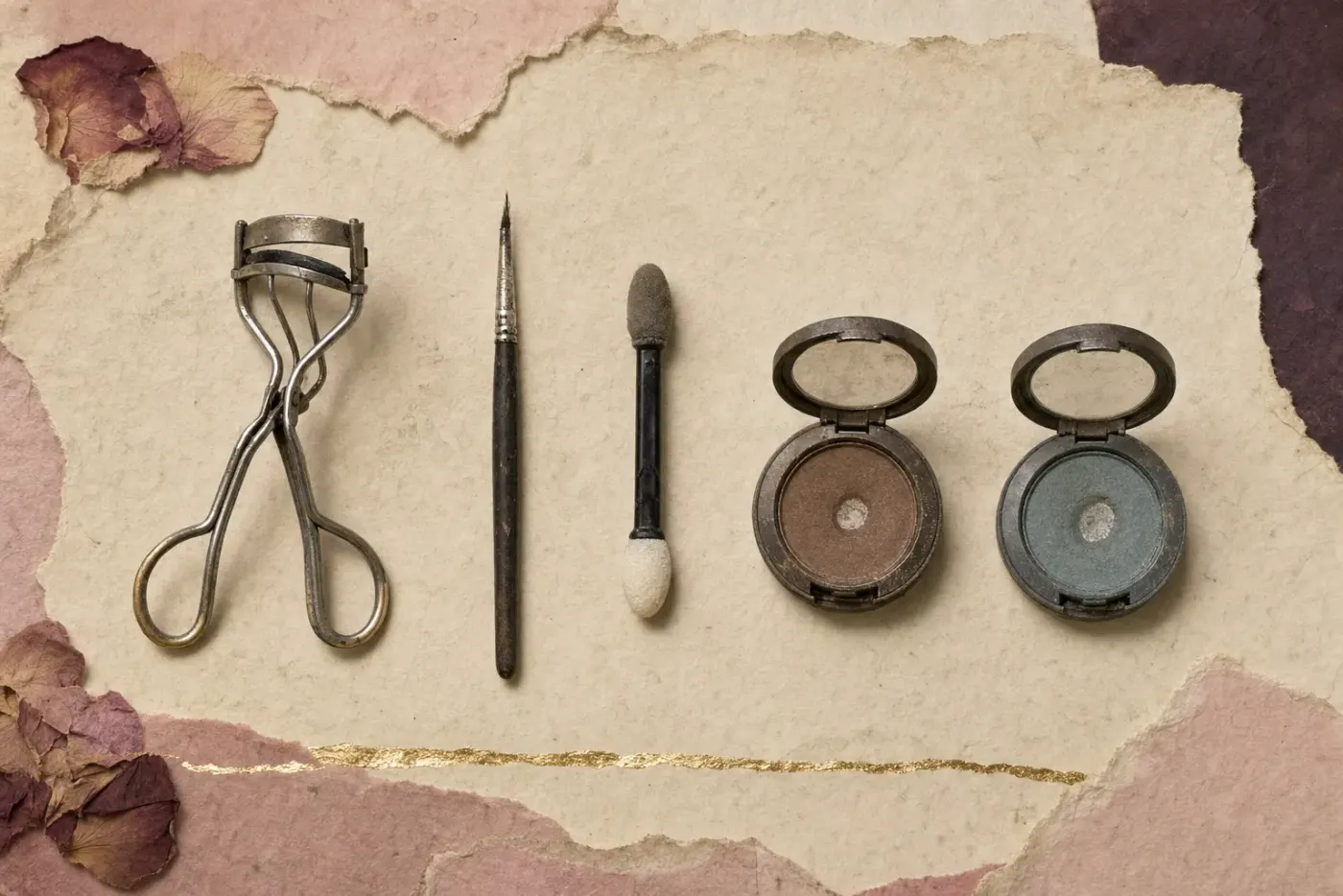
The eye is also the only region of the face that generated its own hardware. Lashes need a curler, shadow needs a brush or a sponge tip, liner needs either a fine brush or a tip engineered to behave like one, and none of that is required by a lipstick.
So the shift to the eye grew an adjacent trade in implements, which is a business with a longer replacement cycle but a much higher first purchase — and it made application a skill rather than a gesture, which in turn made instruction a product.[3]
That last consequence is the durable one. A lipstick needs no demonstration and an eye does, so the diagram, the counter lesson and eventually the tutorial all follow the emphasis to the same place.[3]
A mouth takes one product. An eye takes three, and a lesson.
What Mary Quant Actually Claimed
Quant’s cosmetics range launched on 28 March 1966, and the claim attached to it speaks directly to the problem above: that the products worked well together, so that women spent less time applying them and had fewer items to carry around.[4]
She also claimed to have worked from artists’ materials — paint brushes, water-colour paint boxes and crayons. That is an account of where an idea came from rather than a description of a product, and it is worth repeating in exactly those terms, because a great deal of what is written about this range describes objects the museum record does not.[4]
What Survives in a Museum
One accessioned object shows what "worked well together" meant in practice: an orange PVC ‘Overnighter’ case, catalogued to around 1970, 20 by 11.7 by 8 centimetres, with a top handle, a stud closure and a silver daisy on the front flap, holding two lift-out trays of Quant cosmetics and skincare.[5]
It is a fitted carrying case rather than a tray of pressed pans, and the record says so plainly. The record also notes that Quant cosmetics were licensed to Gala Cosmetics of Surbiton, Surrey, and that the case itself was probably made elsewhere in Britain — a reminder that a designer brand in this period was frequently a name on someone else’s manufacturing.[5]
The Law the Eye Was Already Under
Emphasis on the eye ran into rules written after injuries. Cases reported in the Journal of the American Medical Association in 1933 and 1934 documented harm from a lash and brow dye, and that episode fed the campaign that produced the Federal Food, Drug, and Cosmetic Act of 1938.[6]
The consequence is still in force: in the United States no colour additive is approved for permanently dyeing or tinting eyelashes or eyebrows, with a single narrow exception added by a final rule of 6 October 2021 for a professional-use silver nitrate gel, capped at four per cent, not for sale to consumers, not for use on anyone under sixteen, and not left on for longer than a minute.[7]
What Is Not Known
Why the emphasis moved when it did is not settled by any source cited here. The usual explanations — youth culture, television, a reaction against the mid-century mouth — are plausible and none of them is demonstrated.
The contents of the 1966 range are also not established by the museum article, which describes no specific set of products. Accounts that list them with confidence are drawing on something else, and should name it.[8]
Sources
- [1, 3]Beauty Imagined: A History of the Global Beauty Industry Oxford University Press, 2010.
- [2]Kurlash Cosmetics and Skin.View source (opens in a new tab) Accessed 2026-09-25.
- [4, 8]The story of Mary Quant make-upView source (opens in a new tab) Accessed 2026-09-22.
- [5]'Overnighter' cosmetics case, Mary Quant, accession number T.107-2021 Victoria and Albert Museum, London.View source (opens in a new tab) Accessed 2026-09-22.
- [6]Lash Lure and Paraphenylenediamine: Toxic Beauty Past and Present American Academy of Ophthalmology.View source (opens in a new tab) Accessed 2026-09-22.
- [7]Eye Cosmetic Safety US Food and Drug Administration.View source (opens in a new tab) Accessed 2026-09-22.
Filed under